From Significance to Morality: The Social Architecture of APS
APS explains social normativity as the progressive and recursive organisation of Significance through Values, Shared Evaluation, Norm Formation, Social Norms, institutions, Moral Evaluation, Morality, and Ethics. This article shows how living evaluation becomes socially organised, how Social Organisation becomes capable of assessing its own norms and institutions, and why naturalising morality does not by itself justify moral claims. It integrates the APS social architecture with cognition, Mind, Reflective Agency, Meaning, environmental responsibility, institutional power, and distributed responsibility.
Key Points
- Social normativity develops through the organisation of Significance across Values, Shared Evaluation, Social Norms, and institutions.
- Social realities are organisationally real without requiring strong collective Biological Agency.
- Social Organisation enables but does not automatically generate Moral Evaluation.
- Moral Evaluation begins when conduct, norms, and institutions become answerable to the standing, vulnerability, treatment, responsibility, and legitimate claims of those affected.
- Morality organises collective life; Ethics investigates and revises that organisation.
- Naturalising morality does not establish Moral Legitimacy.
Introduction
Living systems do not encounter an indifferent world. Conditions matter because they support, disrupt, enable, or threaten organised persistence. Human social life transforms this elementary structure of Significance. What matters becomes communicated, stabilised, contested, institutionalised, and transmitted across agents and generations. Shared expectations emerge. Institutions organise participation. Relations of power shape whose concerns are recognised, whose actions are enabled, and whose vulnerabilities are exposed (Lukes 2005; Pettit 1997; Young 2011).
Yet social organisation is not already morality.
A society may be coordinated, stable, legally ordered, and institutionally effective while remaining unjust, exclusionary, dominating, or indifferent to those it harms. A norm may be widely accepted without being legitimate. A law may be valid without being just. An institution may fulfil its stated purpose while treating some of those affected in ways that cannot be (Copp 2007; Scanlon 1998; Street 2006).
Moral Evaluation begins when actions, norms, institutions, and collective arrangements themselves become answerable to the standing, vulnerability, treatment, responsibility, and legitimate claims of those affected.
APS explains this transition through an architecture extending from living organisation into social and moral organisation:
Life
→ Agency
→ Biological Evaluation
→ Significance
→ Values
→ Shared Evaluation
→ Norm Formation
→ Social Norms
→ Social Organisation
→ Moral Evaluation
→ Morality
→ Ethics
This is an architecture of organisational and explanatory dependencies. It is not a simple causal chain, chronology, hierarchy, evolutionary ladder, or reduction of morality to biology.
The pathway identifies a series of organisational achievements. Life establishes the conditions of organised persistence. Agency enacts and maintains those conditions. Biological Evaluation generates relations of Significance. Significance becomes organised as relatively stable Values. Values enter relations of Shared Evaluation. Recurring Shared Evaluation becomes stabilised through Norm Formation. Social Norms and institutions coordinate and order social interaction. Social Organisation creates the conditions within which actions, norms, institutions, and arrangements can themselves become objects of Moral Evaluation. Morality organises collective moral life, while Ethics investigates and revises that organisation.
The pathway is also recursive. Institutions reshape Values. Social Norms influence what agents notice and expect. Social Organisation contributes to the development of cognition, Mind, Selfhood, and Reflective Agency. Ethics feeds back through Moral Revision into Values, norms, institutions, and Social Organisation.
APS therefore does not treat morality as a final layer placed on top of biology. Moral life develops through the recursive organisation of living, cognitive, social, institutional, and reflective activity.
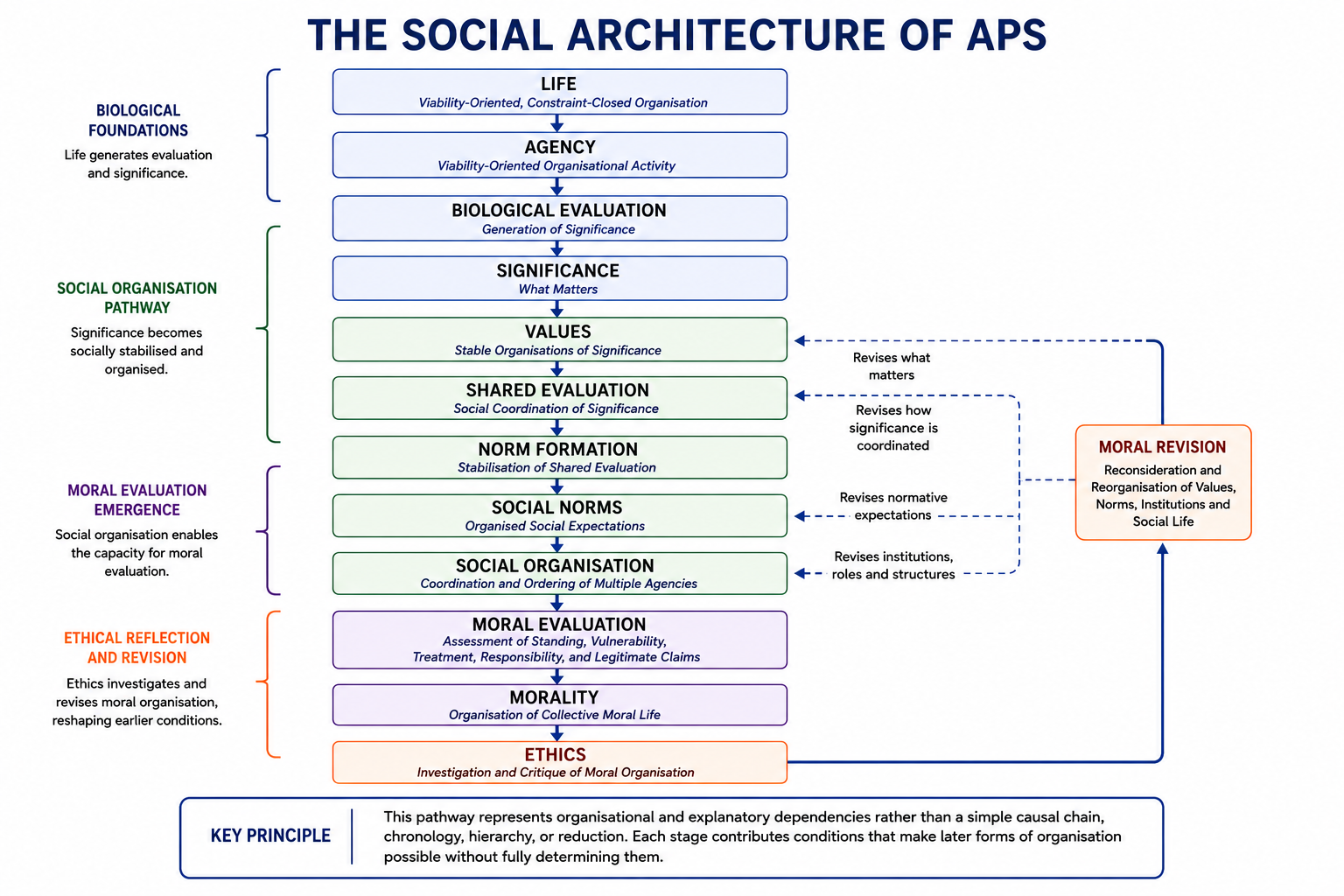
The Social Architecture of APS. The pathway traces the organisational dependencies through which Significance becomes socially organised, normatively stabilised, morally assessable, and ethically revisable. The pathway represents explanatory and organisational dependencies rather than a simple causal chain, chronology, hierarchy, or reduction.
Where This Article Fits Within APS: APS explains life through a series of connected organisational architectures. Earlier articles examine how living systems maintain organised persistence, how Biological Evaluation generates Significance, and how Significance becomes organised across time through Cognition, Mind, Selfhood, and Reflective Agency. This article addresses a different but equally important question: how Significance becomes organised across relations among agents. Its focus is the emergence of Values, Shared Evaluation, Social Norms, Social Organisation, Moral Evaluation, Morality, and Ethics. The article therefore serves as the principal APS account of social normativity. It explains how biological evaluation becomes socially organised, how social organisation becomes morally assessable, and how ethical reflection contributes to the revision of existing moral arrangements. The pathway developed here does not replace the cognition architecture or the meaning architecture. Instead, it complements them by examining how what matters to living agents becomes organised within collective life. Together these architectures help explain how living organisation gives rise not only to cognition and meaning but also to norms, institutions, responsibility, morality, and ethical reflection.
Why Social Normativity Requires Explanation
Social life is saturated with normativity.
People do not merely observe how others behave. They form expectations about how others should behave. They distinguish appropriate from inappropriate conduct, authorised from unauthorised action, loyalty from betrayal, responsibility from excuse, and legitimate authority from domination. They participate in practices that distribute roles, recognition, resources, burdens, opportunities, and risks.
These forms of organisation cannot be explained by behavioural regularity alone.
A repeated action is not necessarily a norm. A stable pattern may result from habit, imitation, coercion, environmental constraint, or strategic equilibrium. Normativity appears when conduct becomes organised through socially recognisable expectations that affect how actions are interpreted, reinforced, criticised, sanctioned, or contested (Bicchieri 2006; Bicchieri 2017)
Nor can social normativity be explained merely by individual preference.
Individuals are born into already organised worlds (Searle 2010; Guala 2016; Ostrom 1990). They encounter languages, customs, classifications, roles, institutions, technologies, and histories that shape the conditions under which they evaluate and act. Their Values are not formed in isolation. What they regard as important, permissible, shameful, admirable, or possible is influenced by relations and practices that precede them.
At the same time, social realities do not require the existence of a collective organism or independent social mind.
Institutions can organise action without being biological agents. Social Norms can guide interaction without possessing intentions. Systems of authority can shape the conduct of millions of people without constituting a living super-agent. Their reality lies in the maintained organisation of relations, roles, procedures, infrastructures, records, expectations, and consequences (Searle 2010; Guala 2016; Miller 2010).
Contemporary social ontology likewise treats institutions as real forms of social organisation rather than as physical objects or mere summaries of isolated behaviour. Accounts differ, however, over whether institutional reality is grounded primarily in collective recognition, shared intention, rules, equilibria, or organised purposes. APS incorporates these dimensions while placing additional emphasis on material infrastructure, power, social memory, and maintained constraint (Searle 2010; Guala 2016; Miller 2010).
APS therefore rejects two opposed reductions.
It rejects the claim that social organisation is merely an aggregate of isolated individual choices. It also rejects the claim that societies, institutions, or norms must be treated as independent biological agents.
Social realities are organisationally real (Guala 2016; Searle 2010; List and Pettit 2011). They exist through the coordinated activity of living agents, but the organisation thereby sustained modifies the conditions under which those agents subsequently act.
Social organisation also raises a further problem. The existence of social norms does not yet explain morality.
Norms can preserve privilege. Institutions can stabilise domination. Social expectations can exclude, stigmatise, or silence. Law can authorise unjust treatment. Cultural continuity can reproduce avoidable harm. Evolutionary or historical persistence can explain why a practice survives without establishing that it ought to survive.
The central explanatory challenge is therefore not simply to explain how norms arise. It is to explain how Social Organisation becomes capable of evaluating its own norms, institutions, and distributions of power.
APS addresses this challenge by tracing how Significance becomes socially organised, normatively stabilised, morally assessable, and ethically revisable.
Before examining the individual stages of the pathway, it is important to understand what APS is attempting to explain. The framework is not seeking a single cause of morality, nor does it treat social life as something added to an otherwise complete biology. Instead, it identifies a series of organisational dependencies through which living evaluation becomes socially organised, normatively structured, morally assessable, and ethically revisable. Each stage contributes conditions that make later forms of organisation possible without fully determining them.
The Social Architecture of APS
Life
Life is viability-oriented, constraint-closed organisation.
Living systems persist not by remaining unchanged but through the ongoing modulation of constraints by which they maintain and re-establish the conditions of their own continuation. Organisation is therefore an activity rather than a static arrangement.
Life establishes the domain within which conditions can become differentially consequential for an organised system.
Agency
Biological agency is viability-oriented organisational activity.
Agency is the present-tense activity through which living organisation is enacted and sustained. It is not an additional substance possessed by an organism. It is what living organisation does as it regulates, repairs, explores, resists, responds, and reorganises the conditions of its own persistence.
Biological Evaluation
Biological Evaluation is the process through which agency generates Significance.
A living system does not need reflective judgment to distinguish favourable from unfavourable conditions. Through its organisation and activity, it responds differently to conditions according to their consequences for viability.
Biological Evaluation is not mental appraisal. It is the viability-relative differentiation through which some conditions become supportive, threatening, damaging, usable, avoidable, or irrelevant to a living system.
Significance
Significance is a relationally real product of Biological Evaluation.
Significance is not a property contained within an object independently of its relation to living organisation. Nor is it merely a subjective projection. It arises through the relation between an organised agent and conditions that matter to its continued functioning.
A nutrient, threat, shelter, signal, opportunity, or injury becomes significant because of how it bears upon the organisation and activity of a living system.
Significance explains what matters. The APS cognition architecture examines how Significance becomes organised across time through Integration, Cognition, Mind, Selfhood, and Reflective Agency. The present article examines how Significance becomes organised across relations among agents through Values, Shared Evaluation, Social Norms, Social Organisation, Morality, and Ethics.
Values
Values are relatively stable organisations of Significance that guide evaluation, attention, preference, and action.
Not every significant condition becomes a Value. Significance may be immediate and transient. Values arise when patterns of what matters become sufficiently integrated and persistent to guide activity across occasions or contexts.
Values therefore stabilise Significance through time.
They may guide what an agent notices, seeks, avoids, protects, prioritises, or sacrifices. In cognitively complex organisms, Values may become explicit commitments, ideals, loyalties, or conceptions of a worthwhile life. But their foundational role is broader: they organise recurring patterns of what matters.
Shared Evaluation
Shared Evaluation is the relational process through which Significance becomes socially coordinated, communicated, stabilised, imposed, negotiated, or contested among multiple agents.
Shared Evaluation does not require agreement. It includes cooperation and conflict, persuasion and resistance, imitation and criticism, mutual recognition and unequal power.
Through Shared Evaluation, what matters to agents becomes organised within relations among them.
Norm Formation
Norm Formation is the process through which socially organised evaluation becomes stabilised as recognisable, expected, transmitted, reinforced, contestable, and revisable constraint. It explains how recurring patterns of Shared Evaluation acquire social continuity. Expectations become recognisable. Conduct becomes interpretable in relation to them. Departures may be criticised, sanctioned, defended, or used to challenge the norm itself.
Social Norms
Social Norms are stabilised organisational constraints guiding social interaction.
They shape what agents expect of one another, how conduct is interpreted, and what consequences follow from participation or deviation.
Social Norms are neither merely private beliefs nor external forces acting independently of agents. They are maintained through practices, expectations, communications, sanctions, institutions, and material arrangements.
Social Organisation
Social Organisation is the relatively stable coordination and ordering of multiple agencies through Values, Shared Evaluation, Social Norms, roles, institutions, power relations, and material arrangements.
Social Organisation includes both cooperation and conflict. It may enable participation or restrict it. It may distribute resources fairly or concentrate them. It may preserve beneficial practices or stabilise domination.
Its existence does not establish its legitimacy.
Moral Evaluation
Moral Evaluation is the socially and reflectively organised assessment of actions, omissions, relationships, norms, institutions, and collective arrangements in relation to the standing, vulnerability, treatment, responsibility, and legitimate claims of those affected.
Moral Evaluation differs from merely judging whether conduct conforms to prevailing expectations. It makes the expectations themselves available for criticism.
Morality
Morality is the organised social practice through which communities stabilise, transmit, contest, revise, and enforce judgments concerning treatment, standing, responsibility, obligation, and legitimate claims.
Morality organises collective life.
It gives social form to judgments about how beings should be treated, which claims should be recognised, who bears responsibility, and what kinds of conduct or organisation can be justified.
Ethics
Ethics is the systematic investigation, criticism, and revision of moral organisation.
Ethics investigates the concepts, reasons, principles, exclusions, contradictions, and institutional arrangements through which morality is organised.
Ethics does not stand outside social life. It emerges within moral organisation and feeds back into its revision.
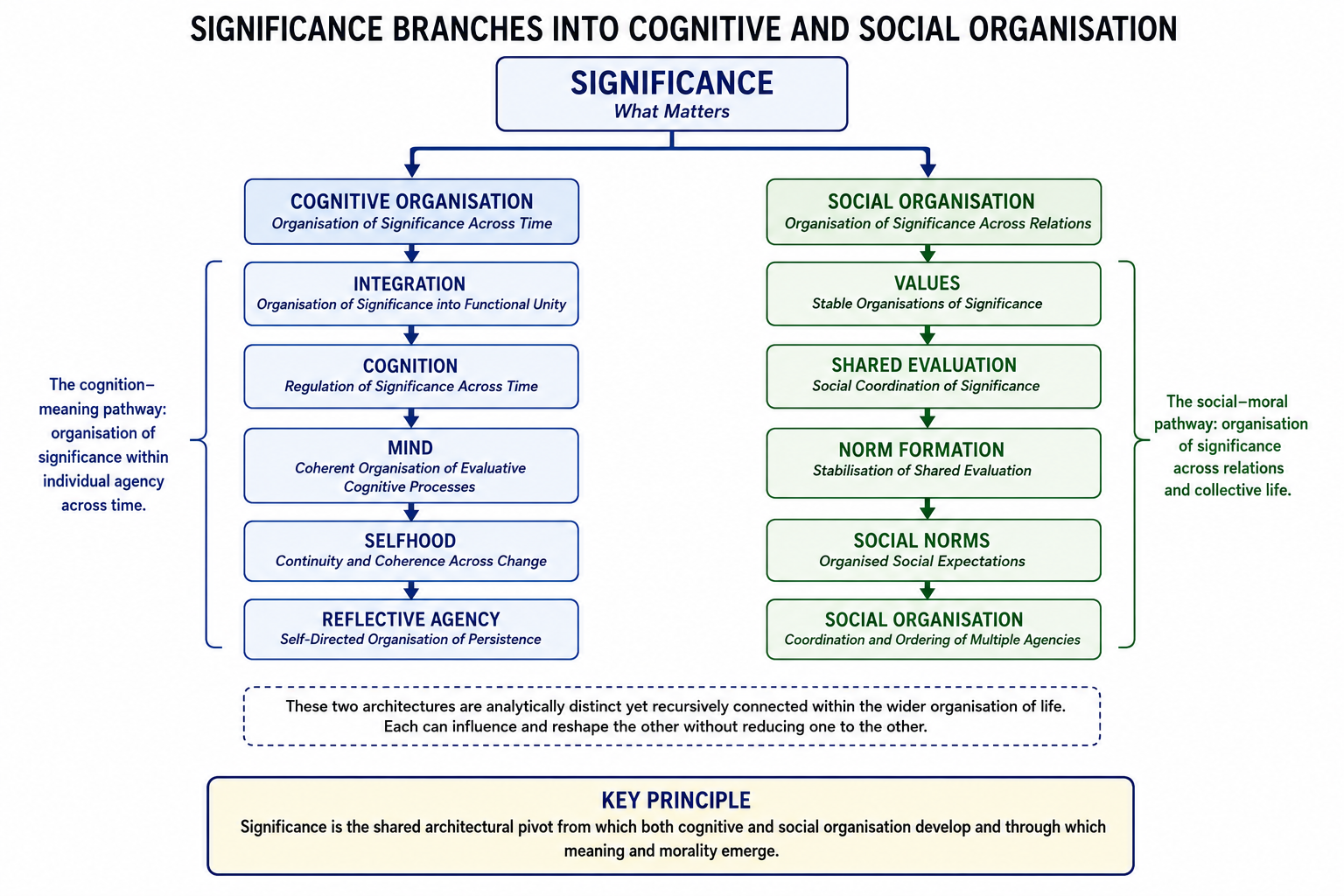
From Significance to Morality. The APS social pathway traces how living evaluation becomes socially organised, morally assessable, and ethically revisable. The arrows express organisational and explanatory dependencies rather than a simple causal chain, chronology, hierarchy, or reduction.
From Biological Evaluation to Values
The social architecture begins before society.
It begins with the evaluative organisation of life.
A living system must continually distinguish among conditions that bear differently upon its organised persistence. Some relations support continued functioning. Others impair, disrupt, or threaten it. Agency generates these differences through Biological Evaluation, and those differences become relationally real as Significance.
This does not mean that living systems consciously judge their environments. Biological Evaluation precedes reflective awareness. A bacterium moving toward a nutrient source, a plant adjusting growth to light, or an animal avoiding injury may exhibit evaluative organisation without forming explicit representations of what is good or bad.
The relevant distinction is organisational.
Conditions do not matter in the abstract. They matter in relation to what a living system is organised to maintain and accomplish.
Significance is therefore not equivalent to information.
Information may describe a difference, correlation, or signal. Significance concerns what that difference means for the activity and viability of an organised system. A chemical gradient may contain information for an observer, but it becomes biologically significant when a living system is organised to detect and respond to it in ways bearing upon its continued functioning.
Significance is also not equivalent to preference.
A preference is one possible expression of organised evaluation, especially in cognitively complex agents. Significance is more fundamental. Conditions can matter biologically without being consciously preferred, represented, or chosen.
Values develop when patterns of Significance become more stable and integrated.
An isolated response to discomfort is not yet a Value. A durable orientation that repeatedly guides attention, choice, protection, or avoidance may become one. In human life, Values may include care, loyalty, autonomy, fairness, achievement, security, belonging, or truthfulness. These differ greatly in content, but each involves a relatively stable organisation of what matters.
Values therefore add temporal and organisational depth to Significance.
They allow an agent to maintain orientations across changing situations. They influence what is noticed, which possibilities are taken seriously, which costs are accepted, and which actions are resisted.
Values require some degree of Integration.
Significance must be organised across processes and occasions if it is to guide activity with relative stability. But Integration does not automatically generate Values. A system may integrate sensory input, motor activity, or metabolic regulation without forming enduring evaluative orientations of the kind APS identifies as Values.
The relation is therefore enabling rather than sufficient:
Significance explains what matters; Integration explains how what matters becomes organised into functional unity; Values explain how organised patterns of what matters become relatively stable guides to evaluation and action.
This pathway intersects with, but is not identical to, the APS cognition architecture. Significance contributes both to the organisation of cognition and Meaning and to the organisation of social life. The cognitive–meaning pathway and the social–moral pathway therefore share a common evaluative foundation while developing distinct forms of organisation.
Human Values are also extensively social.
They are communicated through language, embodied in practices, reinforced by institutions, interpreted through cultural narratives, and challenged through conflict (De Jaegher and Di Paolo 2007; Searle 2010; Boyd and Richerson 1985). An individual may inherit Values before being able to examine them reflectively. Institutions may reward some Values and suppress others. Social movements may expose contradictions between publicly declared Values and actual social arrangements.
Values are therefore neither wholly private nor wholly imposed from outside.
They emerge through recursive interaction among:
- Biological Evaluation;
- cognitive Integration;
- personal history;
- Shared Evaluation;
- institutions;
- social power;
- Reflective Agency;
- moral criticism.
This recursive formation is essential to the APS account.
Biological organisation supplies the possibility that conditions can matter. It does not predetermine the content of social Values. Historical Social Organisation shapes how Significance is interpreted, distributed, reinforced, and contested.
Biological significance is therefore not moral value (Copp 2007; Street 2006; Buchanan and Powell 2018).
A condition may contribute to survival, reproduction, institutional stability, or group success without being morally justified. Adaptive usefulness explains one relation between an organisation and its conditions. It does not establish how agents or institutions ought to treat those affected.
The transition from Significance to Values is consequently a necessary part of the social architecture, but it does not yet produce morality.
Values may remain:
- self-regarding;
- group-regarding;
- inherited;
- exclusionary;
- conflicting;
- insufficiently examined.
They become socially normative only when they enter organised relations among multiple agents.

Significance Branches into Cognitive and Social Organisation. Significance is the shared architectural pivot from which cognitive Integration and social organisation develop. The cognitive–meaning and social–moral pathways remain analytically distinct while recursively shaping one another.
Shared Evaluation and the Social Organisation of What Matters
Values organise relatively stable patterns of Significance. Shared Evaluation explains how those patterns become organised among multiple agents.
No living system exists in complete isolation. Organisms interact, coordinate, compete, cooperate, communicate, imitate, resist, and modify one another’s conditions of action. In socially organised species, these interactions become increasingly structured through recurring relations in which what matters to one agent becomes relevant to others.
Shared Evaluation is the relational process through which Significance becomes socially coordinated, communicated, stabilised, imposed, negotiated, or contested among multiple agents. Shared Evaluation overlaps with theories of shared agency, collective intentionality, and participatory sense-making, each of which explains how interaction among agents can organise action or meaning beyond isolated individual cognition. APS uses the term more broadly, however, because evaluation may become socially organised through conflict, asymmetry, institutional imposition, or resistance as well as through shared intention and cooperation (Bratman 2014; De Jaegher and Di Paolo 2007; Searle 2010).
The concept should not be understood as a form of collective agreement. Shared Evaluation begins whenever evaluative relations become socially organised. Agreement is only one possible outcome.
Agents may participate in Shared Evaluation through:
- cooperation;
- communication;
- imitation;
- coordination;
- negotiation;
- persuasion;
- conflict;
- sanction;
- resistance;
- institutional classification;
- unequal power relations.
What is shared is not necessarily a common judgment. What is shared is the evaluative field within which actions, expectations, opportunities, risks, and consequences become socially organised.
Many influential theories of shared action focus primarily on cooperation, joint intention, or coordinated planning. These phenomena are important instances of Shared Evaluation, but they do not exhaust it. Socially organised evaluation may also emerge through unequal power, institutional authority, coercion, strategic accommodation, conflict, or resistance (Bratman 2014; List and Pettit 2011).
A simple queue illustrates the point.
People waiting in a queue typically orient themselves toward a shared expectation regarding order of service. They recognise positions within the queue, notice violations, and often respond when someone attempts to bypass established ordering. The norm may never be formally articulated, yet participants evaluate conduct relative to a socially organised expectation.
Importantly, not everyone must approve of the arrangement. Some may dislike it. Others may seek to evade it. The expectation nevertheless exists as a socially organised pattern shaping interpretation and action.
More complex examples reveal that Shared Evaluation is not restricted to cooperative situations.
Workplaces, schools, professions, governments, markets, and legal systems organise expectations concerning competence, authority, responsibility, status, eligibility, performance, and participation. Individuals may comply, challenge, reinterpret, resist, or seek to reform these expectations, but they remain participants in a shared evaluative field.
Conflict often reveals Shared Evaluation more clearly than agreement.
A labour dispute, public protest, or institutional controversy demonstrates that different groups may organise Significance in incompatible ways. One group may regard a policy as necessary and beneficial, while another experiences it as unfair or harmful. Yet both sides participate within an evaluative relation organised around the same institutional conditions.
Shared Evaluation therefore does not eliminate disagreement. It provides the social organisation within which disagreement becomes intelligible.
The concept also helps explain how Values become socially transmitted.
Individuals do not merely inherit genetic traits. They inherit languages, customs, stories, expectations, classifications, educational systems, technologies, and institutional arrangements. Through participation in these organised environments, agents acquire, revise, reinforce, and contest Values (Boyd and Richerson 1985; Ostrom 1990; De Jaegher and Di Paolo 2007).
Values are therefore neither wholly individual nor wholly collective.
They emerge through recursive interaction among:
- Biological Evaluation;
- cognitive Integration;
- personal experience;
- Shared Evaluation;
- institutional organisation;
- social power;
- reflective criticism.
This recursive structure is central to the APS account.
Social organisation influences what agents come to value, while Values contribute to the maintenance, transformation, and contestation of Social Organisation.
Shared Evaluation thus provides the principal bridge between individual evaluative organisation and social normativity.
It explains how what matters becomes organised across relations among agents.
The next question is how these recurring patterns of Shared Evaluation become sufficiently stable to function as Social Norms.
From Recurring Evaluation to Social Norms
Shared Evaluation explains how Significance becomes socially organised.
Norm Formation explains how socially organised evaluation becomes stabilised across time.
Not every recurring behaviour becomes a norm.
People may repeatedly perform the same action because they face identical environmental constraints. They may imitate successful behaviour. They may respond to incentives. They may comply with coercive demands. None of these situations necessarily generates normativity.
Normativity appears when socially organised evaluation acquires recognisable expectations that guide interpretation, participation, accountability, reinforcement, sanction, and contestation (Bicchieri 2006; Bicchieri 2017).
Norm Formation is the process through which socially organised evaluation becomes stabilised as recognisable, expected, transmitted, reinforced, contestable, and revisable constraint.
Norm Formation therefore concerns more than repetition.
A repeated action describes what happens.
A norm organises what participants are expected to do and how departures from those expectations are interpreted.
Contemporary norm theory likewise distinguishes norm-guided conduct from behaviour produced solely by repetition, incentive, or private preference. Such accounts provide more detailed analyses of expectations, conditional compliance, sanctions, and rule-following. APS places these mechanisms within a wider architecture connecting Significance, Values, Shared Evaluation, institutions, and Moral Evaluation (Bicchieri 2006; Bicchieri 2017; Ostrom 1990).
The queue example can again be instructive.
People may repeatedly stand in line because doing so is efficient. Yet efficiency alone does not explain the social response to queue violation. When someone ignores the established order, other participants often interpret the action as inappropriate. The violation may provoke criticism, correction, resistance, or sanction.
The expectation has become socially organised.
Norm Formation explains how such expectations become recognisable and transmissible.
Cultural-evolutionary approaches explain how practices, norms, and norm-related dispositions are transmitted, selected, and stabilised across populations. APS does not replace those mechanism-level explanations. It asks how transmitted patterns become organised as Significance-bearing expectations, institutional constraints, and eventual objects of Moral Evaluation (Boyd and Richerson 1985).
Social Norms are stabilised organisational constraints guiding social interaction.
The term “constraint” is important.
A Social Norm does not physically determine conduct. Individuals can violate norms. Norms instead alter the conditions under which action is interpreted and responded to. They shape expectations, opportunities, reputations, sanctions, and forms of participation.
Norms may be explicit or implicit.
Some are formally codified in policies, regulations, professional standards, or laws. Others operate through custom, routine practice, or tacit expectation (Bicchieri 2006; Ostrom 1990). In both cases, their reality consists in their organisational effects.
Norms differ from habits.
A habit may guide an individual’s behaviour without requiring social recognition. A Social Norm depends upon socially organised expectations.
Norms also differ from incentives.
An incentive alters behaviour by modifying costs or benefits. A norm alters behaviour by organising expectations concerning what participants should do and how conduct will be interpreted.
Norms differ from coercive restrictions as well.
A coercive restriction may prevent certain actions without generating normative commitment or expectation. Norms can be enforced coercively, but their organisation involves more than force alone. They become part of the evaluative structure through which actions acquire social meaning.
The distinction becomes clearer in higher-stakes settings.
Consider an institutional rule governing eligibility for participation in a profession, access to education, citizenship status, or public office.
Such a rule may influence who participates, who is excluded, whose interests are represented, and whose vulnerabilities are recognised. The rule is not merely a behavioural regularity. It organises expectations, opportunities, sanctions, and social consequences.
Norms therefore help distribute social possibilities.
They shape access to:
- participation;
- recognition;
- resources;
- authority;
- protection;
- responsibility;
- opportunity.
Because norms influence these conditions, they become central components of Social Organisation.
Norm Formation explains how expectations become stabilised.
Social Norms explain how those stabilised expectations guide social interaction.
Neither concept implies legitimacy.
A norm may be beneficial or harmful.
It may support cooperation or domination.
It may enable participation or exclude vulnerable groups.
The existence of a norm explains how conduct becomes organised. It does not determine whether the organisation is morally justified (Bicchieri 2006; Bicchieri 2017).
The next stage of the architecture therefore concerns the larger systems through which norms become coordinated, preserved, reinforced, and transformed.
These systems constitute Social Organisation.
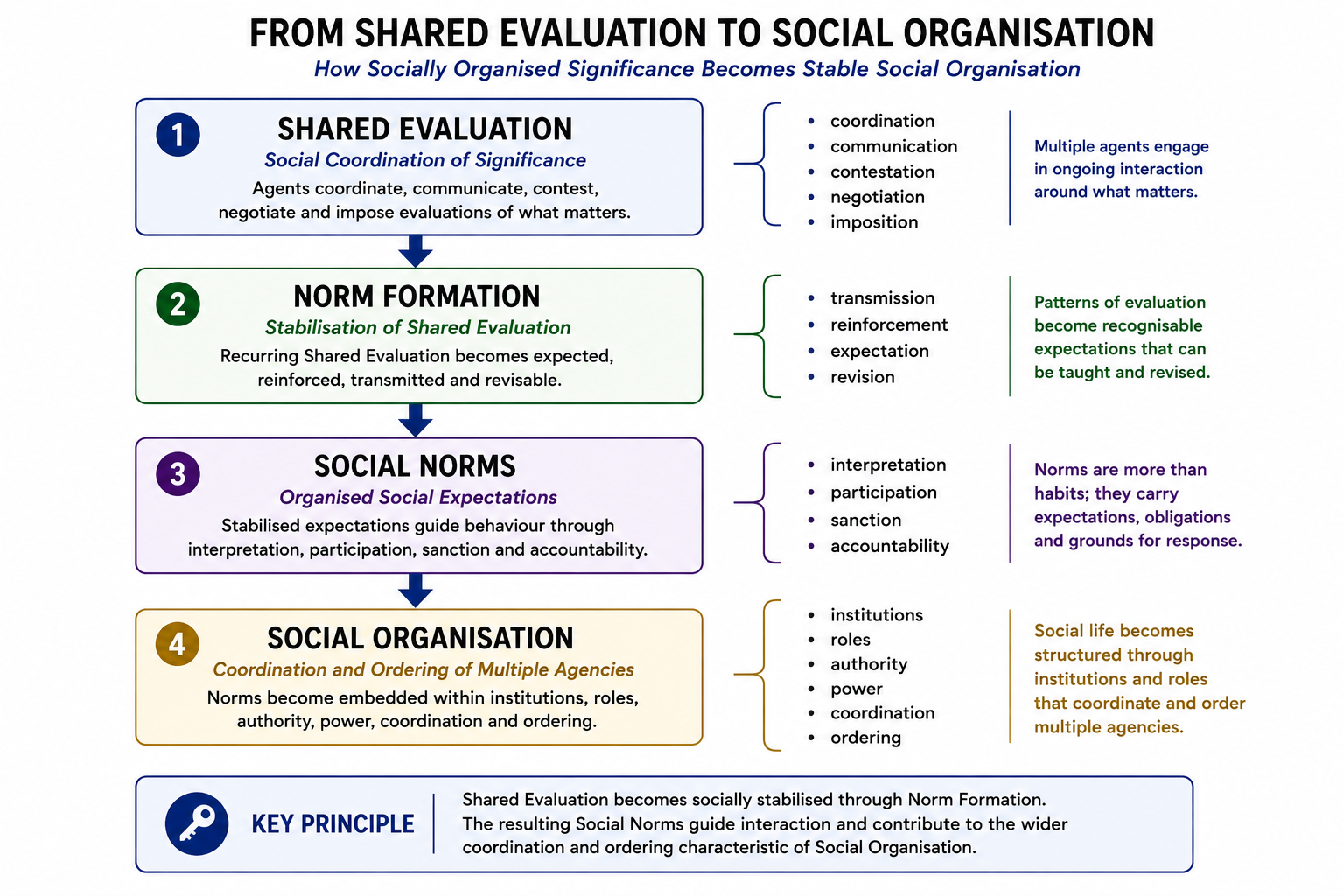
From Shared Evaluation to Social Organisation. Shared Evaluation becomes socially stabilised through Norm Formation. The resulting Social Norms guide interaction and contribute to the wider coordination and ordering characteristic of Social Organisation.
Social Organisation, Institutions, and Power
Social Norms do not exist in isolation.
They operate within wider arrangements through which agents coordinate activity, distribute responsibilities, allocate resources, preserve memory, organise authority, and shape participation.
APS describes these arrangements as Social Organisation.
Social Organisation is the relatively stable coordination and ordering of multiple agencies through Values, Shared Evaluation, Social Norms, roles, institutions, power relations, and material arrangements (Ostrom 1990; Guala 2016; Miller 2010).
The phrase “coordination and ordering” is deliberate.
Some forms of Social Organisation facilitate cooperation, mutual support, and collective achievement.
Others involve hierarchy, exclusion, asymmetrical authority, dependency, or domination.
Social Organisation includes both possibilities.
It should not be interpreted as synonymous with cooperation, harmony, or legitimacy.
A workplace provides a useful illustration.
Workplaces organise:
- roles;
- responsibilities;
- expectations;
- procedures;
- authority structures;
- communication channels;
- resource allocation;
- systems of accountability.
These arrangements allow coordinated activity across many individuals. At the same time, they establish differences in authority, responsibility, vulnerability, and decision-making power.
The organisation is therefore more than the sum of individual actions because it structures the conditions under which those actions occur. This is what APS means when it describes social realities as organisationally real.
Social Organisation exists through living agents and their activities, but it modifies the conditions under which those activities subsequently occur.
The most stable forms of Social Organisation are institutions.
Institutions are relatively stabilised social organisations combining norms, roles, authority, decision procedures, material infrastructures, and social memory (Searle 2010; Guala 2016; Ostrom 1990; Miller 2010).
Institutions preserve and reproduce organised patterns of interaction across time.
They can:
- allocate authority;
- preserve decisions;
- coordinate action;
- manage resources;
- classify participants;
- establish procedures;
- organise accountability;
- maintain records;
- transmit expectations.
Schools, courts, governments, universities, professions, markets, religious organisations, corporations, and regulatory systems all exemplify institutional organisation.
Institutions enable continuity beyond the lifespan of individual participants.
They preserve organisational memory and maintain patterns of coordination across generations.
Their reality is therefore not reducible to the intentions of any particular individual.
Yet institutions are not biological agents.
Some accounts attribute robust agency to suitably organised groups or institutions. APS does not deny that institutional organisation can support coordinated decision-making, representation, accountability, or collective action. It leaves open broader questions concerning group agency while rejecting the inference that institutions thereby possess Biological Agency (List and Pettit 2011; Bratman 2014; Miller 2010).
This distinction is essential.
APS rejects the claim that institutions are merely convenient descriptions of individual behaviour.
It also rejects the claim that institutions are organisms, minds, or independent biological agents.
Institutions are organisationally real because they alter the conditions under which agents act.
Their reality consists in maintained organisation rather than biological individuality.
Institutional organisation also introduces the question of power.
Social Power is the relationally organised capacity to shape the conditions, options, resources, expectations, and consequences through which others act and participate (Lukes 2005; Young 2011).
Power is not simply coercion.
It may operate through:
- authority;
- expertise;
- control of resources;
- institutional position;
- access to information;
- legal status;
- social recognition;
- technological infrastructure.
Power becomes visible whenever some agents are able to influence the conditions under which others pursue their goals, fulfil their responsibilities, or participate in collective life.
Power is therefore a normal feature of Social Organisation.
It is not automatically pathological.
Parents exercise power over children. Teachers exercise power within educational systems. Courts exercise power through legal authority. Managers exercise power within workplaces. Governments exercise power through institutions.
The existence of power alone does not establish domination.
Domination is durable, arbitrary, insufficiently accountable control over conditions central to agency, participation, or vulnerability (Pettit 1997; Lukes 2005).
The distinction matters because not every exercise of power is dominating.
Power becomes domination when those subject to it lack meaningful accountability mechanisms, opportunities for challenge, avenues of participation, or protection against arbitrary control.
Domination therefore concerns the organisation of power rather than its mere existence.
This distinction prepares the transition to Moral Evaluation.
Social Organisation explains how Values, norms, institutions, authority, responsibility, and power become organised across multiple agents.
It explains how collective life becomes possible.
Yet Social Organisation alone does not determine whether the resulting arrangements are legitimate.
A norm may be socially stabilised.
An institution may be effective.
A law may be valid.
A workplace may function efficiently.
A government may maintain order.
None of these facts establishes whether those affected are treated justifiably.
The transition to morality begins when Social Organisation itself becomes an object of evaluation.
The Transition from Social Evaluation to Moral Evaluation
Moral Evaluation emerges within already organised social life.
It does not automatically produce it.
This distinction is one of the most important in the APS social architecture.
A society may possess:
- stable norms;
- effective institutions;
- organised authority;
- legal systems;
- systems of accountability;
- complex forms of cooperation;
without developing robust Moral Evaluation.
Social Organisation is therefore an enabling organisational dependency rather than a sufficient cause of morality (Copp 2007; Scanlon 1998; Street 2006).
The transition occurs when actions, norms, institutions, and collective arrangements become assessable in relation to those affected by them.
Moral Evaluation is the socially and reflectively organised assessment of actions, omissions, relationships, norms, institutions, and collective arrangements in relation to the standing, vulnerability, treatment, responsibility, and legitimate claims of those affected.
This form of evaluation must be distinguished from several neighbouring forms.
Biological Evaluation
Biological Evaluation is the process through which agency generates Significance.
It concerns what supports, disrupts, enables, or threatens organised persistence.
Its central question is:
What matters for the continued functioning of this living system?
Biological Evaluation is necessary for the existence of Significance, but it is not itself moral.
A condition may be biologically beneficial without being morally justified.
Prudential Evaluation
Prudential Evaluation concerns what benefits an individual, group, or specified beneficiary.
It may involve:
- self-interest;
- security;
- advantage;
- long-term planning;
- strategic cooperation;
- flourishing.
Its central question is:
What is good for me, us, or a specified beneficiary?
Prudential Evaluation can be sophisticated and reflective, but it remains oriented toward benefit rather than legitimacy.
Social Evaluation
Social Evaluation concerns conformity to socially organised expectations.
It evaluates conduct relative to norms, customs, roles, and accepted practices.
Its central question is:
Does this conduct accord with established expectations?
Social Evaluation explains approval, disapproval, praise, criticism, inclusion, exclusion, and sanction.
A norm may be socially accepted without being morally justified.
Legal Evaluation
Legal Evaluation concerns validity within a recognised legal framework.
Its central question is:
Is this action, decision, or procedure legally authorised?
Legal Evaluation determines legality, compliance, jurisdiction, and procedural validity.
Legal validity and Moral Legitimacy are not identical.
A law may be valid while remaining morally challengeable.
Institutional Evaluation
Institutional Evaluation concerns whether organisational purposes, procedures, and responsibilities have been fulfilled.
Its central question is:
Has the institution operated according to its established aims and procedures?
An institution may function effectively while producing morally problematic outcomes.
Institutional effectiveness therefore does not establish Moral Legitimacy.
Moral Evaluation
Moral Evaluation asks a different question.
Can this action, norm, institution, or arrangement be justified in relation to those affected?
This question transforms the architecture.
Existing norms cease to function solely as standards of evaluation. They themselves become objects of evaluation.
Existing institutions cease to function solely as sources of authority. Their authority itself becomes assessable.
Existing arrangements cease to be justified merely because they persist, succeed, or command acceptance.
The transition therefore involves a shift from evaluating conduct within a system to evaluating the system itself.
These distinctions draw together questions often treated in separate literatures concerning norm compliance, naturalistic moral explanation, institutional validity, and interpersonal justification. APS does not treat these domains as independent. Rather, it argues that Moral Evaluation emerges only when prevailing norms, institutions, and distributions of power themselves become subject to assessment in relation to standing, vulnerability, treatment, responsibility, and legitimate claims (Bicchieri 2006; Copp 2007; Scanlon 1998).
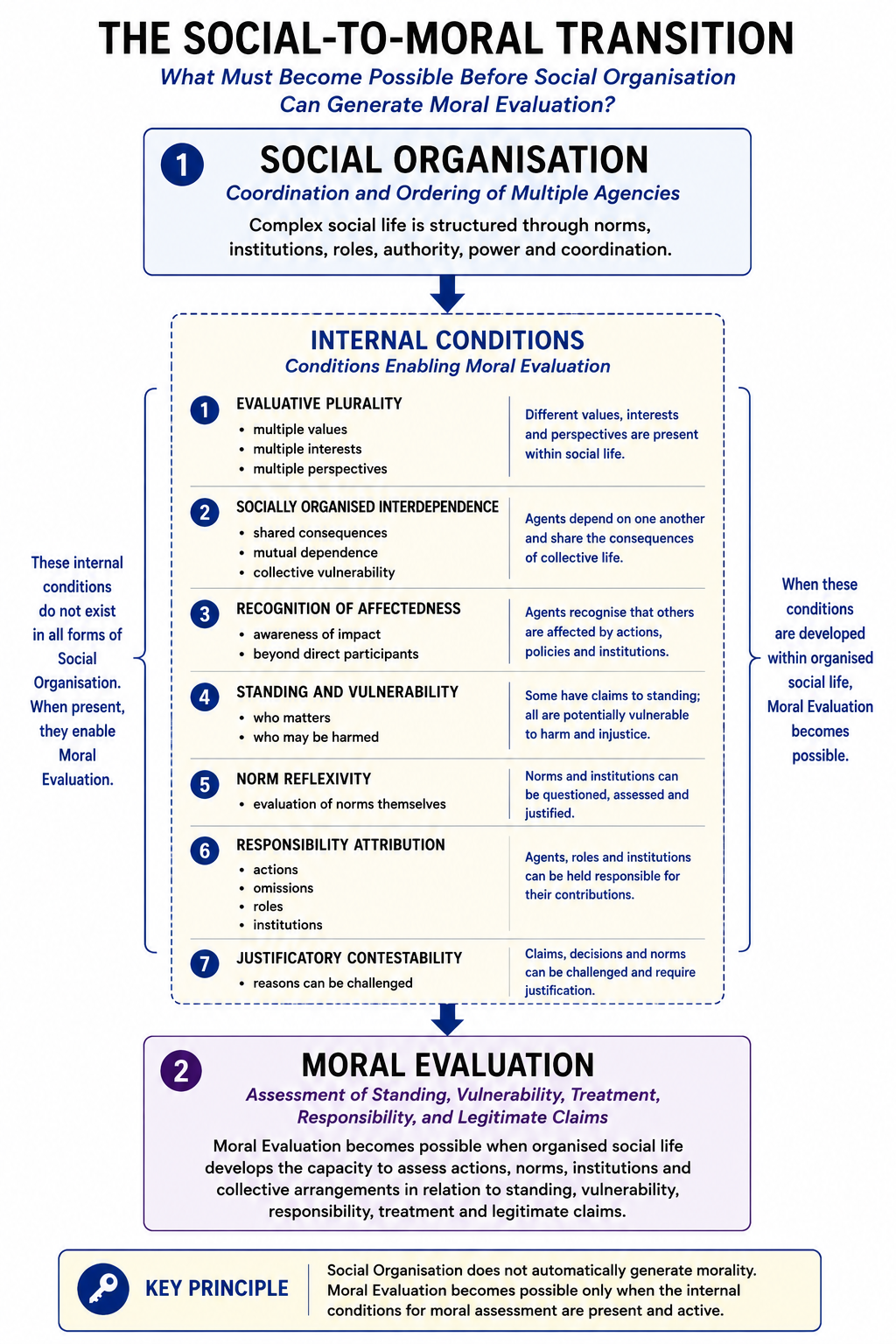
The Social-to-Moral Transition. Social Organisation creates the conditions within which standing, vulnerability, treatment, responsibility, and justification become objects of evaluation. Moral Evaluation begins when norms and institutions themselves become answerable to those affected by them.
The transition depends upon several organisational conditions.
These conditions should not be treated as additional stages in the main APS pathway.
They are the internal architecture of the dependency between Social Organisation and Moral Evaluation.
Evaluative Plurality
Moral Evaluation presupposes the existence of multiple agents or affected beings whose conditions, interests, vulnerabilities, or Values are not identical.
Without plurality there is no problem of treatment among differently situated beings.
Plurality introduces cooperation, conflict, dependency, competition, obligation, and responsibility.
Socially Organised Interdependence
The actions, omissions, decisions, and arrangements of some agents must affect the conditions of others.
Interdependence may be:
- social;
- institutional;
- economic;
- ecological;
- technological;
- intergenerational.
Moral questions emerge where the organisation of one life becomes consequential for another.
Recognition of Affectedness
Participants must be capable of recognising that actions and arrangements affect beings other than the immediate actor.
This does not require perfect empathy or impartiality.
It requires only that the condition of another can become evaluatively relevant.
Responsiveness to Standing and Vulnerability
The condition of affected beings must become relevant to assessment.
Social Organisation alone can recognise participation, compliance, authority, or status.
Moral Evaluation additionally recognises vulnerability and standing.
Norm Reflexivity
This is the decisive threshold.
Norm Reflexivity is the capacity to evaluate norms themselves.
Questions become possible such as:
- Is this norm justified?
- Whom does it benefit?
- Whom does it burden?
- Whose standing does it ignore?
- Does it organise domination?
- Should it be revised?
When such questions become available, Social Norms cease to function solely as standards and become objects of evaluation.
Responsibility Attribution
Consequences must become attributable to actions, omissions, roles, procedures, institutions, or organised arrangements.
Without responsibility attribution, harms and benefits remain disconnected from answerability.
Justificatory Contestability
Actions, norms, institutions, and authorities must become open to demands for reasons.
A practice becomes morally evaluable when statements such as:
- “This is our tradition.”
- “This is how things are done.”
- “The law permits it.”
- “The institution requires it.”
are no longer treated as sufficient justification.
Justificatory contestability does not guarantee agreement.
It establishes the possibility that existing arrangements may be challenged.
These conditions collectively explain how Social Organisation becomes capable of Moral Evaluation.
They do not establish that every society will develop morality in the same way, nor do they determine which moral conclusions are correct.
They explain the conditions under which moral assessment becomes possible.
This distinction protects one of the central constitutional commitments of APS.
Naturalisation and justification are not the same task.
This distinction leaves the architecture compatible with more than one metaethical position. A naturalistic realist may interpret it as an account of the conditions under which moral knowledge becomes possible. A constructivist may emphasise the organisation of justificatory practice. An evolutionary critic may accept much of the genealogy while questioning its relation to moral truth. The present article does not attempt to resolve that dispute (Copp 2007; Street 2006; Scanlon 1998).
APS explains how morality becomes possible.
It does not claim that biological success, institutional effectiveness, cultural persistence, or social acceptance determine what is morally legitimate.
A discriminatory institutional rule illustrates the point.
A rule may be:
- socially accepted;
- legally valid;
- institutionally effective;
- historically established;
while nevertheless remaining morally challengeable because of how it treats those affected.
The fact that a rule persists explains something about its organisation.
It does not settle whether the rule is justified.
Similarly, a law may satisfy all requirements of legal validity while remaining subject to moral criticism.
Legal systems determine legality.
Moral Evaluation asks whether the legal arrangement can be justified in relation to those affected.
The transition to morality therefore begins when legitimacy becomes a distinct evaluative problem.
Standing, Vulnerability, Treatment, and Legitimate Claims
Moral Evaluation differs from other forms of evaluation because it is organised around a specific set of concerns.
These concerns are:
- standing;
- vulnerability;
- treatment;
- responsibility;
- legitimate claims.
Together they provide the central architecture of moral assessment.
Moral Standing
Moral Standing is the status of being a proper object of moral consideration.
To possess Moral Standing is not necessarily to possess:
- Reflective Agency;
- moral responsibility;
- reciprocal obligation;
- participation in ethical reasoning.
Standing concerns whether a being can become morally relevant.
A being with Moral Standing is one whose condition, treatment, vulnerability, or interests can generate claims upon moral evaluation.
This distinction is critical.
The capacity to generate Significance does not exhaust the domain of moral concern.
Reflective Agency may contribute to developed Moral Evaluation, but it is not required for Moral Standing (Palmer 2010; Mackenzie, Rogers, and Dodds 2014; Scanlon 1998).
This allows APS to recognise moral consideration for:
- infants;
- cognitively impaired persons;
- many non-human animals;
without requiring them to participate in moral reasoning.
Vulnerability
Vulnerability is susceptibility to impairment, deprivation, disruption, domination, exclusion, injury, or loss through dependence upon biological, ecological, social, institutional, or technological conditions (Fineman 2008; Mackenzie, Rogers, and Dodds 2014; Young 2011).
Vulnerability provides the strongest bridge currently established between living organisation and Moral Consideration.
Living systems depend upon conditions they do not fully control.
Those conditions may be shaped by:
- other agents;
- institutions;
- technologies;
- environments;
- infrastructures;
- social arrangements.
Because living beings are vulnerable, treatment matters.
The concept should not be overstated.
Vulnerability establishes moral relevance.
It does not by itself determine:
- priority;
- obligation;
- legitimacy;
- the resolution of competing claims.
It identifies why treatment becomes morally significant.
Vulnerability is an important condition for Moral Evaluation, but it is not a complete moral principle. The existence of vulnerability does not by itself determine priority, obligation, legitimacy, or the resolution of competing claims. Questions concerning responsibility, justification, institutional authority, and the treatment of affected parties remain necessary components of moral assessment (Mackenzie, Rogers, and Dodds 2014; Palmer 2010).
Treatment
Treatment concerns how beings are:
- enabled;
- constrained;
- recognised;
- excluded;
- protected;
- burdened;
- represented;
- neglected;
- exposed to consequences.
Treatment is not restricted to direct interpersonal interaction.
Institutions, procedures, technologies, classifications, and policies may organise treatment without a single individual intending every outcome.
This is why Social Organisation becomes morally relevant.
An institution may treat affected parties differently through:
- admission rules;
- eligibility criteria;
- access restrictions;
- procedural design;
- resource allocation;
- patterns of representation.
The moral question concerns not only what individuals do but how organised arrangements affect those subject to them.
Legitimate Claims
The concept of a legitimate claim enters when treatment requires justification.
A claim becomes morally relevant when those affected can no longer be dismissed merely because:
- they lack power;
- they lack status;
- they lack institutional authority;
- they fall outside established expectations.
Legitimate claims require consideration within Moral Evaluation.
They need not be accepted automatically.
They must become part of the justificatory field.
This is why moral criticism can be directed toward accepted institutions.
An institution may function effectively.
A law may be valid.
A procedure may be properly followed.
Yet affected parties may still possess claims requiring justification.
The possibility of such claims is central to Moral Evaluation.
Moral Legitimacy
Moral Legitimacy is the achieved and revisable justification of actions, norms, institutions, and collective organisation in relation to those affected (Scanlon 1998; Young 2011).
Several clarifications are necessary.
Moral Legitimacy is not constituted by:
- social approval;
- majority agreement;
- legal validity;
- institutional authorisation;
- procedural completion;
- adaptive success;
- persistence;
- power.
These factors may influence social organisation.
None is sufficient to establish legitimacy.
The phrase “in relation to those affected” should also be interpreted carefully.
It does not require unanimous endorsement.
Some affected parties may be:
- excluded;
- marginalised;
- incapable of participation;
- not yet born;
- unable to represent themselves.
Their absence from public deliberation does not eliminate their moral relevance.
Legitimacy therefore concerns justification, not merely acceptance.
This distinction preserves the separation between naturalisation and justification that runs throughout the APS architecture.
APS explains how societies become capable of evaluating treatment, vulnerability, responsibility, and claims.
It does not claim that legitimacy follows automatically from any biological, social, legal, institutional, or historical process.
The achievement of the social architecture is therefore not that it discovers morality hidden within biology.
Its achievement is to explain how living organisation becomes capable of generating forms of Social Organisation within which standing, vulnerability, treatment, responsibility, and legitimate claims can become objects of evaluation.
Moral Evaluation emerges when those concerns become organised into a socially and reflectively sustained practice of justification.
The result is morality: the organised social practice through which communities stabilise, transmit, contest, revise, and enforce judgments concerning treatment, standing, responsibility, obligation, and legitimate claims.
Responsibility in Organised Social Systems
Moral Evaluation concerns not only what happens but also who is answerable for what happens.
This introduces the problem of responsibility.
In simple situations, responsibility attribution may appear straightforward. A person performs an action that produces a consequence. The connection between actor and outcome is readily identifiable.
Many morally significant outcomes, however, arise within complex systems involving:
- multiple agents;
- institutional procedures;
- technological infrastructures;
- distributed authority;
- delegated decision-making;
- organisational roles;
- historical design choices.
The existence of complexity does not eliminate responsibility.
It changes how responsibility must be attributed.
Responsibility therefore requires careful differentiation.
Causal Contribution
Causal contribution concerns participation in producing an outcome.
A causal contributor influences the occurrence, likelihood, form, or consequences of an event.
Causal contribution alone does not determine moral responsibility.
Many factors may contribute causally to an outcome without being morally accountable for it.
A storm may contribute to a disaster. A software malfunction may contribute to a harmful decision. A supply-chain disruption may contribute to institutional failure.
Causal relevance and moral answerability are related but distinct.
Responsibility for Action
Responsibility for action concerns conduct performed by an agent.
An agent acts, and that action becomes attributable to them.
Questions of intention, knowledge, foresight, and control often become relevant at this stage.
Responsibility for Omission
Responsibility may arise not only through action but also through failure to act (Young 2011; Miller 2010; Nissenbaum 1996).
An omission becomes morally relevant when an agent, role occupant, or institution could reasonably have intervened, prevented harm, fulfilled an obligation, or responded to a recognised problem.
Not every failure to act generates responsibility.
The relevant question concerns the relation between capacity, expectation, knowledge, and consequence.
Role Responsibility
Social Organisation distributes responsibilities through roles.
A teacher, manager, physician, regulator, judge, engineer, elected official, or safety officer may acquire responsibilities because of their position within an organised system.
Role responsibility therefore cannot be reduced entirely to individual preference.
It arises through participation in institutional organisation.
Design Responsibility
Responsibility may attach to those who create systems, procedures, technologies, classifications, or decision architectures.
Design decisions shape the conditions under which later actions occur.
Choices regarding:
- categories;
- metrics;
- eligibility criteria;
- interface design;
- data selection;
- procedural structure;
may continue to influence outcomes long after the original designers cease direct involvement.
Oversight Responsibility
Oversight responsibility concerns monitoring, correction, review, intervention, and accountability.
Those charged with supervision may become responsible for harms that persist because recognised problems are ignored, concealed, or inadequately addressed.
Oversight responsibility becomes particularly important in complex organisations where no single actor directly controls every outcome.
Institutional Accountability
Institutions may be accountable even though they are not biological agents. Accounts of group and institutional responsibility differ over whether accountability requires a genuinely corporate agent. APS does not attempt to resolve that broader dispute here. It maintains only that institutions can be proper objects of accountability because their procedures, roles, authorities, and remedies organise morally significant consequences. Institutional accountability therefore does not require institutions to possess Biological Agency (Miller 2010; List and Pettit 2011; Young 2011).
This distinction must be maintained carefully.
Institutions do not possess Biological Agency merely because they organise decisions.
Nor do they become moral persons simply because they produce consequences.
Yet institutions can still be proper objects of accountability.
Institutional accountability concerns the organisation through which decisions are made, authority is exercised, consequences are produced, and remedies are provided or denied.
Accountability may involve:
- transparency;
- explanation;
- record keeping;
- review procedures;
- appeals;
- correction;
- compensation;
- reform.
The relevant question is not whether an institution is a biological agent.
The relevant question is whether the organisation itself can be required to answer for its consequences and revise its practices.
Moral Responsibility
Moral responsibility concerns justified attribution of answerability in relation to agency, knowledge, capacity, role, consequences, and legitimate claims.
Moral responsibility therefore differs from both causal contribution and institutional accountability.
An outcome may be causally connected to an individual without making them fully morally responsible.
An institution may be accountable without being a moral agent in the biological sense.
The architecture of responsibility must therefore remain differentiated.
The distinction becomes especially important in technologically mediated systems.
AI-Mediated Eligibility Decisions
Consider an automated system used to assess eligibility for employment, education, insurance, housing, credit, or public services.
A harmful outcome occurs. An applicant is denied access because the system reproduces biased classifications or systematically disadvantages particular groups.
Who is responsible?
The answer is rarely a single actor.
Responsibility may be distributed across:
- software developers;
- data curators;
- procurement decisions;
- institutional leadership;
- deployment teams;
- policy designers;
- regulators;
- oversight bodies;
- appeal procedures;
- operational decision-makers.
The AI system itself may contribute causally to the outcome.
Yet causal participation does not automatically establish moral responsibility.
The system is not a biological agent.
It does not possess Biological Evaluation, Significance, Moral Evaluation, or Moral Responsibility.
The morally relevant question concerns the organised architecture through which the system was created, deployed, monitored, authorised, and maintained.
This is why APS treats responsibility as an organisational problem rather than a search for a single controlling actor. Contemporary AI-governance frameworks likewise treat risk and accountability as properties of wider socio-technical systems rather than of isolated models alone. Responsibility-gap arguments nevertheless show why opacity, learning behaviour, and distributed control make attribution difficult. APS responds by examining the complete organised architecture of design, authorisation, deployment, oversight, review, and remedy (NIST 2023; Nissenbaum 1996; Matthias 2004).
The phrase “distributed responsibility” should therefore never be interpreted as “no responsibility” (Young 2011; Nissenbaum 1996; Matthias 2004).
Distributed responsibility means that answerability must be attributed across multiple organisational locations. Complexity increases the difficulty of attribution, but it does not eliminate the need for attribution. APS therefore rejects two opposing errors: individual reductionism, which assumes every outcome can be explained through the actions of a single responsible actor, and responsibility dissolution, which assumes that complexity, automation, bureaucracy, or institutional organisation remove responsibility altogether (Young 2011; Nissenbaum 1996; Matthias 2004).
The appropriate response is organisational analysis.
Responsibility follows the architecture through which actions, decisions, omissions, authorities, procedures, and consequences become organised.
This conclusion prepares the transition from responsibility to morality itself.
Responsibility attribution identifies who and what may be answerable.
Morality organises the wider practice within which such judgments are made.
Morality, Ethics, and Moral Revision
Moral Evaluation makes actions, norms, institutions, and collective arrangements assessable.
Morality stabilises and organises that assessment.
Morality is the organised social practice through which communities stabilise, transmit, contest, revise, and enforce judgments concerning treatment, standing, responsibility, obligation, and legitimate claims (Copp 2007; Bicchieri 2006; Miller 2010).
Morality is therefore not merely a collection of private opinions.
Nor is it identical with formal ethical theory.
It consists in the organised practices through which communities determine:
- what counts as acceptable conduct;
- which obligations are recognised;
- whose claims matter;
- how responsibilities are distributed;
- which forms of treatment are condemned or approved;
- how violations are addressed.
Morality organises collective life.
This organisation may take many forms.
It may be expressed through:
- customs;
- traditions;
- institutions;
- laws;
- professional codes;
- public expectations;
- social movements;
- educational systems;
- religious practices.
Different societies may organise morality differently.
APS does not claim that all moral systems possess identical content.
The architecture concerns how moral organisation becomes possible, not which moral conclusions must follow.
The distinction between morality and legitimacy therefore remains essential.
A moral system may be socially organised without being fully legitimate.
Communities can preserve exclusionary norms, institutionalised inequalities, discriminatory classifications, or unjust distributions of vulnerability.
The existence of moral organisation does not guarantee the correctness of its conclusions.
Changes in norms, institutions, or moral judgments may improve, worsen, or merely transform existing arrangements. Historical persistence does not establish legitimacy, and revision does not automatically establish improvement. APS therefore distinguishes organisational revision from justified moral progress while leaving open further questions concerning moral truth, moral knowledge, and the standards by which competing revisions should be assessed (Buchanan and Powell 2018; Street 2006).
This is precisely why Ethics becomes necessary.
Ethics is the systematic investigation, criticism, and revision of moral organisation (Copp 2007; Buchanan and Powell 2018).
Ethics investigates:
- concepts;
- principles;
- reasons;
- justifications;
- contradictions;
- exclusions;
- assumptions;
- institutions;
- practices.
Where morality organises collective life, Ethics investigates that organisation.
The distinction is constitutional within APS.
Morality and Ethics are related but not identical.
Morality provides organised judgments.
Ethics examines those judgments.
Morality stabilises expectations.
Ethics subjects them to criticism.
Morality may inherit traditions.
Ethics asks whether those traditions are justified.
Morality may distribute responsibilities.
Ethics investigates whether those distributions are defensible.
The relationship is therefore recursive rather than hierarchical.
Ethics emerges within morally organised life and feeds back into its revision.
This feedback architecture is one of the defining features of the APS social pathway.
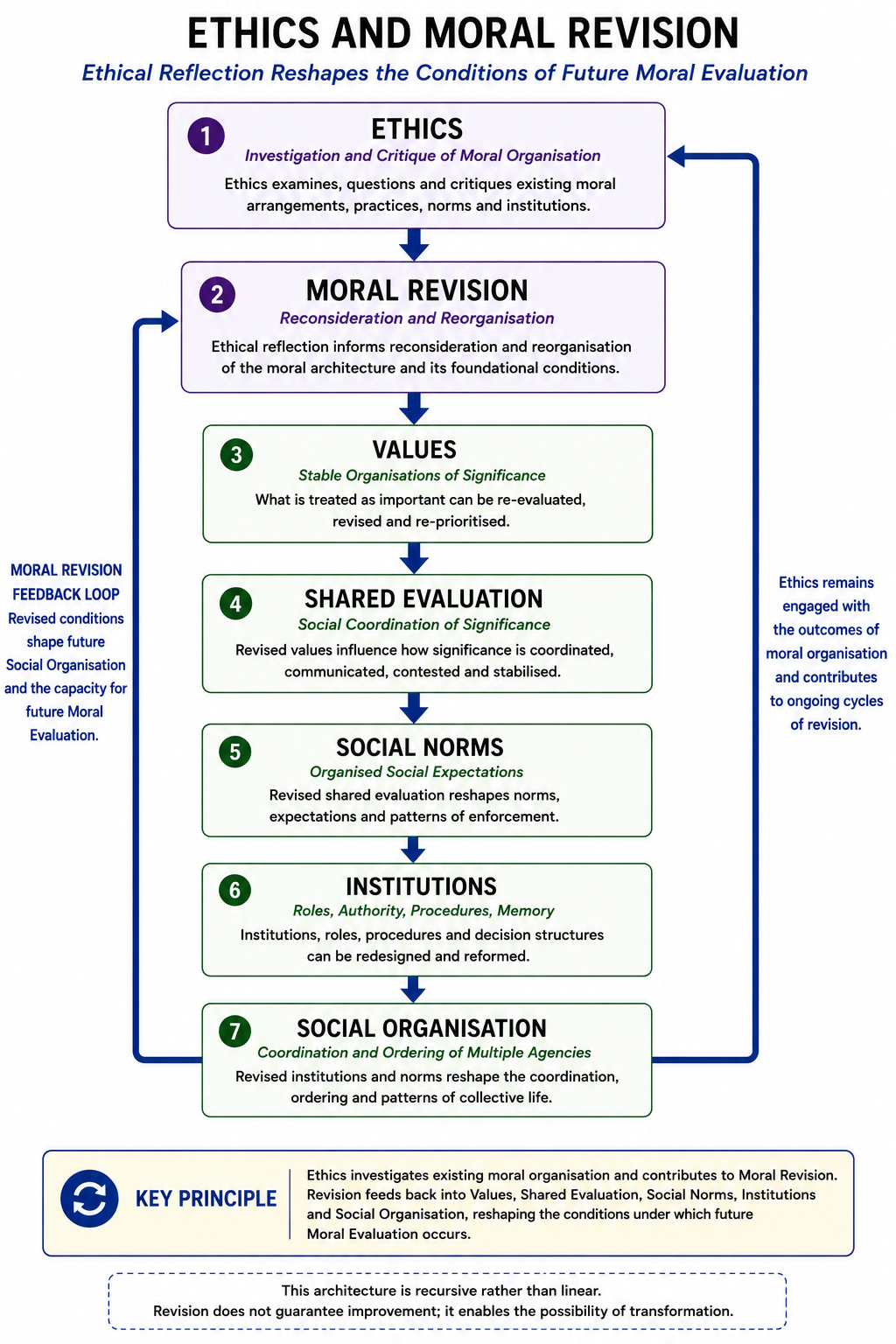
Ethics and Moral Revision. Ethics investigates existing moral organisation and contributes to Moral Revision. Revision feeds back into Values, Shared Evaluation, Social Norms, institutions, and Social Organisation, thereby reshaping the conditions under which future Moral Evaluation occurs.
Moral Revision
Moral Revision occurs when moral organisation becomes subject to critical examination and subsequent transformation.
Revision may affect:
- Values;
- Shared Evaluation;
- Social Norms;
- institutions;
- Social Organisation.
The architecture is recursive.
Values influence Shared Evaluation.
Shared Evaluation contributes to Social Norms.
Social Norms shape institutions.
Institutions organise participation, authority, responsibility, and vulnerability.
These arrangements become objects of Moral Evaluation.
Morality stabilises judgments concerning them.
Ethics investigates those judgments.
Moral Revision then feeds back into the earlier stages of the architecture.
The result is not a simple sequence but an ongoing process of reorganisation.
Revised Values may alter expectations.
Revised expectations may transform norms.
Revised norms may change institutions.
Revised institutions may redistribute power, responsibility, participation, and vulnerability.
Moral life is therefore dynamic rather than static.
Importantly, revision must not be confused with progress.
A society may revise its norms without improving them.
Institutions may be reformed in ways that increase exclusion or domination.
Ethical reflection may be ignored, distorted, suppressed, or captured by existing power structures.
New forms of organisation may reproduce old injustices in altered form.
Revision explains change.
Progress requires an additional judgment.
APS therefore preserves a distinction between:
- revision and progress;
- transformation and improvement;
- change and legitimacy.
Ethical reflection increases the possibility of criticism.
It does not guarantee better outcomes.
This guardrail is essential.
Without it, moral development would appear inevitable.
APS rejects such inevitability.
Moral organisation remains historically contingent, socially contested, and institutionally mediated.
Nevertheless, the capacity for revision remains one of the most significant achievements of social normativity.
Through Ethics, communities become capable of examining not only conduct but also the evaluative frameworks through which conduct is judged.
They become capable of questioning inherited assumptions, exposing contradictions, identifying exclusions, challenging domination, and reconsidering responsibilities.
This capacity does not place Ethics outside social life.
Ethics remains part of the wider organisation of Significance, Values, Shared Evaluation, Social Norms, institutions, and Moral Evaluation.
Its distinctive contribution is reflexive.
Ethics investigates the moral organisation through which collective life is conducted and seeks to determine whether that organisation can be justified in relation to those affected.
The result is a recursive architecture in which morality organises collective life, Ethics investigates that organisation, and Moral Revision reshapes the social conditions from which future moral judgments emerge.
Environmental Responsibility Beyond Direct Social Participation
The social architecture developed in this article explains how Significance becomes organised through Values, Shared Evaluation, Social Norms, Social Organisation, Moral Evaluation, Morality, and Ethics.
At first glance, this pathway may appear limited to participants capable of taking part in social life.
Many morally significant beings, however, do not participate directly in Shared Evaluation (Palmer 2010; Jamieson 2008).
They may lack:
- language;
- social membership;
- reciprocal obligation;
- participation in public justification;
- Reflective Agency.
Yet their condition may still become morally relevant. Environmental ethics has long challenged the assumption that moral concern should be restricted to participants in reciprocal social relations. Questions concerning future generations, non-human organisms, ecological systems, and distant affected parties require forms of representation and responsibility that extend beyond direct participation in deliberation or norm formation (Palmer 2010; Jamieson 2008; Norton 2005).
This issue becomes especially important in environmental ethics.
Environmental decisions frequently affect:
- non-human organisms;
- ecological communities;
- future generations;
- absent populations;
- vulnerable groups lacking political influence;
- beings unable to represent themselves.
APS addresses this problem through the concepts of Moral Standing, vulnerability, affectedness, responsibility, and representation.
The central point is straightforward: Moral Standing does not require participation in Moral Evaluation. A being need not possess Reflective Agency in order to become a proper object of moral consideration.
Nor must it be capable of:
- reciprocal obligation;
- ethical reasoning;
- language;
- social participation;
- institutional membership.
These capacities may become relevant to responsibility, justification, or participation in moral discourse.
They are not necessary conditions of Moral Standing.
This distinction allows Moral Evaluation to extend beyond direct participants in Shared Evaluation.
The social architecture explains how morality becomes organised among agents.
It does not imply that only participating agents can matter morally.
Environmental concern therefore enters the APS framework through the extension of Moral Evaluation to beings, relations, and conditions affected by organised action.
This extension should be interpreted carefully.
Environmental significance is not identical with environmental value.
Environmental significance concerns the relations through which environmental conditions matter for living organisation.
Environmental value concerns the ways those relations may become evaluatively important within social and moral organisation.
Neither concept is identical with Moral Standing.
A river, species, ecosystem, forest, or climatic process may possess environmental significance without automatically possessing Moral Standing in the same sense as a vulnerable organism.
Likewise, environmental value does not by itself establish obligation.
Additional questions concerning affectedness, vulnerability, responsibility, representation, and legitimacy remain necessary.
APS therefore rejects several common confusions.
Viability is not Moral Legitimacy.
A practice may support biological persistence while remaining morally objectionable.
Persistence is not moral priority.
The continued existence of an institution, tradition, species, or practice does not by itself establish that it should be preserved.
Scale does not determine standing.
Large systems are not morally important merely because they are large.
Relational value is not mere usefulness.
Environmental concern cannot be reduced to instrumental benefit for currently powerful agents.
Finally, ecosystems and species need not be treated as biological agents.
APS does not require strong collective Biological Agency in order to recognise environmental responsibility.
Environmental relevance may arise because ecological conditions contribute to the lives, vulnerabilities, dependencies, and futures of living beings.
The key transition occurs through affectedness.
Institutional decisions frequently shape environmental conditions that influence beings unable to participate directly in the decision-making process.
A regional development authority, for example, may approve an industrial project that alters water quality, habitat conditions, or long-term ecological stability.
The decision may be:
- legally valid;
- institutionally authorised;
- procedurally correct;
- economically beneficial.
Yet its consequences may affect:
- future generations;
- vulnerable communities;
- non-human organisms;
- ecological relations upon which many forms of life depend.
These affected parties may not participate directly in the decision.
Some may not yet exist.
Others may be incapable of representation on their own behalf.
The absence of direct participation does not eliminate moral relevance.
Instead, Moral Evaluation expands through representation.
Present agents and institutions become responsible for considering the vulnerability and affectedness of beings who cannot directly advocate for themselves (Palmer 2010; Jamieson 2008; Norton 2005).
Environmental responsibility therefore emerges when Social Organisation becomes capable of recognising and responding to environmentally distributed consequences.
This does not produce a complete environmental ethic.
Nor does it settle every dispute concerning environmental value, standing, obligation, or policy.
The social architecture establishes something more fundamental.
It explains how organised moral life can become responsive to beings and conditions extending beyond immediate participants in Shared Evaluation.
Environmental responsibility is therefore best understood as an extension of Moral Evaluation rather than a separate foundation for morality.
It emerges when standing, vulnerability, treatment, responsibility, and legitimacy are applied to relations whose consequences extend across ecological, institutional, and temporal boundaries.
What APS Explains—and What It Does Not
The purpose of this article has been explanatory rather than justificatory.
APS seeks to explain how social normativity and moral life become possible.
It does not claim to provide a final moral theory.
The distinction is essential.
Naturalisation and justification are different tasks.
Explanation and legitimacy are different tasks.
Organisation and moral correctness are different tasks.
The principal achievement of the APS social architecture is to explain how moral life emerges from the organisation of Significance without reducing morality to biology, convention, power, law, institutional persistence, or social approval.
More specifically, APS explains:
- how Biological Evaluation generates Significance;
- how Significance becomes organised as Values;
- how Values become socially coordinated through Shared Evaluation;
- how recurring Shared Evaluation becomes stabilised through Norm Formation;
- how Social Norms guide interaction through organisational constraint;
- how institutions preserve, coordinate, and reproduce social organisation;
- how Social Power shapes participation and opportunity;
- how Social Organisation creates the conditions for Moral Evaluation;
- how standing, vulnerability, treatment, responsibility, and legitimate claims become objects of evaluation;
- how Morality organises collective life;
- how Ethics investigates and revises that organisation;
- how responsibility remains attributable within distributed systems;
- how environmental responsibility extends Moral Evaluation beyond direct participants in social interaction.
The architecture therefore provides a unified explanatory account linking:
- life;
- agency;
- Significance;
- Values;
- social organisation;
- institutions;
- morality;
- responsibility;
- environmental concern.
At the same time, APS does not yet provide a complete account of every issue within moral philosophy or social theory.
Several questions remain open.
APS does not yet provide a complete theory of Moral Standing.
The framework explains why standing becomes relevant and how standing functions within Moral Evaluation. It does not yet settle every question concerning the boundaries or criteria of standing.
APS does not provide a final account of moral truth.
The framework explains how moral claims become possible and how they are organised. It does not determine the ultimate status of moral truth.
APS does not yet provide a complete theory of obligation.
The architecture identifies the conditions under which obligations become morally significant, but further work remains concerning the structure, scope, and resolution of obligations.
APS does not yet provide a full theory of institutional authority.
The framework explains how institutions become organisationally real and morally assessable. It does not yet fully explain how authority itself becomes justified.
APS does not provide a final account of moral progress.
Moral Revision explains how moral organisation changes. It does not establish when change constitutes improvement.
APS does not yet provide a settled account of artificial moral standing.
Current technological systems may participate in organised action architectures without possessing Biological Agency, Biological Evaluation, Significance, Moral Evaluation, or Moral Responsibility. Accounts of group and institutional responsibility differ over whether accountability requires a genuinely corporate agent. APS does not attempt to resolve that broader dispute here. It maintains only that institutions can be proper objects of accountability because their procedures, roles, authorities, and remedies organise morally significant consequences. Institutional accountability therefore does not require institutions to possess Biological Agency (Miller 2010; List and Pettit 2011; Young 2011).
Whether future systems could satisfy conditions relevant to standing remains unresolved.
These limitations should not be viewed as weaknesses unique to APS.
They identify domains requiring further theoretical development.
The purpose of the present article has been architectural.
Its aim is to explain the organisational conditions under which moral life becomes possible.
That aim should not be confused with the claim that the architecture itself determines which moral judgments are correct.
A society may understand standing and still fail to respect it.
An institution may recognise vulnerability and still reproduce domination.
Ethical reflection may occur without producing legitimacy.
A community may organise morality while remaining morally mistaken.
The explanatory success of APS therefore does not depend upon claiming that organisation automatically yields correctness.
Its success depends upon clarifying how the relevant forms of organisation arise, interact, stabilise, and become available for criticism.
Conclusion
Human beings do not live merely in environments.
They live within worlds organised by Significance, Values, expectations, norms, institutions, responsibilities, and moral claims.
These forms of organisation are neither detached from life nor reducible to biology.
APS explains their relationship through a single social architecture.
Life establishes organised persistence.
Agency enacts and sustains that organisation.
Biological Evaluation generates Significance.
Significance becomes organised as Values.
Values become socially coordinated through Shared Evaluation.
Recurring Shared Evaluation becomes stabilised through Social Norms and institutions.
Social Organisation creates the conditions under which actions, norms, institutions, and collective arrangements themselves become objects of Moral Evaluation.
Morality organises collective life.
Ethics investigates and revises that organisation.
The resulting architecture explains how social normativity and moral life become possible without reducing them to adaptation, preference, convention, power, legality, or institutional success.
It preserves the distinction between explaining and justifying morality, between social organisation and Moral Legitimacy, and between moral revision and moral progress.
The central claim of the article can therefore be stated simply.
Living systems generate relations in which conditions matter. Social life organises what matters among agents. Moral life begins when actions, norms, institutions, and collective arrangements become answerable to the standing, vulnerability, treatment, responsibility, and legitimate claims of those affected.
APS explains this transformation as the progressive and recursive organisation of Significance through Values, Shared Evaluation, Social Norms, Social Organisation, Moral Evaluation, Morality, and Ethics.
In doing so, it provides a naturalised account of how moral life becomes possible while leaving open the continuing task of determining how it ought to be organised.
See Also
Related Articles
References
- (2006). The Grammar of Society: The Nature and Dynamics of Social Norms.
- (2017). Norms in the Wild: How to Diagnose, Measure, and Change Social Norms.
- (1985). Culture and the Evolutionary Process.
- (2014). Shared Agency: A Planning Theory of Acting Together.
- (2018). The Evolution of Moral Progress: A Biocultural Theory.
- (2007). Morality in a Natural World: Selected Essays in Metaethics.
- (2007). Participatory Sense-Making: An Enactive Approach to Social Cognition. https://doi.org/10.1007/s11097-007-9076-9
- (2008). The Vulnerable Subject: Anchoring Equality in the Human Condition.
- (2011). A Perfect Moral Storm: The Ethical Tragedy of Climate Change.
- (2016). Understanding Institutions: The Science and Philosophy of Living Together.
- (2011). Group Agency: The Possibility, Design, and Status of Corporate Agents.
- (2005). Power: A Radical View. https://doi.org/10.1007/978-0-230-80257-5
- (2014). Vulnerability: New Essays in Ethics and Feminist Philosophy.
- (2004). The Responsibility Gap: Ascribing Responsibility for the Actions of Learning Automata. https://doi.org/10.1007/s10676-004-3422-1
- (2010). The Moral Foundations of Social Institutions: A Philosophical Study.
- (2023). Artificial Intelligence Risk Management Framework (AI RMF 1.0). https://doi.org/10.6028/NIST.AI.100-1
- (1996). Accountability in a Computerized Society. https://doi.org/10.1007/BF02639315
- (1990). Governing the Commons: The Evolution of Institutions for Collective Action.
- (2010). Animal Ethics in Context.
- (1997). Republicanism: A Theory of Freedom and Government.
- (1998). What We Owe to Each Other.
- (2010). Making the Social World: The Structure of Human Civilization.
- (2006). A Darwinian Dilemma for Realist Theories of Value. https://doi.org/10.1007/s11098-005-1726-6
- (2011). Responsibility for Justice.