Fitness — Differential Continuity and Organised Persistence
Fitness is one of the most influential and contested concepts in evolutionary biology. It is commonly understood as reproductive success or contribution to future generations, yet such formulations do not fully explain why some forms of living organisation remain historically continuous while others do not. APS reframes fitness as the differential continuity of lineages of persistence-sustaining organisation under changing developmental and ecological conditions. Fitness therefore concerns the historically situated continuity of organised persistence rather than optimisation, superiority, or reproductive output alone. This perspective reconnects fitness with viability, adaptation, inheritance, natural selection, development, and evolutionary transformation within a unified framework of organised biological persistence.
Key Points
- Fitness is commonly understood as reproductive success, but this interpretation is incomplete on its own.
- APS reframes fitness as the differential continuity of persistence-sustaining organisation.
- Fitness presupposes viability and organised persistence rather than explaining their emergence.
- Adaptation, fitness, and natural selection perform distinguishable explanatory roles whose causal relations must be specified for the biological case concerned.
- Fitness identifies differential historical continuity within the broader APS framework of evolutionary explanation.
Where this article fits: This article develops the APS interpretation of fitness as the differential historical continuity of persistence-sustaining organisation. Its role within Evolutionary Dynamics is to distinguish fitness from viability, adaptation, natural selection, and evolutionary transformation while clarifying the particular explanatory question that fitness addresses.
Fitness characterises differences in historical continuity; it does not by itself identify the mechanisms or processes responsible for producing those differences. Viability, inheritance, adaptation, development, ecology, natural selection, and other biological relations may contribute to particular differences in continuity, but their relevance and causal relations must be established for the evolutionary case concerned.
The article therefore positions fitness within the APS evolutionary architecture without treating it as an independent causal force, a measure of biological superiority, or a necessary intermediary in a predetermined evolutionary sequence.
Introduction
Fitness is one of the most important concepts in evolutionary biology and also one of the most difficult to interpret. Evolutionary theory invokes fitness to explain why some forms of living organisation remain historically continuous while others disappear, why natural selection produces differential outcomes, and why evolutionary change follows particular trajectories through time. Despite its centrality, however, considerable disagreement remains about what fitness actually measures and what explanatory role it performs.
In many conventional accounts, fitness is understood as reproductive success or as the contribution an organism makes to future generations. These formulations have proved enormously valuable for population genetics and evolutionary modelling because they provide quantitative descriptions of evolutionary dynamics. Yet they leave open a deeper explanatory question. Reproductive success describes a pattern of continuity, but it does not by itself explain why some forms of living organisation remain historically continuous while others do not. Nor does it fully clarify the relationship between fitness, adaptation, inheritance, development, ecological interaction, and the organised persistence of living systems.
APS approaches this problem from a different explanatory starting point. Throughout the framework, living systems are understood as forms of organised persistence sustained through viability-oriented activity. Evolution is then understood as the historical transformation of persistence-sustaining organisation across generations. Within this broader architecture, fitness concerns the differential continuity of lineages of organised persistence under changing developmental and ecological conditions. Fitness therefore identifies historically situated differences in continuity rather than functioning as an independent force that produces those differences.
This perspective changes the role fitness occupies within evolutionary explanation. Instead of treating fitness itself as a mechanism producing reproductive or historical outcomes, APS uses the concept to characterise differential historical continuity among forms of persistence-sustaining organisation. The biological processes responsible for particular differences in continuity require specification independently of the concept of fitness itself.
Conventional Views of Fitness
The concept of fitness emerged within evolutionary biology as an attempt to explain differential continuity across generations. Darwin’s theory of natural selection required some account of why certain organisms contributed more successfully to future populations than others. Later developments in population genetics provided increasingly formal definitions of fitness based upon reproductive output, gene-frequency contribution, survival probabilities, and expected representation within future generations.
These approaches remain indispensable for many areas of evolutionary research. Population genetics, behavioural ecology, and evolutionary modelling all rely upon quantitative measures of fitness to investigate how traits spread, how populations respond to selective pressures, and how evolutionary outcomes emerge through time.
At the same time, the apparent simplicity of the concept has often obscured deeper conceptual difficulties. Fitness is sometimes treated as though it were an intrinsic property possessed independently of context, while other interpretations equate fitness with optimal design, maximal efficiency, or biological superiority. Such formulations can encourage the mistaken impression that evolution proceeds toward ideal forms or that fitness represents a universal ranking of biological success.
These difficulties become especially apparent once development, ecology, and environmental change are taken seriously. Organisms do not exist independently of the conditions under which they persist. Traits that contribute to continuity in one context may undermine continuity in another, developmental organisation may alter evolutionary possibilities, and ecological interactions may transform the very conditions under which continuity is achieved. Fitness therefore cannot be understood adequately as a static property detached from the organisational and environmental circumstances in which living systems exist.
The resulting debates have generated a wide range of interpretations. Some approaches emphasise reproductive outcomes, others statistical expectations, and still others ecological performance or adaptive success. Despite their differences, all are concerned with a common phenomenon: why some biological forms contribute more effectively to future continuity than others.
APS accepts the importance of this question while proposing a different explanatory interpretation. Rather than beginning with reproductive success alone, APS begins with organised persistence itself. Fitness then becomes intelligible as a property of persistence-sustaining organisation and as one dimension of the broader continuity through which living systems remain historically present across generations.
Why Fitness Is Difficult
The persistent controversy surrounding fitness arises because the concept occupies a unique position within evolutionary explanation. Fitness appears simultaneously to describe evolutionary outcomes and to explain them. Organisms persist because they are fit, yet they are often described as fit because they persist. This apparent circularity has generated longstanding philosophical concerns and has encouraged repeated attempts to redefine fitness in more precise or operational terms.
Part of the difficulty stems from the fact that fitness cannot be observed directly. Biologists observe survival, reproduction, developmental success, ecological performance, and historical continuity. Fitness functions as a theoretical concept connecting these observations rather than as an independently observable property. Different theoretical traditions therefore tend to emphasise different aspects of the phenomenon fitness is intended to explain.
A further difficulty arises from the tendency to treat fitness as though it belonged to isolated traits or genes. Traits may contribute to continuity under particular conditions, but living systems persist through integrated forms of biological organisation. Development, physiology, behaviour, ecological interaction, and environmental modification all contribute to whether continuity can be maintained. Fitness therefore cannot be understood adequately by examining isolated components alone. It emerges from organised systems and from their relationships with the conditions under which persistence occurs.
These difficulties suggest that fitness may be most fruitfully understood not as an abstract quantity detached from living organisation, but as a concept concerned with continuity itself. APS develops this possibility by reconnecting fitness to organised persistence and by treating differential continuity among historically extended lineages as the central phenomenon that fitness helps explain.
The APS Reframing
APS approaches fitness from a different explanatory starting point. Rather than beginning with reproductive success, APS begins with organised persistence. Living systems are not static objects that occasionally reproduce. They are ongoing forms of biological organisation that continually maintain the conditions required for their own persistence. Physiology, development, behaviour, ecological interaction, and environmental modification all contribute to this continuity-producing activity. Fitness therefore becomes intelligible only in relation to the persistence-sustaining organisation through which living systems remain viable across time.
From the APS perspective, fitness is best understood as the differential continuity of lineages of persistence-sustaining organisation under changing developmental and ecological conditions. Some lineages remain historically continuous because they successfully maintain viability while reproducing continuity across generations. Others fail to do so and become less historically represented or disappear altogether. Fitness therefore concerns differences in continuity rather than differences in reproductive output considered in isolation.
This reframing alters the explanatory role of fitness within evolutionary theory. Fitness is not a hidden force driving evolutionary change, nor is it a property that exists independently of living organisation. Rather, it reflects the historically situated capacity of organised persistence to contribute to future continuity. Reproductive success remains important because reproduction contributes to continuity, but reproduction becomes intelligible only within the broader context of persistence-sustaining organisation. The continuity of life depends not merely upon producing descendants but upon maintaining forms of organisation capable of remaining viable through changing developmental and ecological circumstances.
APS therefore rejects interpretations of fitness as optimisation. Living systems do not persist because they approach ideal forms of design. They persist because particular forms of organisation remain sufficiently viable under particular conditions. Fitness thus reflects context-dependent continuity rather than perfection. Lineages remain historically present not because they achieve maximal efficiency, but because their organisation successfully contributes to ongoing continuity under the circumstances in which they exist.
Fitness is also inseparable from history. It cannot be understood solely by examining organisms at a single moment in time because continuity unfolds across generations. What counts as fitness depends upon how persistence-sustaining organisation contributes to future continuity under changing developmental, ecological, and evolutionary conditions. Fitness is therefore a fundamentally historical concept concerned with the differential continuity of organised persistence through time.
Fitness and Viability
The relationship between fitness and viability is foundational to the APS interpretation of evolution. Although the two concepts are closely related, they address different explanatory questions. Viability concerns whether organised persistence can be maintained under present conditions. Fitness concerns whether such persistence contributes to continuity across generations. The distinction is subtle but essential because it clarifies the relationship between present organisation and future continuity.
Viability addresses the immediate conditions under which organised persistence succeeds or fails. A living system remains viable when it successfully maintains the organisation required for continued existence despite internal fluctuations and environmental challenges. Metabolic regulation, developmental stability, behavioural flexibility, and ecological interaction all contribute to viability because they help sustain organised persistence in the present. Viability therefore concerns the maintenance of continuity across relatively short timescales.
Fitness addresses a different dimension of continuity. It concerns whether persistence-sustaining organisation contributes to longer-term historical continuity through developmental and evolutionary time. A viable organism may survive temporarily while contributing little to future continuity, whereas forms of organisation that repeatedly contribute to continuity across generations become increasingly represented within evolutionary history. Fitness therefore concerns the historical continuity of viability rather than viability alone.
This distinction reveals an important asymmetry. Viability is explanatorily prior to fitness. Living systems must first remain viable before continuity across generations becomes possible. Fitness therefore presupposes organised persistence rather than explaining its emergence. Before differences in fitness can exist, there must already be systems capable of maintaining themselves sufficiently for continuity to occur.
The distinction also helps clarify the relationship between biological and evolutionary explanation. Biological explanation investigates how viability is maintained through physiological, developmental, behavioural, and ecological organisation. Evolutionary explanation investigates how differences in continuity emerge across historical time. Fitness occupies the boundary between these perspectives because it links present viability to future continuity.
From the APS perspective, viability and fitness should not be treated as competing concepts. Rather, they describe different temporal dimensions of organised persistence. Viability concerns the maintenance of continuity in the present. Fitness concerns the continuity of such persistence through time. Together they provide a more complete understanding of how living systems remain historically present despite ongoing developmental, ecological, and evolutionary change.
Fitness and Adaptation
Fitness and adaptation are often discussed together because both concern the relationship between living systems and the conditions under which they persist. Yet APS distinguishes them because they perform different explanatory functions. Adaptation concerns continuity-preserving reorganisation under changing conditions. Fitness concerns differential historical continuity among forms of persistence-sustaining organisation.
This distinction becomes clearer when adaptation is viewed as a process rather than as a static property. Living systems continually encounter changing developmental, ecological, and environmental circumstances. Adaptive reorganisation can help preserve viability under such conditions. Fitness, by contrast, characterises differences in historical continuity rather than naming the processes through which those differences are produced.
Adaptive processes may affect the conditions under which differential continuity occurs, but this does not make adaptation a definitional or universally necessary cause of fitness. Conversely, describing a lineage as having greater fitness does not identify the mechanism responsible for its greater continuity. The causal relationship between particular adaptive processes and differential historical continuity must therefore be established for the biological case concerned.
This distinction also preserves the context dependence of fitness. Organisational arrangements that support viability or continuity in one developmental or ecological context may have different consequences in another. Fitness therefore reflects historically situated differential continuity under particular conditions rather than providing a universal measure of adaptive quality.
APS consequently treats adaptation and fitness as distinguishable aspects of organised persistence. Adaptation concerns continuity-preserving reorganisation; fitness concerns differential historical continuity. Their relationship may be biologically important without being fixed in advance by their positions within the APS explanatory architecture.
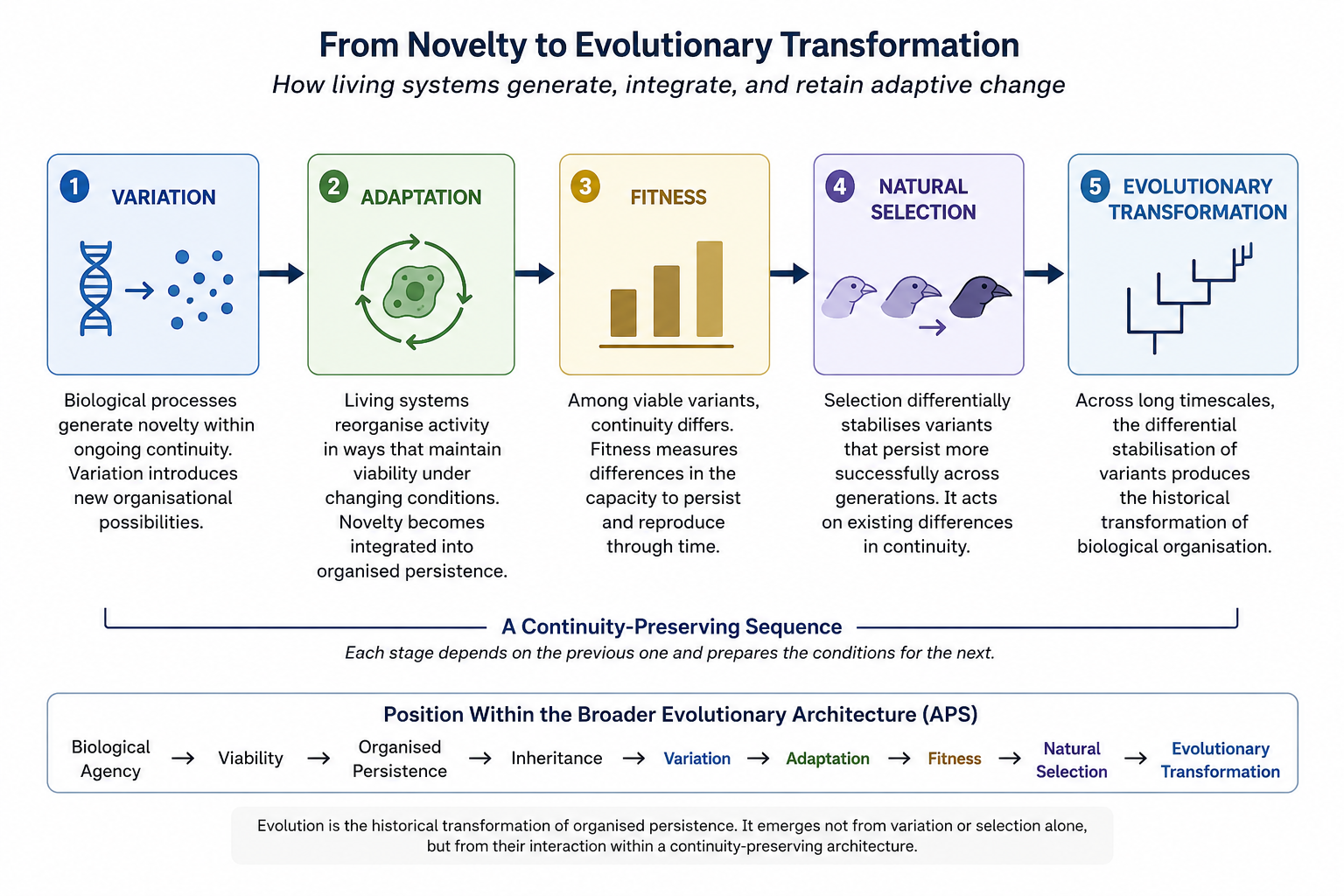
Evolutionary Concepts Visual. APS distinguishes variation, adaptation, fitness, and natural selection as different explanatory concepts within evolutionary organisation. Their arrangement in this visual represents APS explanatory organisation; it does not by itself establish temporal succession, causal priority, or a necessary biological dependency among them.
Fitness and Natural Selection
The relationship between fitness and natural selection has long been central to evolutionary theory. Selection is often described in relation to differences in fitness, yet the explanatory roles of the two concepts should be distinguished. APS interprets fitness as differential historical continuity and natural selection as differential historical stabilisation.
On this interpretation, fitness characterises differences in continuity among lineages or forms of persistence-sustaining organisation. Natural selection concerns a historical process through which biological differences may become differentially represented or stabilised. Describing differences in fitness therefore does not by itself specify the causal processes that produced those differences or establish that fitness acts as a mechanism upon which selection depends.
Fitness should consequently not be confused with selection itself. Fitness concerns differential historical continuity; selection concerns differential historical stabilisation. Their biological relationship may be causal and consequential in particular evolutionary explanations, but its form must be independently specified rather than inferred from the conceptual ordering of fitness before selection.
APS therefore situates fitness and natural selection as related but distinguishable concepts within evolutionary explanation. This preserves the usefulness of fitness for describing differential continuity without treating fitness as an independent causal force, an intermediate mechanism, or a sufficient explanation of selection.
Fitness and Development
Fitness cannot be understood independently of development because continuity is always realised through developmental processes. Living systems do not inherit finished forms. They inherit developmental organisations through which biological continuity is regenerated across time. The persistence of life therefore depends not only upon what is transmitted between generations, but also upon the developmental processes through which inherited organisation becomes viable, adaptive, and historically continuous.
This developmental perspective challenges interpretations of fitness that focus exclusively upon reproductive outcomes or static traits. Traits contribute to continuity only because developmental processes generate and sustain them within living systems. Development influences physiology, behaviour, ecological interaction, and adaptive flexibility throughout the life history of organisms. Fitness therefore emerges through developmental organisation rather than existing independently of it.
Development also helps explain why fitness remains historically situated. The continuity of organised persistence depends upon developmental trajectories unfolding within particular ecological and environmental contexts. Developmental systems both enable and constrain future possibilities, shaping the forms of organisation that become available for continuity through time. Fitness consequently reflects not merely present success, but the developmental capacity of living systems to sustain continuity under changing conditions.
APS therefore treats fitness as developmentally realised rather than statically possessed. Organised persistence contributes to future continuity through developmental processes that continually regenerate and reorganise living organisation. Fitness becomes intelligible only when continuity is understood as something actively produced through development rather than passively inherited across generations.
Fitness Across Scale
Fitness operates across multiple interacting scales of biological organisation because organised persistence itself is distributed across physiology, development, behaviour, ecology, and lineage history. Continuity therefore cannot be reduced to any single scale of analysis, and neither can fitness.
At physiological scales, fitness depends upon regulatory organisation capable of maintaining viability. At developmental scales, it depends upon the capacity to regenerate continuity under changing conditions. At behavioural and ecological scales, it depends upon interactions through which living systems modify and respond to their environments. At lineage scales, it depends upon continuity across generations and the historical persistence of forms of organisation through evolutionary time. These dimensions are not independent but continuously interact in shaping continuity.
The multiscale character of fitness helps explain why attempts to localise fitness within a single biological component often prove inadequate. Genes contribute to continuity, but only within developmental systems capable of sustaining viable organisation. Organisms contribute to continuity, but only within ecological conditions that support persistence. Lineages remain historically continuous, but only because continuity is maintained across interacting scales of organisation. Fitness therefore emerges from the relationships among these scales rather than residing at any single scale alone.
APS consequently approaches fitness as a multiscale property of organised persistence. Understanding fitness therefore requires understanding how continuity is generated and maintained across the interacting scales through which living systems persist.
Fitness and Ecological Context
Fitness is inseparable from ecological context because organised persistence always occurs through relationships between living systems and their environments. No organism can be considered fit in abstraction from the conditions under which continuity is maintained. Ecological circumstances influence viability, adaptation, development, behaviour, and reproduction, thereby shaping the continuity of organised persistence through time.
This ecological dependence explains why fitness is inherently relational. Organisational arrangements that contribute to continuity in one environment may fail under different conditions. Changes in climate, resource availability, ecological interactions, or environmental structure can alter the viability conditions under which persistence occurs. Fitness therefore reflects the relationship between organised persistence and the ecological circumstances in which continuity is realised.
The ecological character of fitness also helps explain why evolutionary outcomes remain historically contingent. Continuity depends upon conditions that themselves change through time. Ecological systems are not static backgrounds against which evolution unfolds. They are dynamic components of the continuity-producing processes through which living systems persist. Fitness therefore emerges through ongoing interactions between organised persistence and ecological context rather than through intrinsic properties alone.
APS consequently rejects the notion that fitness represents timeless biological superiority. Fitness always reflects historically situated continuity under particular conditions. Organised persistence remains viable and historically continuous only through ongoing interaction with ecological circumstances that both enable and constrain continuity through time.
Fitness and Normativity
Fitness possesses an inherently normative dimension because organised persistence can succeed or fail relative to viability conditions. Living systems are not merely physical systems undergoing change. They are forms of organisation whose continuity depends upon maintaining conditions that support persistence. Consequently, distinctions between continuity-supporting and continuity-undermining organisation are built into the very phenomenon that fitness describes.
This normativity does not arise from external standards imposed upon living systems. Rather, it emerges from the organisation of living systems themselves. Organised persistence establishes conditions under which continuity can be maintained or lost, viability can be sustained or undermined, and future continuity can become more or less likely. Fitness therefore reflects differences in continuity relative to these internally generated conditions of persistence.
The normative dimension of fitness helps explain why evolutionary explanation cannot be reduced entirely to neutral descriptions of change. Some forms of organisation contribute more effectively to continuity than others. Some developmental trajectories support persistence, whereas others destabilise it. Fitness therefore concerns historically situated differences in continuity that matter because organised persistence itself can succeed or fail.
APS consequently treats fitness as one expression of the broader normativity inherent within living systems. The continuity of organised persistence establishes standards internal to biological organisation, and fitness reflects the differential continuity achieved relative to those standards. Normativity is therefore not an additional feature imposed upon fitness but one of the reasons fitness possesses explanatory significance in the first place.
Fitness and Evolutionary Transformation
Fitness is relevant to evolutionary transformation because evolutionary histories exhibit differences in the continuity of lineages and forms of persistence-sustaining organisation. Evolution concerns historical transformation, while fitness characterises differential historical continuity within that transformation. This relation does not by itself make fitness a causal mechanism producing evolutionary change.
Fitness alone therefore does not explain evolutionary transformation. Variation, inheritance, development, adaptation, ecological interaction, natural selection, and other biological processes may bear upon the historical continuities characterised in fitness terms. Which processes explain particular differences in continuity is an empirical question requiring specification for the explanandum concerned.
This perspective clarifies why fitness should not be treated as the sole explanatory principle of evolution. It can characterise an important feature of evolutionary histories—differential continuity—without independently identifying the mechanisms through which those histories arise.
APS consequently situates fitness within a broader evolutionary explanatory architecture. Viability, inheritance, variation, adaptation, fitness, natural selection, and evolutionary transformation identify distinguishable aspects of biological continuity and change. Their organisation within APS does not by itself establish a fixed causal, temporal, or necessary sequence among them.

Fitness as Differential Continuity. APS interprets fitness as the differential continuity of persistence-sustaining organisation across historical time. Viability, adaptation, fitness, natural selection, and evolutionary transformation identify related but distinguishable explanatory concepts; their particular causal and dependency relations require specification for the biological case concerned.
The APS Perspective
The APS interpretation of fitness emerges from a broader reorganisation of evolutionary explanation. Rather than treating fitness as an abstract measure of reproductive success, APS reconnects fitness to organised persistence and continuity through time. Fitness becomes intelligible as a concept concerned with the differential continuity of persistence-sustaining organisation under changing developmental and ecological conditions.
Within this framework, fitness identifies differences in historical continuity among lineages of persistence-sustaining organisation. Agency, development, inheritance, adaptation, ecological interaction, natural selection, and evolutionary transformation address other explanatory questions concerning how biological continuity is maintained, reproduced, reorganised, differentially stabilised, and historically transformed. Their relations cannot be read directly from their ordering within the APS architecture.
This interpretation therefore integrates fitness into the wider APS account without making it an independent causal force or an obligatory intermediary between adaptation and selection. Fitness contributes a particular explanatory description—differential historical continuity—while the processes responsible for those differences require independent biological explanation.
Conclusion
Fitness has long occupied a central position within evolutionary theory, yet its meaning has often remained contested. Conventional interpretations have typically emphasised reproductive success, gene-frequency contribution, or population-level outcomes. While these approaches provide valuable tools for describing evolutionary dynamics, they do not fully explain why some forms of living organisation remain historically continuous while others do not.
APS approaches this problem by beginning with organised persistence. Living systems persist through viability-oriented activity that continually maintains the conditions required for continuity. Fitness therefore becomes intelligible not as optimisation, superiority, or reproductive output alone, but as the differential continuity of persistence-sustaining organisation under changing developmental and ecological conditions.
This interpretation clarifies the relationship of fitness to viability, inheritance, adaptation, development, natural selection, and evolutionary transformation by assigning fitness a specific explanatory role. Fitness characterises differential historical continuity among forms of persistence-sustaining organisation. It does not, by that definition alone, identify the mechanisms producing those differences or determine their causal consequences.
From the APS perspective, fitness is therefore best understood as historically situated differential continuity within persistence-sustaining organisation. Other concepts within the evolutionary architecture address the processes and relations through which biological continuity is maintained and transformed. Their causal and dependency relations must be established independently rather than inferred from the position of fitness within that architecture.
Explanatory Architecture
Central Question
What explanatory role does fitness perform once differential historical continuity is distinguished from the processes that produce it?
Architectural Role
Fitness characterises differential historical continuity among lineages or forms of persistence-sustaining organisation. It identifies differences in continuity without, by itself, specifying the biological mechanisms or processes responsible for producing those differences.
Builds On
The article builds on the APS accounts of viability, organised persistence, inheritance, variation, adaptation, development, ecology, biological agency, and evolutionary organisation.
Develops Into
Fitness becomes relevant to more specific questions concerning natural selection, differential historical stabilisation, lineage continuity, ecological context, developmental organisation, and evolutionary transformation. Which processes produce particular differences in fitness remains a biological question requiring independent specification.
Position within APS
Fitness is distinct from viability, adaptation, and natural selection. Viability concerns the conditions under which organised persistence remains possible; adaptation concerns continuity-preserving reorganisation; fitness concerns differential historical continuity; and natural selection concerns differential historical stabilisation. These distinctions organise explanatory questions without establishing a universal causal or temporal sequence among them.
Corpus Significance
Within Evolutionary Dynamics, fitness provides the principal APS concept for characterising differential historical continuity. Its architectural role is therefore to distinguish the pattern requiring explanation from the biological processes that produce it, preventing fitness from becoming either an independent causal force or an obligatory intermediary within evolutionary transformation.
See Also
Related Articles
References
- (1859). On the Origin of Species. John Murray.
- (1930). The Genetical Theory of Natural Selection. Clarendon Press.
- (1970). The Units of Selection. Annual Review of Ecology and Systematics, 1, 1–18 .
- (1982). Evolution and the Theory of Games. Cambridge University Press.
- (2019). Everything Flows: Towards a Processual Philosophy of Biology. Oxford University Press.
- (2003). Niche Construction: The Neglected Process in Evolution. Princeton University Press.
- (2026). Agency as the Defining Activity of Life: A Viability-Oriented Framework Integrating Process and Scale. Biological Theory . https://doi.org/10.1007/s13752-026-00547-6
- (2003). Developmental Plasticity and Evolution. Oxford University Press.