Space, Time, and Organisation in Biology — An APS Clarification
This article clarifies the roles of space and time in biological explanation within the APS framework. It argues that space and time are not primary explanatory domains in biology but are organisational dimensions through which viability-oriented processes are structured and understood. By situating spatial configuration and temporal extension within the dynamics of organisation, the analysis shows how biological systems are best understood as processual, scale-dependent, and structured by constraints that sustain viability rather than by static spatial form or linear temporal sequence.
1. The Problem: Space and Time as Background Assumptions
Biology routinely employs spatial and temporal concepts. Processes occur in particular locations, unfold over time, and are distributed across organisms and environments. Descriptions of “levels,” “scales,” “stages,” and “timelines” are standard across biological disciplines. Yet these concepts are typically treated as neutral coordinates within which biological phenomena occur, rather than as features that require explanation.
This creates a tension. In physics, space and time are formalised as part of the structure of the world. In biology, by contrast, they are widely used but rarely theorised. Biological explanation presupposes spatial and temporal organisation, but does not usually specify how that organisation arises in living systems.
The result is a familiar pattern. Increasingly detailed descriptions of where processes occur and when they unfold are taken to deepen explanation. However, without an account of how spatial and temporal relations contribute to the organisation of living systems, such descriptions risk remaining incomplete. The question is not simply where and when biological processes occur, but how spatial and temporal relations are organised as part of the maintenance of life.
This requires a shift in how space and time are understood in biological explanation.
2. The Limits of Spatial and Temporal Description
Descriptions of biological systems are often richly spatiotemporal. Molecular processes are localised within cells, tissues are organised within organisms, and organisms are situated within environments. Similarly, biological activity is described in terms of sequences, cycles, and developmental trajectories.
These descriptions are indispensable. They identify the distribution of processes and the order in which events occur. However, they do not by themselves constitute biological explanation. To specify that a process occurs in a particular location or at a particular time is to describe its position or sequence, not to explain its role in sustaining the system.
This limitation parallels the broader distinction between description and explanation. Spatial and temporal descriptions can be highly precise, yet still fail to account for what makes a system biological. A non-living system can also exhibit spatial organisation and temporal dynamics. What distinguishes living systems is not the mere presence of spatial and temporal structure, but the way in which that structure contributes to maintaining viability.
Biological explanation therefore requires more than the mapping of processes in space and time. It requires an account of how spatial and temporal relations are organised in ways that sustain the system as a whole.
3. From Coordinates to Organisation
The central shift is from treating space and time as background coordinates to understanding them as organised dimensions of activity.
In biological systems, spatial organisation is not simply a matter of position. It involves boundaries, compartments, gradients, and patterns of coupling between system and environment. Membranes define regions within which processes occur; gradients structure flows of matter and energy; organisms maintain distinctions between themselves and their surroundings. Space, in this sense, is structured difference that matters for activity.
Temporal organisation is likewise more than sequence or duration. Living systems persist, regulate their activity, and transform across time. Their present state depends on prior states and contributes to future possibilities. Processes such as development, repair, and adaptation reflect the continuous reorganisation of activity. Time, in this sense, is the continuity and transformation of organisation.
From an APS perspective, spatial and temporal relations are therefore not external parameters imposed on biological systems. They are enacted through the organisation of activity. Living systems do not simply occupy space and time; they actively structure spatial and temporal relations as part of maintaining viability.
4. Process as Spatiotemporal Integration
Spatial and temporal organisation are not independent dimensions that must be combined. They are already integrated in process.
Biological processes are inherently spatiotemporal. They are distributed across regions of a system and unfold through time as coordinated activity. Metabolic regulation, for example, involves the spatial organisation of reactions within cellular structures and the temporal coordination of those reactions in maintaining viable conditions. The spatial distribution of processes cannot be separated from their temporal unfolding without losing what makes them part of a living system.
In APS terms, this integration is captured by the relation between process, scale, and agency. Process expresses the temporal unfolding of activity; scale captures its distributed organisation across domains; agency reflects the coordination of that activity in maintaining viability. These dimensions are co-constitutive. Spatial and temporal relations are integrated through the organisation of process itself.
Spatiotemporal organisation is therefore not an additional feature of biological systems, but intrinsic to their mode of existence as dynamically maintained processes.
5. Why “Levels” and “Stages” Mislead
Much biological description relies on hierarchical language, referring to “levels of organisation” or “stages” of development. While often convenient, such terms can mislead by suggesting that biological systems are composed of separable layers or discrete phases.
From an organisational perspective, biological systems are not stratified in this way. Their activity is distributed and coordinated across domains, with processes at different spatial and temporal extents continuously interacting. Development is not a sequence of isolated stages but a continuous reorganisation of activity. Similarly, what are often described as “levels” are better understood as domains of organisation that are dynamically related rather than hierarchically ordered.
Replacing hierarchical language with organisational terms—such as domains, processes, and distributions—helps to align description with the underlying structure of biological systems. It also clarifies that explanation must account for coordination across these domains, rather than reduction to a single one or fragmentation into disconnected parts.
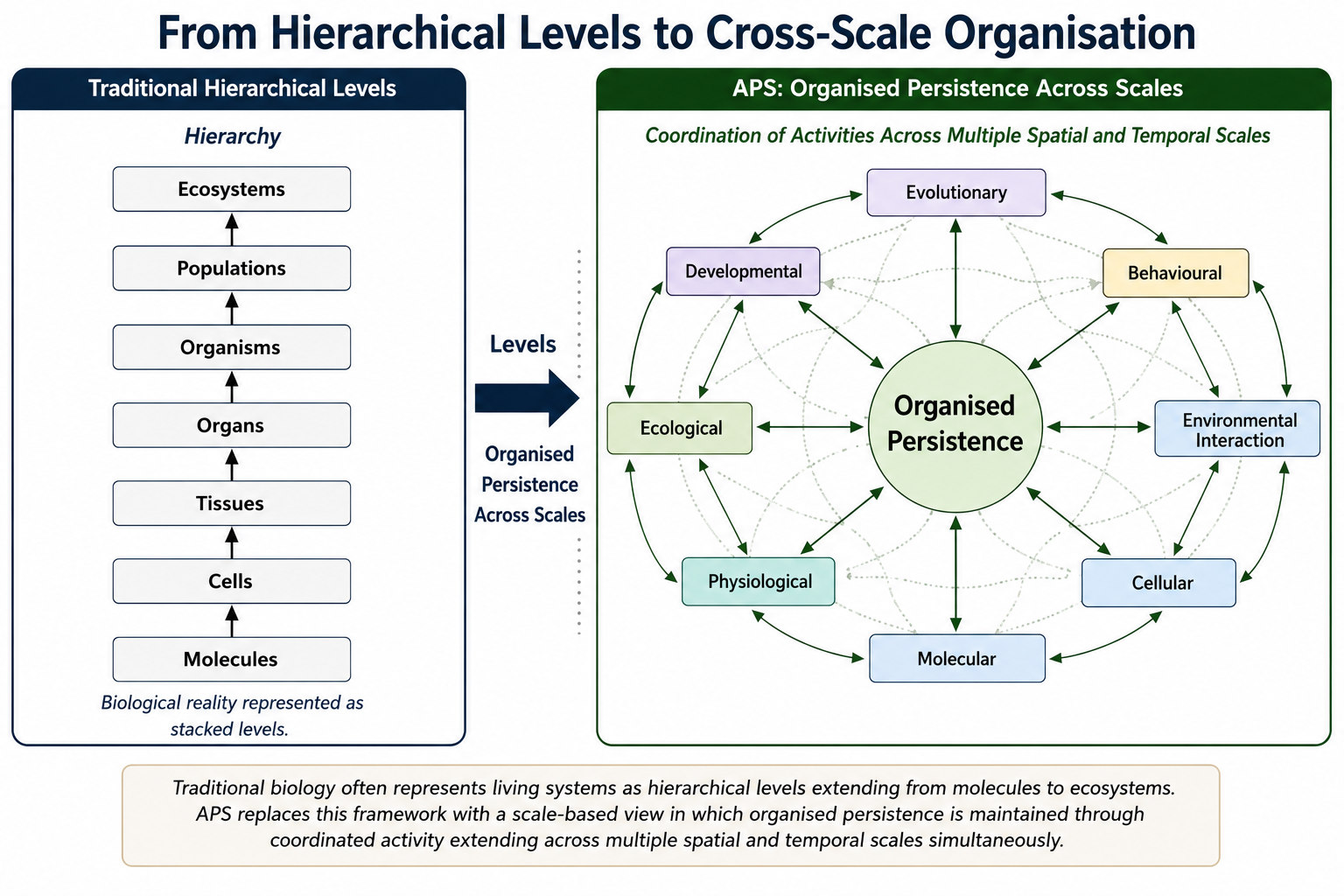
From Hierarchical Levels to Cross-Scale Organisation. Traditional biology often represents living systems as hierarchical levels extending from molecules to ecosystems. APS replaces this framework with a scale-based view in which organised persistence is maintained through coordinated activity extending across multiple spatial and temporal scales simultaneously. Molecular, cellular, physiological, behavioural, developmental, ecological, and evolutionary processes are not independent levels but interconnected dimensions of the same viability-oriented organisation.
6. Relation to Physical Space-Time
The account developed here does not deny the role of physical space and time. Biological systems are embedded in the physical world and are subject to its constraints. However, the organisation of space and time in biology is not reducible to their physical description.
In physics, space and time are formalised as part of a general framework within which phenomena occur. In biology, by contrast, the focus is on how systems organise spatial and temporal relations in the course of maintaining themselves. The same physical space and time can support very different forms of organisation, only some of which are biological.
The distinction is therefore not between different kinds of space and time, but between different ways in which spatial and temporal relations are organised. Biological explanation concerns this organisation. It addresses how living systems use and structure spatial and temporal relations in sustaining their own persistence.
7. Consequences for Biological Explanation
Recognising the organised character of space and time has direct implications for biological explanation.
First, explanation must account for spatial organisation. It must specify how processes are distributed, how boundaries are maintained, and how system–environment relations are structured. Second, it must account for temporal organisation, including persistence, regulation, and transformation across time. Third, it must address the coordination of processes across domains, showing how spatial and temporal relations are integrated in maintaining viability.
These requirements align with the explanatory architecture developed in APS. Mechanistic explanations describe processes in their spatiotemporal context; functional explanations specify how those processes contribute across time to maintaining the system; evolutionary explanations account for how such organisation is transformed across generations. Their integration depends on a shared target: the organisation of activity in space and time as part of viability.
8. Toward a Spatiotemporal Theory of Biological Organisation
The clarification developed here opens a number of directions for further work in theoretical biology.
One direction concerns the formalisation of biological scale as distributed organisation across spatial and temporal domains, rather than as hierarchical structure. Another concerns the relation between temporal organisation and cognition, particularly in systems that exhibit extended integration of activity across time. Development can be reinterpreted as the continuous reorganisation of spatiotemporal relations, rather than as progression through discrete stages. evolution can be understood as the transformation of such organisation across lineages, linking spatial distribution and temporal continuity.
Further work may also explore how biological systems structure their environments, not as passive surroundings but as domains of coupling that participate in the maintenance of viability. At a more formal level, this perspective suggests the development of models that capture organisation in terms of processes and constraints, rather than static configurations.
These directions indicate that a systematic account of spatiotemporal organisation could contribute to unifying different areas of biology, from molecular processes to ecological systems, within a common explanatory framework.
Key Point
Space and time in biology are not neutral coordinates in which life unfolds. They are organised dimensions of viability-oriented activity, integrated through process and distributed across scale. Biological explanation must therefore account not only for what happens, but for how spatial and temporal relations are structured in the maintenance and transformation of living systems.
Explanatory Architecture
1. Central Question
How should space and time be understood within biological explanation?
APS argues that space and time are not themselves primary explanatory domains in biology. Rather, they are organisational dimensions through which viability-oriented activity is structured, coordinated, and maintained.
2. Architectural Role
This article clarifies the explanatory status of space and time within the APS framework.
It distinguishes physical space-time from biological explanation by showing that biology is concerned not simply with where and when living systems exist, but with how living systems organise spatial and temporal relations in maintaining organised persistence.
The article therefore establishes the conceptual position of space and time within APS rather than introducing new theoretical entities or extending physical theory.
3. Builds On
This article builds directly upon the APS concepts of:
- Life
- Biological Organisation
- Organised Persistence
- Biological Agency
- Process
- Scale
- Viability
- Constraint Closure
It assumes these concepts in their canonical forms and explains how spatial and temporal organisation should be understood within that existing conceptual architecture.
4. Develops Into
The conceptual clarification provided here supports subsequent work on:
- Development
- Evolution
- Ecology
- Cognition
- Biological Explanation
- The Explanatory Geometry of Biology
- Cross-scale Organisation
- Environmental Organisation
It provides the conceptual foundation for interpreting biological organisation as distributed across spatial and temporal domains.
5. Related Explanatory Questions
This article contributes to the following broader biological questions:
- Why is biological explanation organisational rather than merely descriptive?
- How should scale be understood in biological explanation?
- What distinguishes biological organisation from physical organisation?
- How should process integrate spatial and temporal organisation?
- Why are “levels” and “stages” descriptive rather than primary explanatory concepts?
- How do living systems organise spatial and temporal relations in maintaining viability?
6. Position within APS
This article occupies the Conceptual Foundations cluster.
Its role is to stabilise APS’s interpretation of space and time and prevent category errors between physical description and biological explanation.
Rather than proposing a theory of space or time, it explains where spatial and temporal organisation belongs within the Agency–Process–Scale explanatory architecture.
It complements the canonical articles on Biological Organisation, Process, Scale, Organised Persistence, and The Explanatory Geometry of Biology while providing an important conceptual bridge to later discussions of development, evolution, ecology, and cognition.