How Does Theoretical Biology Make Progress? — From Historical Change to Comparative Explanation
Theoretical biology progresses not simply when its theories and frameworks change, expand, or become more integrated, but when those changes produce warranted improvements in biological knowledge, explanation, understanding, inference, discrimination, constraint, or research practice. This article examines how progress can occur within an explanatorily plural biology and proposes transparent comparison among explanatory systems as one possible mechanism of theoretical development.
Key Points
- Historical change in theoretical biology does not by itself establish scientific or explanatory progress.
- Empirical, explanatory, architectural, and comparative progress should be distinguished rather than treated as a single form of improvement.
- Integration, coherence, breadth, and common terminology do not by themselves establish explanatory gain.
- APS proposes a Comparator Dependency Map for comparing explanatory systems through their targets, warranted dependencies, differences, and scientific consequences.
- Comparison can contribute to theoretical development by supporting retention, differentiation, correction, or revision of either explanatory system.
- APS must demonstrate its own explanatory progress through the same transparent comparisons applied to other explanatory systems.
Where This Article Fits
This article continues the argument of What Is Theoretical Biology? — Historical Transformations and Contemporary Explanatory Practice. That article examines how theoretical biology and its explanatory practices have changed. The present article asks the next question: when should such change count as progress?
It also connects that historical question with APS’s work on scientific explanation and comparative methodology. Those articles examine in greater detail how explanatory targets should be specified, how explanations can be compared fairly, what counts as explanatory gain, and how a new framework should be tested against strong alternatives.
The resulting reading sequence is:
History of theoretical biology → Progress in theoretical biology → Comparative explanatory methodology → Tests of explanatory gain
APS enters this sequence as a framework to be investigated, not as the predetermined destination of theoretical biology.
How Does Theoretical Biology Make Progress?
From Historical Change to Comparative Explanation
Theoretical biology has never stood still. Its questions, concepts, models, explanatory priorities, and relationships with experimental biology have changed repeatedly. Earlier approaches to biological form, organisation, development, evolution, physiology, and systems have been extended, reorganised, challenged, or replaced as biological knowledge has grown.
The companion article, What Is Theoretical Biology? — Historical Transformations and Contemporary Explanatory Practice, traces some of these changes. But history raises a further question. When does change in theoretical biology count as progress?
A new theory may introduce new concepts. A framework may connect previously separate areas of biology. An explanatory system may become more coherent, comprehensive, or mathematically sophisticated. None of these changes, by itself, establishes that biological explanation has improved.
Scientific progress requires something more. Changes must make a warranted difference to what scientists can know, explain, understand, infer, discriminate, constrain, test, or investigate.
This article examines that problem in a biology where several legitimate forms of explanation coexist. It then asks whether transparent comparison among explanatory systems might itself become one means by which theoretical biology progresses. The Agency–Process–Scale (APS) framework provides a contemporary worked case, but it is subject to the same requirements as the explanatory approaches with which it is compared.
1. Theoretical Biology Has Always Changed
The history of theoretical biology is not the history of a single theory becoming progressively more complete. Different periods have emphasised different explanatory problems. Biological form and organisation, heredity, evolution, development, physiological regulation, ecological interaction, molecular mechanisms, mathematical dynamics, and complex systems have each generated distinctive theoretical traditions. Some have been integrated; some have remained partly independent; some have been transformed as new experimental methods and bodies of evidence became available.
The result is not simply a succession of competing theories. Contemporary biology contains explanatory practices operating at different spatial and temporal scales, addressing different questions, using different forms of evidence, and representing biological dependencies in different ways. That history matters because it warns against a tempting retrospective picture: theoretical biology should not be described as if its successive transformations were stages in a predetermined movement towards a single contemporary framework. Historical succession demonstrates change; it does not, by itself, demonstrate improvement.
That distinction takes us from the history of theoretical biology to the problem of scientific progress.
2. But Change Is Not the Same as Progress
Philosophers of science have long disagreed about exactly what scientific progress consists in.
Thomas Kuhn’s account of scientific change made it difficult to treat the history of science simply as the continuous accumulation of truths within an unchanged conceptual framework. Larry Laudan instead emphasised the capacity of research traditions to solve empirical and conceptual problems. Philip Kitcher subsequently developed a broader account in which progress can occur in different components of scientific practice rather than requiring the wholesale replacement of one theory by another.
These approaches differ, but together they make an important point: historical change and scientific progress are not equivalent.
The distinction is particularly important for theoretical biology. A biological framework can acquire more concepts without explaining more. It can encompass more phenomena without demonstrating that its explanations are better. It can organise established knowledge more elegantly without discovering any new biological dependency. It can even become more internally coherent while becoming less responsive to evidence.
Conversely, progress need not require the appearance of a more comprehensive theory. Correcting a mistaken dependency, restricting an overgeneralised claim, establishing the limits of a model, or discovering that two apparently competing explanations address different questions can all improve biological knowledge.
Progress must therefore be assessed in relation to what has actually improved.
3. What Can “Progress” Mean?
For present purposes, it is useful to distinguish four kinds of progress.
Empirical progress occurs when biological knowledge becomes better warranted. New observations, experiments, measurements, or analyses may establish phenomena or dependencies more securely, overturn earlier claims, or reveal previously unknown conditions.
Explanatory progress occurs when scientists become better able to explain a specified biological phenomenon or dependency. This might involve identifying a previously unknown difference-maker, discovering a mechanism, establishing a constraint, improving a model, or showing why a phenomenon occurs under one set of conditions but not another.
Architectural progress concerns relationships among independently warranted explanatory resources. It occurs when organising or relating explanations produces a scientifically consequential improvement—for example, by supporting an inference across domains, exposing a missing dependency, identifying an explanatory boundary, or revealing a new research problem.
Simply connecting more things is not enough. Increased coherence, connectedness, or systematicity may be useful, but architectural progress requires a consequential improvement in scientific or epistemic practice.
Comparative progress occurs when comparison itself reveals consequential similarities, differences, omissions, redundancies, or relationships that justify retaining, differentiating, correcting, or revising one or more of the explanatory systems being compared.
These categories need not be mutually exclusive. One scientific development might contribute to several at once. Their purpose is not to provide a numerical measure of progress, but to prevent different achievements from being treated as though they were the same.
4. Biology Does Not Have Just One Kind of Explanation
The problem becomes more difficult because biology is explanatorily plural. An evolutionary explanation may ask how selection changed the distribution of a trait through generations. A developmental explanation may ask how that trait is produced during an organism’s development. A physiological explanation may ask how it contributes to regulation within the living organism. An ecological explanation may ask how its consequences depend upon relationships between organisms and environments. These explanations can concern the same organism without answering the same question.
Biology also employs different explanatory forms. Mechanistic explanations identify organised entities and activities. Mathematical models may reveal dynamical relationships or consequences of specified assumptions. Evolutionary explanations reconstruct historical processes. Organisational approaches examine relationships through which living systems maintain themselves. Ecological explanations may depend upon interactions distributed across organisms, populations, communities, and environments.
Explanatory plurality therefore need not indicate scientific disorder. Sandra Mitchell and Michael Dietrich have shown how biological integration can coexist with pluralism rather than requiring large-scale theoretical unification. Work on scientific understanding likewise supports the importance of recognising different explanatory forms rather than assuming that one model of explanation must perform every scientific task.
The question for theoretical biology is consequently not merely:
Which explanation is correct?
It is also:
What is each explanation explaining, what dependencies does it require, how is it warranted, and how does it relate to other explanations?
5. Integration Is Not the Same as Unification
Once several explanations are recognised, it is natural to ask how they fit together, but there are several very different possibilities. Two explanations may address different aspects of the same phenomenon. One may provide conditions required by another. One may describe a process whose consequences become inputs to another process. Two explanations may overlap substantially while organising their dependencies differently. They may genuinely compete, or they may have little explanatory relationship at all.
Lindley Darden and Nancy Maull’s account of interfield theories provided an important early analysis of how relationships between scientific fields can themselves become theoretically productive. Fields concerned with different aspects of a phenomenon may be connected through warranted relationships, and those connections can help answer questions, direct attention, or generate predictions that would not arise from either field considered in isolation.
But integration must not be confused with unification.
Several explanatory resources can be related without being reduced to a single theory. Conversely, placing them under a common vocabulary does not establish that they have been scientifically integrated.
This gives theoretical biology an important control:
More connected does not automatically mean more explanatory.
A framework that connects evolution, development, physiology, ecology, and organisation has not demonstrated explanatory progress merely by drawing links among them. The links themselves must be scientifically warranted, and their organisation must make a consequential difference to explanation or inquiry.
6. Explanatory Systems Can Be Compared
This suggests a broader object of investigation. For the purposes of comparison, an explanatory system can be treated as an organised set of concepts, dependencies, models, principles, and evidentially warranted claims through which biological phenomena are explained.
This does not imply that every explanatory system is a unified theory. Nor does it require biology to possess a small number of sharply bounded rival frameworks. An explanatory system may be distributed across several theories, models, research traditions, and domain-specific practices. That point is methodologically important because a framework cannot claim explanatory superiority simply because its alternative is distributed across several disciplines.
Suppose one framework places several biological relationships within a single conceptual architecture, while established biology represents the same relationships through a combination of evolutionary theory, developmental biology, physiology, ecology, and systems biology. The relevant comparison is with the strongest appropriately organised alternative, whether that alternative is a single theory or a combination of established explanatory resources.
Fair comparison also requires target matching. Two explanations should not be treated as competitors merely because they use different terminology or discuss the same organism. We must first establish that they are attempting to explain sufficiently comparable phenomena. Only then does architectural comparison become informative.
7. Compare the Dependencies, Not Just the Labels
As a methodological proposal arising from APS research, the Comparator Dependency Map (CDM) offers one way of making such comparisons explicit; it is not presented here as an established method of theoretical biology.
Instead of beginning with the names of frameworks and asking which is better, the map begins with an explanatory target.
For each target it asks:
What dependency is being claimed?
What evidence warrants it?
What does the strongest relevant alternative claim?
Are the dependencies actually different?
If they are different, what scientific consequence follows?
A comparison can then be classified more precisely.
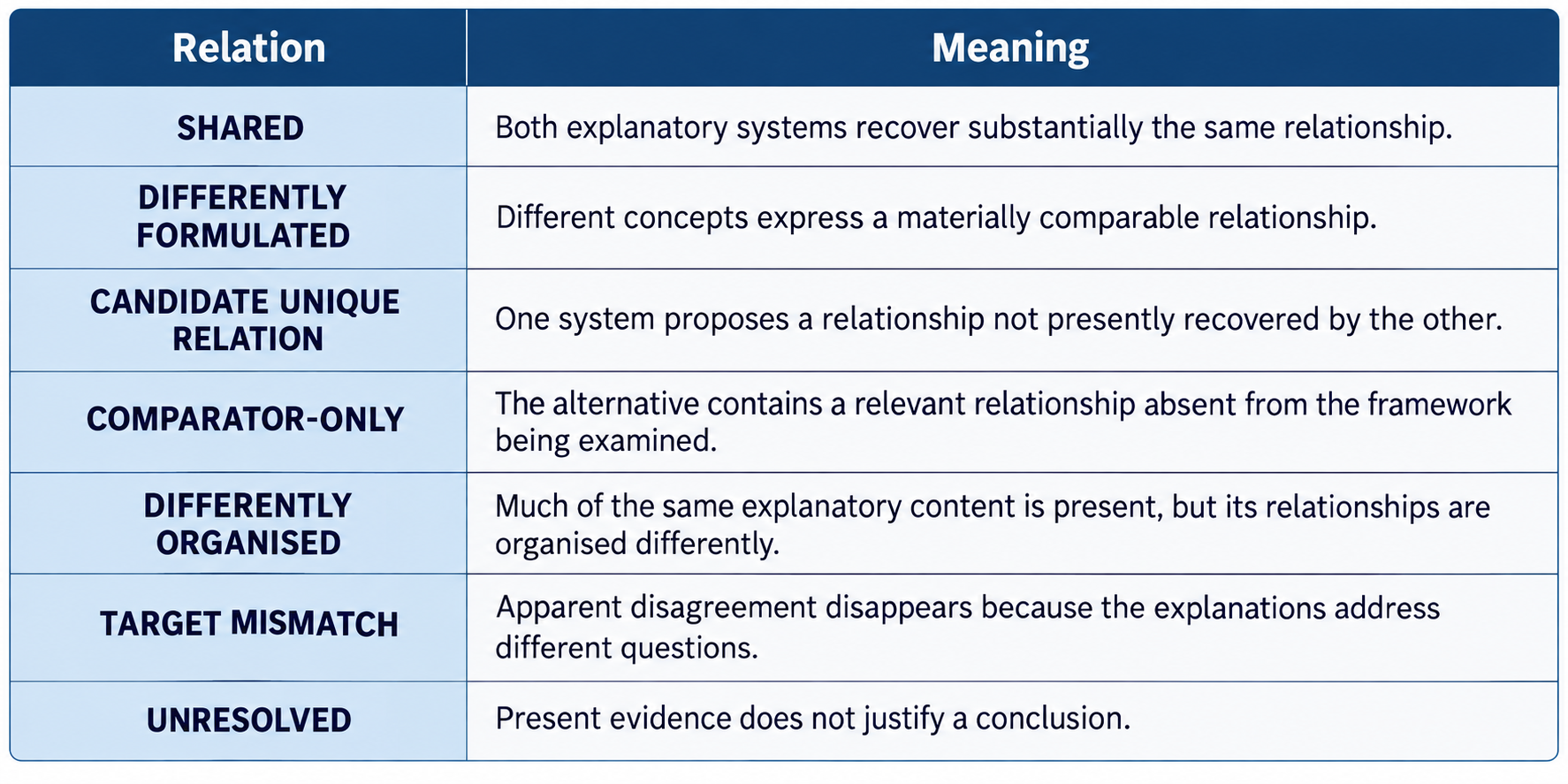
Table 1. Comparator Dependency Map relation classes. These categories describe how explanatory systems relate at a specified explanatory target. They identify shared, differently formulated, potentially unique, missing, differently organised, mismatched, or unresolved relationships without themselves constituting judgments of explanatory quality or explanatory gain.
These categories describe relationships between explanatory architectures. They are not scores of explanatory quality.
A candidate unique relation is not automatically an explanatory advantage. It may be unsupported, scientifically inconsequential, or already recoverable through other resources.
A comparator-only relationship need not count against the framework being examined. It may reveal a boundary in its intended scope or identify something that should be incorporated or addressed.
A differently organised relationship may prove important—or may merely express established knowledge in another vocabulary.
The map therefore makes differences visible without deciding in advance which differences matter.
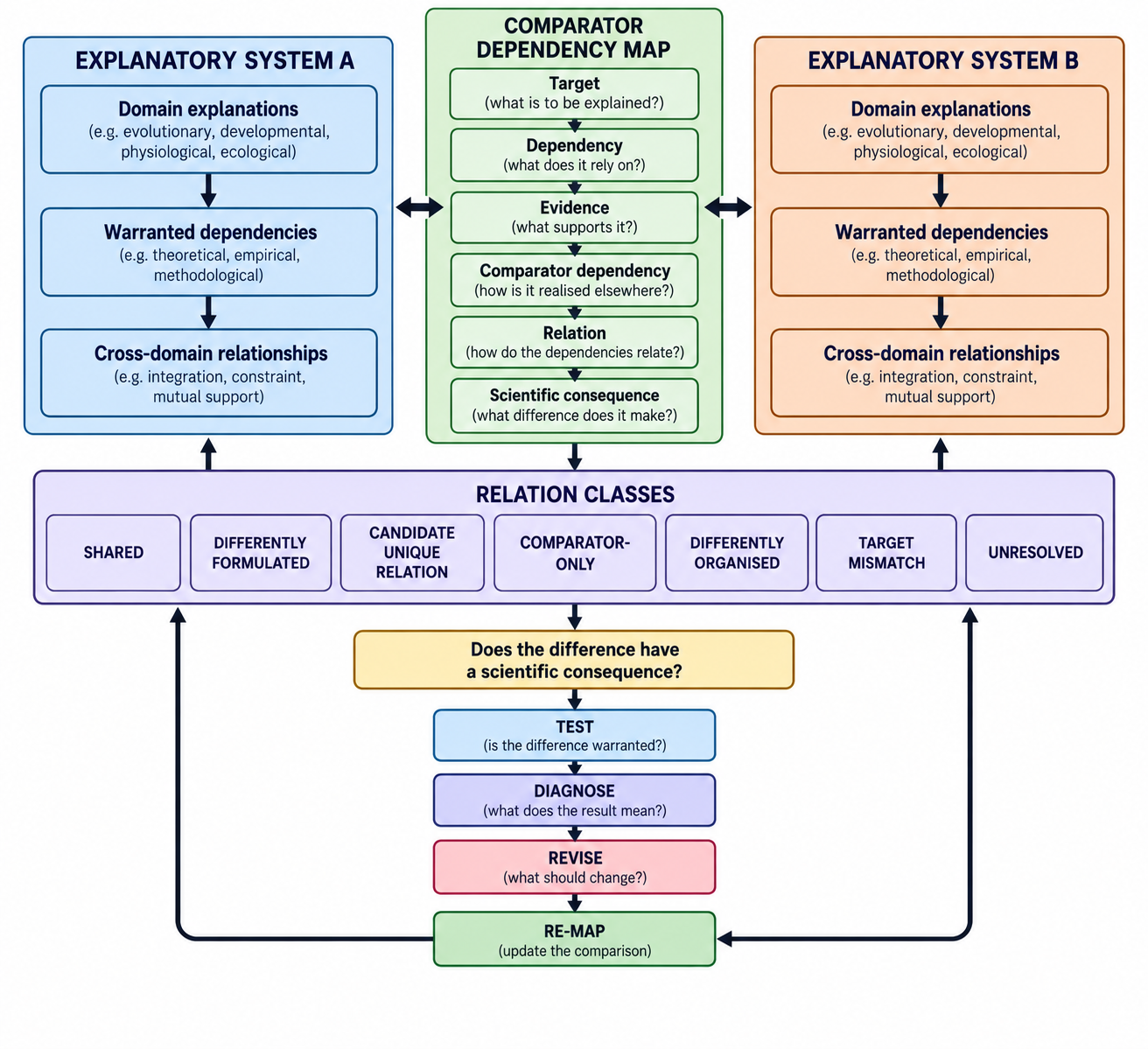
Figure 1. How comparison can contribute to theoretical progress. The Comparator Dependency Map is proposed here as a way of comparing explanatory systems through their warranted dependencies rather than through framework labels alone. Architectural differences become candidates for explanatory progress only when they have scientifically consequential effects. Comparison may support retention, differentiation, correction, or revision of either explanatory system; it does not presuppose a winner.
8. When Does a Difference Matter?
This is the decisive step.
Theoretical frameworks often differ. The scientific question is whether the difference has a consequence.
A difference may matter if it identifies a biological difference-maker that was previously missed. It may change a warranted inference, distinguish cases another explanation treats alike, constrain the range of adequate explanations, expose a missing dependency or boundary condition, generate a discriminating empirical test, or redirect research towards a problem that would otherwise remain hidden.
These are consequential differences because something scientifically relevant follows from them.
By contrast, several apparent improvements require more caution.
A common vocabulary can make a body of knowledge easier to navigate without adding explanatory content. A diagram can display relationships more clearly without demonstrating that those relationships were previously unknown. A framework can provide conceptual coherence while leaving all relevant biological inferences unchanged. An elegant redescription can be illuminating without explaining the phenomenon better than the strongest alternative.
Such achievements may still have intellectual or practical value. They should simply not be reported as a stronger kind of explanatory gain than the evidence establishes.
Comparison therefore requires two separate questions:
How are the explanatory systems different?
and then:
What follows because they are different?
The second question is what turns architectural comparison into a test of explanatory significance.
9. Comparison Can Improve the Frameworks Being Compared
Comparison need not be merely a final judgment performed after theoretical development has finished. It can become part of development itself. APS research therefore proposes a recurring comparative cycle:
Map → Compare → Test → Diagnose → Revise → Re-map
First, make the relevant explanatory dependencies explicit and compare them with the strongest relevant alternative. Then test whether the apparent difference is scientifically warranted and consequential, diagnose what the result means, and revise where revision is justified. The changed explanatory landscape can then be mapped again.
The important feature of this cycle is its symmetry.
Comparison might reveal something that APS contributes. But it might instead show that an established alternative already contains the relevant explanatory content. It might expose a missing APS dependency. It might show that two apparently competing accounts address different targets. It might support retaining two complementary explanations. Or it might find no scientifically important difference at all.
Systematic comparison can therefore reveal differences, omissions, or redundancies that, where scientifically consequential, may provide grounds for retaining, differentiating, correcting, or revising one or more of the explanatory systems involved.
On this view, comparison is not simply a way to choose a winner. It can be a mechanism of theoretical development.
10. What Would Progress in APS Actually Mean?
This question applies directly to APS.
APS can certainly develop internally. A biological dependency may become better supported. A claim may be narrowed when evidence does not justify its earlier scope. Relationships between Agency, Process, and Scale may be represented more accurately. Work in cognition, evolution, development, ecology, or other domains may expose missing distinctions or require conceptual revision.
These are legitimate forms of scientific development within APS, but their occurrence does not by itself establish comparator-relative explanatory gain.
Internal APS progress is not the same as comparator-relative explanatory gain.
Suppose APS independently identifies a genuine biological relationship and later comparison shows that established biological theory already represents the same relationship equally well. APS has still improved internally: it now represents the biology more accurately. But the comparison has not demonstrated an additional APS explanatory contribution.
The reverse is also important. A comparator may reveal something APS has missed. If APS then corrects the omission, the comparison has contributed to APS’s progress even though APS did not “win” the comparison.
A third claim is stronger again: APS-wide explanatory progress.
It would not follow simply from accumulating many local improvements. Nor would it follow from adding more cross-domain connections. A claim about APS as an integrated explanatory architecture would require evidence that scientifically consequential results arise from that architecture at the relevant scope.
These distinctions allow APS development to be assessed without either undervaluing genuine progress or converting every improvement into a claim of explanatory superiority.
11. What APS Has Already Learned from Comparison
APS’s comparative research has already produced an important methodological lesson.
A biological relationship can be genuine. Its evidential support can be adequate. Its place within APS can be coherent. And yet an appropriately organised combination of existing explanatory resources may recover the same consequential biological content.
In such a case, APS may provide a useful organisation of the material without having demonstrated additional explanatory utility.
That is not a methodological failure. It is precisely the kind of distinction comparative testing is intended to reveal.
The same research has produced another lesson. Sometimes a stronger explanatory claim cannot yet be tested fairly because the required evidence, comparator, or relational structure is unavailable. The appropriate response is then to withhold the stronger conclusion.
A framework should not redesign its test simply because the existing comparison failed to establish an advantage.
These results change how APS development should be understood. Building more dependencies, extending the framework into additional biological domains, and improving its internal architecture can strengthen APS as a candidate explanatory system. Whether those developments produce additional explanatory gain remains a separate comparative question.
The distinction is essential if APS is to remain corrigible.
12. From Competing Frameworks to Comparative Explanatory Systems
Theoretical biology need not face a choice between unrestricted explanatory fragmentation and eventual convergence upon one universal framework.
Another possibility is increasingly transparent comparison among explanatory systems. This is one possible future methodology for theoretical biology, not a prediction about how the field will develop.
On this view, theoretical progress might sometimes proceed through a sequence such as:
multiple explanatory systems → explicit comparison → reciprocal correction → clearer division of explanatory labour → selective integration → new questions and tests
This does not imply that every explanatory system can be translated into every other one.
Some explanations may remain legitimately distinct because they address different questions. Some differences may resist meaningful comparison. Some integrations may erase distinctions that biology needs to preserve. And some apparent theoretical disagreements may disappear once their explanatory targets are properly specified.
The objective is therefore not to force theoretical biology into a common language. It is to make comparison sufficiently transparent that scientists can ask more precise questions: Which dependencies are shared, and which are merely expressed differently? Where does one explanatory system contain something another lacks? Which apparent disagreements are really differences of explanatory target? Which architectural differences have consequences for explanation, inference, prediction, constraint, or research? And when comparison exposes a weakness, what should change?
Transparent comparison among explanatory systems may therefore provide one productive methodology for the future development of theoretical biology. It turns comparison from a contest between labels into an investigation of explanatory relationships and their consequences.
For APS, the long-term ambition is correspondingly bounded. It is not to become the framework into which all biology must fit. It is to become an increasingly well-tested explanatory architecture whose contribution to theoretical biology can be made visible through transparent comparison with the strongest available alternatives.
Whether APS ultimately makes that contribution is not something its architecture can decide in advance.
It is something comparative research must establish.
See Also
Related Articles
References
- (1977). Interfield Theories. Philosophy of Science, 44(1), 43–64 . https://doi.org/10.1086/288723
- (2017). Understanding Scientific Understanding. Oxford University Press. https://doi.org/10.1093/oso/9780190652913.001.0001
- (1993). The Advancement of Science: Science without Legend, Objectivity without Illusions. Oxford University Press.
- (1977). The Essential Tension: Selected Studies in Scientific Tradition and Change. University of Chicago Press.
- (1977). Progress and Its Problems: Towards a Theory of Scientific Growth. University of California Press.
- (2006). Integration without Unification: An Argument for Pluralism in the Biological Sciences. The American Naturalist, 168(S6), S73–S79 . https://doi.org/10.1086/509050