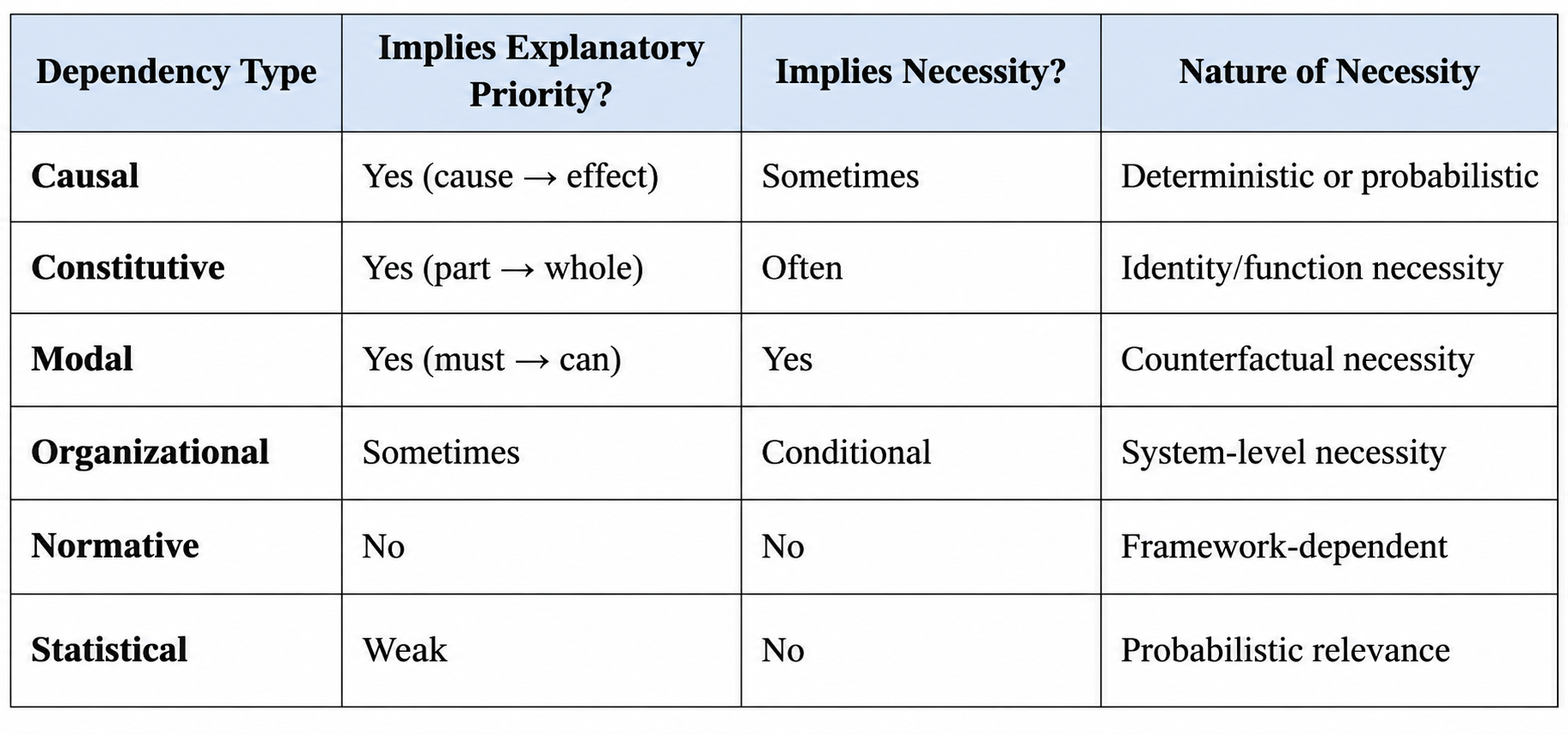
A dependency is a specified relation in which one explanatorily relevant feature depends, in a stated sense and under stated conditions, upon another feature, process, condition, structure, constraint, or relation.
Dependency is a general methodological term. It does not mean causation by default. Biological explanations may involve causal, mechanistic, constitutive, constraint-based, organisational, functional, historical, enabling, mathematical, or other appropriately specified forms of dependence. Different dependency types support different explanatory claims and must not be treated as interchangeable.
A dependency claim therefore requires more than identifying two related phenomena. The relevant relata, type of dependence, conditions, evidential warrant, scope, and—where relevant—failure conditions must be specified sufficiently for the claim being made.
Temporal succession does not by itself establish dependency. Statistical association may provide evidence for investigating a dependency but does not by itself establish an explanatory dependency. Likewise, the independent evidential support of two biological phenomena does not automatically establish the proposed relation between them.
Architectural Summary
Within APS, dependencies connect explanatory claims within and across biological domains, but APS architecture does not establish those dependencies merely by representing them.
An arrow or sequence in an APS diagram may represent a proposed dependency, conceptual ordering, enabling relation, constitutive relation, organisational relation, explanatory priority, or another specified relationship. Its meaning must therefore be established independently rather than inferred from the arrow itself.
Proposed relation → Dependency type → Evidence → Scope → Explanatory consequence
Accordingly, an APS architectural sequence must not be interpreted as a demonstrated causal or temporal chain unless each relevant relation has independently been shown to have that character.