Plant Cognition and the Development of APS: From Biological Agency to Comparative Explanation
Plant cognition provides a longitudinal case through which the development of the Agency–Process–Scale framework can be examined. The originating APS account placed biological agency at the centre of the plant-cognition question. Subsequent work differentiated agency, biological evaluation, significance, integration, and cognition; developed a more discriminating boundary between cognition and sophisticated biological regulation; and introduced comparative controls requiring specified explananda, adequate comparators, and demonstrable explanatory gain. When these resources were reapplied to plants, they narrowed what APS could warrant as cognition without diminishing the biological significance of the underlying phenomena. The resulting change is neither straightforward continuity nor simple correction, but a documented case of conceptual differentiation and methodological constraint altering the claims a developing framework is entitled to make.
Key Points
- Plant cognition was an originating problem in the development of APS.
- Biological agency remains foundational to the APS treatment of cognition but does not by itself warrant cognitive attribution.
- Biological Evaluation, Significance, and Integration progressively differentiated the explanatory pathway between Agency and Cognition.
- APS development was non-linear: comparatively permissive plant-cognition attribution persisted while important elements of the later conceptual architecture were already present.
- Comparative explanatory methodology subsequently made cognitive attribution dependent on specified explanatory targets, adequate comparators, and the possibility of null or indeterminate outcomes.
Introduction
Plant cognition has occupied an unusual place in the development of the Agency–Process–Scale framework. It was one of the problems through which APS was first publicly articulated, and it later became a case against which the framework’s developing account of cognition and biological explanation could be tested.
The result is not a simple history in which an early position was replaced by a later one. Important commitments remained stable. Others became more sharply differentiated. Still others arose through research elsewhere within APS and were subsequently brought back to the plant-cognition problem. The standards governing explanatory claims also changed.
Plant cognition therefore provides a longitudinal case through which APS itself can be examined. The question is not simply whether the framework once attributed cognition to plants and now does so more cautiously. It is what that change reveals about the development of the concepts and standards of biological explanation through which the attribution is made.
1. Plant Cognition as an Originating APS Problem
The 2025 paper Biological Agency as the Context for Plant Cognition placed biological Agency at the centre of the problem (Spencer 2025). Its starting point was that cognition should not be approached by assuming that familiar human or neural manifestations determine what cognition must be throughout biology. Plants therefore mattered not because they could be assimilated to animals, but because they forced attention towards the biological organisation within which capacities conventionally described as cognitive arise.
Agency supplied that context. Living systems were treated as active rather than passive organisations: they regulate their relations with changing conditions, maintain their viability, and modify activity in ways relevant to continued functioning. The original treatment of biological cognition was correspondingly broad. Capacities associated with information processing, prioritisation, retention, learning, prediction, problem solving, and adaptive modulation could be considered within a biologically general account rather than being restricted in advance to organisms possessing nervous systems.
This formulation performed an important conceptual task. It relocated the plant-cognition question within biology. Whether plants were cognitive could not be settled merely by noting the absence of brains, nervous systems, consciousness, or human-like representation.
At the same time, the originating formulation placed considerable explanatory weight on Agency. The distinctions that later APS would draw among biological Agency, Biological Evaluation, Significance, Integration, and Cognition did not yet structure the problem in their developed form. Adaptive biological organisation and biological cognition consequently stood closer together than they would in later APS.
That difference should not be retrospectively removed. The 2025 position needs to be understood in the conceptual terms available to APS at that time rather than rewritten as though the developed architecture were already fully present.
2. What Remained Stable
Development did not remove the biological starting point of the original argument.
APS continues to reject the assumption that cognition can be defined simply by possession of a nervous system. It also continues to distinguish cognition from consciousness, reflective thought, linguistic reasoning, and human intelligence. The absence of those capacities cannot by itself decide whether a biological system is cognitive.
Agency also remains fundamental. Developed APS defines biological Agency as viability-oriented organisational activity. Cognition, if present, occurs within such activity rather than constituting an independent faculty added to an otherwise passive organism.
The continuing importance of the 2025 argument therefore lies partly in the question it established. Plants confront theories of cognition with organisms displaying complex sensing, signalling, regulation, developmental plasticity, historical responsiveness, and coordinated organism–environment relations without animal neural architecture. Those phenomena remain biologically significant regardless of where the cognition boundary is eventually placed.
What changes is not their existence or importance. What changes is what APS considers sufficient to warrant the further attribution of Cognition.
This distinction matters. A more restrictive attribution of cognition need not imply that plants have become explanatorily less interesting, that the earlier observations were mistaken, or that neural criteria have been restored by another route. The continuity lies in treating plant activity as a serious problem of biological organisation. The development lies in differentiating more precisely what kind of organisation different plant phenomena establish.
3. When Agency Was No Longer Enough
An important development occurred as APS differentiated what Life is from what living systems do.
The published Agency thesis characterised biological Agency as the defining activity of Life (Spencer 2026). Developed APS retains that insight while making a sharper distinction. Life is defined as viability-oriented, constraint-closed organisation. Biological Agency is viability-oriented organisational activity. Agency is therefore the activity through which living organisation is enacted and maintained, not the complete definition of that organisation.
This distinction also clarifies the relation between Agency and Cognition.
If Agency characterises living activity generally, Agency cannot by itself establish Cognition. An organism may sense relevant conditions, regulate internal variables, alter activity in relation to viability, repair damage, coordinate distributed processes, and respond flexibly to environmental change while the question of cognition remains open.
This is not a reduction in the importance of Agency. It is a differentiation of explanatory tasks.
Agency identifies what living systems do as active organisations. Cognition requires a further question about how biologically significant conditions are organised across time. The fact that an activity is adaptive, flexible, or viability-relevant may contribute evidence to that question, but it no longer answers it in advance.
For plant cognition, this changes the burden of attribution. Demonstrating sophisticated plant Agency establishes an important biological result. It does not automatically establish a cognitive one.
4. Evaluation, Significance and Integration
A further change became possible as APS differentiated the organisational pathway connecting Agency and Cognition.
The developed architecture can be represented in part as:
Life → Agency → Biological Evaluation → Significance → Integration → Cognition
The sequence expresses dependency within one living organisation, not a hierarchy, chronology, or series of independent components.
Biological Evaluation identifies the process through which Agency generates Significance. Living activity is not indifferent to conditions. Some differences bear differently on viability, and the system’s organisation can modulate activity accordingly.
Significance identifies what is generated through this viability-relative differentiation. It is relationally real: conditions matter in relation to the organisation and persistence of the living system without requiring conscious interpretation or reflective judgement.
This immediately creates a distinction that was less explicit in the originating treatment of plant cognition. A plant can evaluate conditions biologically. Those conditions can acquire significance for the plant. Neither fact alone establishes cognition.
Integration introduces another distinction. Significance may be organised into functional unity across interacting processes without that integration automatically becoming cognitive. Distributed signalling, physiological coordination, developmental regulation, and organism-wide modulation can therefore be substantial organisational achievements while remaining insufficient by themselves to settle the cognition question.
Cognition occupies a further position in this architecture. Its canonical APS definition is:
Cognition is the organisation of biological significance across time.
The importance of this architecture for plant cognition is discriminatory. It allows observations previously gathered under a broad heading of biological cognition to be separated according to the explanatory work they actually support.
It may demonstrate Evaluation and Significance without demonstrating Cognition. It may demonstrate extensive Integration while the cognitive status of that integration remains unresolved.
The conceptual architecture therefore does not diminish the phenomena. It increases the number of explanatory distinctions available for understanding them.
5. A Development That Was Not Linear
It would be tempting to turn these distinctions into a simple developmental sequence: APS began with a broad conception of plant cognition, differentiated Agency from Evaluation, Significance, Integration, and Cognition, and consequently withdrew its earlier attribution.
The historical record does not support that reconstruction.
During June 2026, the canonical Plant Cognition article still described plants positively as exhibiting a minimal, non-neural form of biological cognition grounded in viability-oriented evaluative organisation. A July version remained comparatively permissive, presenting plant cognition as a minimal form of evaluative organisation and plants as an important case for understanding cognition as a graded biological phenomenon.
Yet important parts of the more differentiated APS architecture were already present during this period. By July, the canonical architecture explicitly distinguished Life, Agency, Biological Evaluation, Significance, Integration, and Cognition.
The coexistence matters.
Conceptual differentiation did not automatically produce the later plant-cognition assessment. Nor did the appearance of intermediate terms make the consequences of those distinctions immediately determinate. APS could distinguish Evaluation from Cognition conceptually while still interpreting sufficiently elaborate evaluative organisation in plants as minimally cognitive.
This is why the development cannot be represented adequately as early error → conceptual correction → mature answer.
Several strands were developing at different rates. The Life–Agency distinction clarified the status of Agency. The Evaluation–Significance–Integration architecture provided new intermediate explanatory distinctions. Cognition research investigated what additional organisation should count as cognitive. Comparative methodology separately tightened the conditions under which explanatory gain could be claimed.
These developments eventually converged on the plant problem, but their convergence should not be projected backwards as a predetermined sequence.
The historical case therefore contains genuine continuity alongside genuine change. The originating biological question persisted even while the conceptual resources available for answering it were being reorganised.
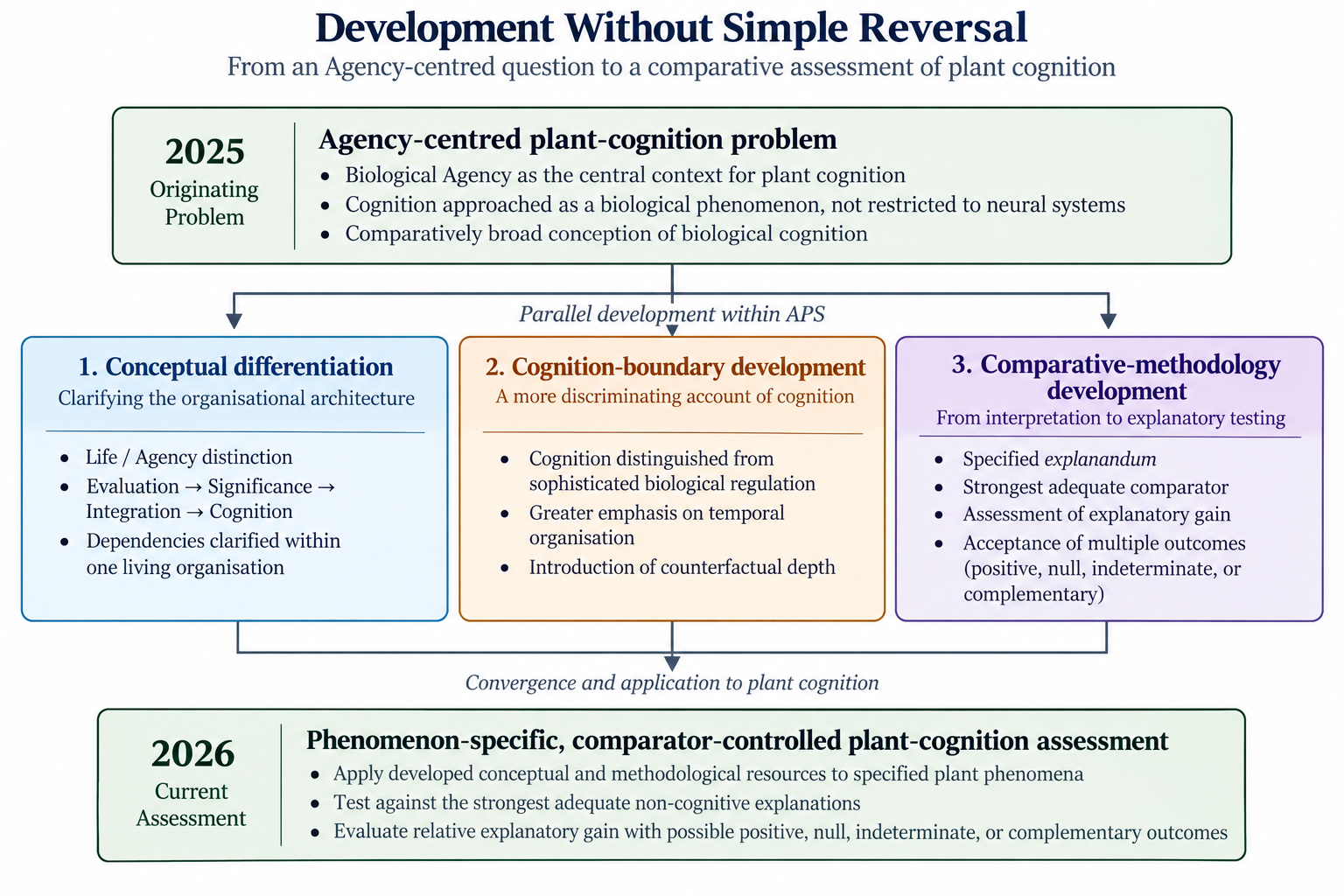
Development without simple reversal. Plant cognition began as an Agency-centred problem for APS. Subsequent conceptual differentiation, cognition-boundary research, and comparative-methodological development proceeded as parallel strands before being brought together in the current phenomenon-specific, comparator-controlled assessment. The arrows indicate historical contribution to the later analytical configuration, not a hierarchy or demonstrated causal sequence.
6. A More Discriminating Boundary for Cognition
The dependency architecture made it possible to distinguish Cognition from earlier forms of viability-oriented organisation. It did not, by itself, determine where the boundary should be placed.
That required a more specific problem: what differentiates cognition from sophisticated biological regulation?
APS minimal-cognition research increasingly focused on this boundary. Immediate responsiveness is insufficient. Fixed regulatory control is insufficient. History-dependent modification or hysteresis is not automatically cognitive. Even retention of prior effects cannot decide the issue if present activity remains exhaustively explainable through fixed or immediate regulatory organisation.
The developing criterion therefore placed greater weight on how biological significance is organised across time and on whether activity is modulated relative to materially available, viability-relevant possibilities rather than merely following a fixed regulatory relation.
This introduces what APS describes as counterfactual depth. The expression does not imply conscious consideration of alternatives or representation of hypothetical futures. It asks whether the organisation of present activity depends on a structured field of possibilities that matters materially to the system, rather than being exhausted by immediate or fixed regulation.
The distinction is particularly important for plants because many candidate phenomena are temporally extended. Stress history can alter later responsiveness. Developmental states can retain consequences of earlier conditions. Priming can modify subsequent responses. Such phenomena establish biologically consequential organisation across time.
They do not automatically establish cognition.
The relevant question becomes whether temporal organisation provides evidence for the organisation of biological significance across viability-relevant possibilities in a way not exhausted by an adequate non-cognitive regulatory account.
Plant cognition was clearly relevant to this developing boundary problem. The historical record does not, however, establish that plant cognition alone—or even primarily—caused APS to formulate counterfactual depth or the later minimal-cognition criterion. Those developments belong to a broader APS cognition research programme and apply across biological cases.
Their importance here lies in what became possible when they were returned to plants: phenomena could now be investigated without either dismissing their complexity or classifying that complexity as cognitive by default.
7. From Interpretation to Comparative Explanation
A second development changed the plant-cognition problem in a different way.
Conceptual architecture asks how a phenomenon can be understood. Comparative explanatory methodology asks what explanatory claim is warranted relative to alternatives.
APS increasingly separated those questions.
A framework may organise observations coherently, connect phenomena that were previously treated separately, or supply a conceptually attractive interpretation. None of those achievements by itself demonstrates additional explanatory capacity.
Comparative explanatory methodology therefore begins with a specified explanandum. The relevant question is not whether APS can describe plants as cognitive, or whether another approach can describe the same phenomena as regulation. The question is what particular biological phenomenon requires explanation and what each candidate account explains about it.
The strongest adequate comparator must then be reconstructed on its own terms. For a proposed case of minimal cognition, this normally means asking whether an adequate non-cognitive account based on regulation, physiological memory, developmental plasticity, signalling, or another materially supported process already explains the target phenomenon.
Only then does a claim of explanatory gain become meaningful.
The operative question becomes:
For this explanandum, relative to the strongest adequate comparator, what additional explanatory contribution is established?
This methodological change has consequences for APS itself. The framework is not entitled to a positive result because a phenomenon can be redescribed successfully in APS terminology. Nor can the architecture of Agency, Evaluation, Significance, Integration, and Cognition guarantee that any particular biological system crosses the cognitive boundary.
A controlled comparison must admit different outcomes. A proposed cognitive explanation may demonstrate bounded explanatory gain. The accounts may prove complementary. No additional gain may be demonstrated. The evidence may remain unresolved. The accounts may turn out not to address sufficiently matched explanatory targets.
Null and adverse results are therefore legitimate outcomes of the method rather than failures to vindicate APS.
There is no basis in the closed historical record for claiming that plant cognition caused APS to develop this comparative methodology. The methodology emerged as a programme-level response to broader problems of comparing biological explanations and research programmes. Its importance to the present history lies in its subsequent application to a problem with which APS had been associated from its originating formulation.
That application changes the status of the question. Plant cognition becomes not only something APS interprets but something against which APS’s own explanatory discipline can be tested.
8. Returning to Plants
When these conceptual and methodological developments are brought together, the plant-cognition problem takes a different form.
The current APS assessment does not ask for a global verdict on whether “plants are cognitive.” It asks whether specified plant phenomena warrant cognitive explanation relative to the strongest adequate non-cognitive account.
This permits an asymmetric result.
Plant Agency is robust. Plants regulate their relations with changing conditions, coordinate distributed activity, and sustain viability through complex physiological, developmental, and ecological organisation.
Biological Evaluation and Significance can also be recognised without thereby settling cognition. Conditions matter differently to plant viability, and plant organisation responds to those differences.
Some phenomena become more interesting near the cognitive boundary. Stress priming and other temporally extended effects can preserve consequences of earlier conditions and alter later activity. Habituation-like findings may be suggestive. Claims of associative learning remain contested.
But the existence of such phenomena does not remove the comparative burden. The question is whether cognitive explanation adds something that an adequate account of regulation, plasticity, physiological memory, or other non-cognitive organisation does not already explain.
The present Core Plant Cognition article therefore distinguishes pre-cognitive, suggestive, cognitively indeterminate, and potentially positive cases rather than inferring cognition from plant complexity as a whole. In the current assessment, no plant phenomenon considered warrants the strongest positive minimal-cognition classification.
That conclusion belongs to the current Core article and should be evaluated there. The significance of the result for the present synthesis is historical and methodological.
APS can now return a null or indeterminate cognitive attribution while continuing to affirm the Agency, Evaluation, Significance, Integration, and biological importance demonstrated by the underlying phenomena.
The framework therefore no longer requires plant cognition to validate the biological insight with which its plant-cognition programme began.
9. What the Plant Case Reveals About APS
The development of APS plant cognition is neither straightforward continuity nor straightforward reversal.
There is continuity in the biological starting point. Agency remains indispensable. Cognition is still approached as a biological phenomenon rather than defined through human capacities, consciousness, or possession of a nervous system. Plant organisation remains scientifically important irrespective of its eventual cognitive classification.
There is differentiation in the conceptual architecture. Life, Agency, Biological Evaluation, Significance, Integration, and Cognition now perform distinguishable explanatory functions. The pathway among them expresses dependencies within one living organisation rather than interchangeable names for increasing complexity.
There is restriction in the cognition boundary. Sophisticated regulation, signalling, integration, temporal retention, and adaptive modulation no longer establish cognition simply by accumulating complexity. Cognitive attribution requires a more discriminating account of how biological significance is organised across time and viability-relevant possibilities.
And there is methodological addition. A coherent APS interpretation is no longer sufficient evidence of explanatory gain. Claims must be attached to specified explananda, tested against adequate comparators, and exposed to outcomes that may be positive, null, adverse, complementary, or unresolved.
Plant cognition brings these developments into unusually clear relation because the biological problem remained recognisable while the framework used to analyse it changed.
That does not show that the 2025 formulation was simply wrong. Nor does it establish that the current formulation is final. A developing research programme may preserve an originating insight while changing the distinctions and evidential requirements through which stronger claims are made.
The important transition is therefore not from taking plants seriously as cognitive organisms to ceasing to take them seriously. It is from asking whether the complexity of plant Agency can support a biologically expanded conception of cognition to asking, phenomenon by phenomenon, whether cognitive explanation provides warranted explanatory gain beyond the strongest adequate account of non-cognitive biological organisation.
This also changes what counts as an informative result.
If a plant phenomenon is adequately explained without cognition, that result helps clarify the boundary between Agency and Cognition. If the evidence remains indeterminate, the uncertainty identifies what additional dependency would need to be demonstrated. If a future case establishes explanatory gain for a cognitive account, APS must be capable of recognising that result without having guaranteed it in advance.
Plant cognition thus remains important to APS for a reason that differs from the role it played at the framework’s public beginning. It is no longer only a domain in which a biologically grounded conception of cognition can be extended beyond familiar neural cases. It is also a domain in which the distinctions and comparative controls of APS can be exposed to a demanding test.
The history therefore illustrates a broader feature of the framework’s development. Increasing conceptual differentiation does not necessarily produce broader explanatory claims. Stronger methodological controls may instead narrow what can responsibly be asserted. In the plant-cognition case, that narrowing preserves rather than diminishes the underlying biological problem: how living organisation comes to evaluate what matters, integrate significance across changing conditions, and, in some cases, organise that significance across time in ways that warrant the further attribution of cognition.
See Also
Related Articles
References
- (2025). Biological Agency as the Context for Plant Cognition. https://doi.org/10.5281/zenodo.16938193
- (2026). Agency as the Defining Activity of Life: A Viability-Oriented Framework Integrating Process and Scale. Biological Theory . https://doi.org/10.1007/s13752-026-00547-6