Human Values
Human values are fundamental to every form of collective life, yet their biological foundations and organisational role remain conceptually fragmented across biology, psychology, anthropology, sociology, and philosophy. Agency–Process–Scale (APS) interprets human values as stable patterns of significance organised through shared evaluation that guide the coordination of collective life. Rather than treating values as arbitrary preferences or timeless moral truths, APS explains them as organisationally real patterns emerging from biological evaluation and becoming stabilised through social organisation. This article establishes the canonical APS account of Human Values and provides the conceptual bridge between Biological Evaluation, Significance, Shared Evaluation, Social Norms, Morality, and Ethics.
Key Points
- Human values are stable patterns of significance organised through shared evaluation.
- Human values originate in biological evaluation through significance.
- Values are organisationally real because they contribute to the coordination of collective life.
- Human values are not reducible to preferences, beliefs, goals, or moral rules.
- Values provide the conceptual bridge between biological organisation and social organisation.
- Shared evaluation explains how values become socially organised.
Introduction: The Problem of Human Values
Human values are among the most influential features of collective life. They shape individual decisions, organise social relationships, influence political institutions, and guide the formation of moral systems. Across cultures and throughout history, values have informed what people regard as desirable, worthwhile, just, or worthy of protection. Yet despite their importance, there is no broadly accepted account of what human values are or how they should be understood within the natural world.
Different disciplines approach values from different perspectives. Psychology often treats values as relatively enduring individual preferences or motivational orientations. Sociology examines how values organise social relationships and institutions. Anthropology investigates the diversity of value systems across cultures, while philosophy asks whether values are objective, subjective, or culturally constructed. Biology has traditionally contributed comparatively little to this discussion, largely because values are often regarded as belonging to the domains of culture, morality, or rational reflection rather than to the organisation of living systems themselves.
These disciplinary perspectives have produced important insights, but they also leave a significant explanatory gap. They describe how values function within particular domains without providing a unified account of why values arise in the first place or how they relate to the organisation of living systems. Consequently, values are frequently treated either as products of individual psychology or as features of social and cultural history, with little explanation of how these perspectives connect.
Agency–Process–Scale (APS) approaches this problem from a different direction. Rather than asking first which values people hold, APS asks what kind of phenomenon a value is. This shifts attention from the specific content of values—such as justice, loyalty, freedom, or equality—to the organisational conditions that make valuing possible. The question is therefore not initially which values are correct, nor why particular societies endorse particular values, but what it means for anything to become valuable within the organisation of living systems.
Within APS, this question begins with biological evaluation. Living systems continuously distinguish conditions that support or undermine their organised persistence. Through biological evaluation, aspects of the world acquire significance in relation to viability-oriented organisation. Human values emerge from this broader evaluative foundation, but they are not reducible to individual biological responses. Instead, they arise when significance becomes organised, communicated, and stabilised within collective life through shared evaluation.
This interpretation neither reduces values to biology nor separates them from it. Human values are understood as organisationally real patterns that depend upon biological agency while emerging through the distinctive forms of coordination that characterise human societies. They therefore occupy the conceptual bridge between the biological organisation of living systems and the social organisation of collective life.
The purpose of this article is to establish this conceptual foundation. It defines human values within the explanatory architecture of APS, clarifies how they arise from biological evaluation and significance, distinguishes them from related concepts such as preferences, norms, morality, and ethics, and prepares the transition to Shared Evaluation, where the social organisation of values is examined in detail.
Human Values as a Biological Phenomenon
At first sight, human values appear to belong exclusively to the domains of culture, morality, or reflective thought. They are commonly associated with ethical commitments, political ideals, religious beliefs, or personal convictions, and are therefore often regarded as phenomena that emerge only after biological explanation has ended. From this perspective, biology may explain the evolution of the human organism, while values are left to psychology, sociology, anthropology, or philosophy.
APS rejects this separation. It argues that although human values possess distinctive social and cultural forms, the capacity to value has biological foundations. The question is therefore not whether human values are biological in the same sense as metabolism or reproduction. Rather, it is whether the activity of valuing can be understood as a natural development of the evaluative organisation already present in living systems.
Throughout APS, biological evaluation refers to the continual activity through which living systems distinguish conditions according to their consequences for organised persistence. Organisms do not merely undergo environmental change; they respond differentially because aspects of their surroundings acquire significance in relation to their continuing viability. Food, shelter, mates, predators, pathogens, and social partners matter biologically because they affect the maintenance and re-establishment of the conditions under which living organisation persists.
This evaluative activity should not be confused with conscious judgement or moral reasoning. Biological evaluation is neither deliberation nor reflection. It is the ongoing organisation of agency through which living systems distinguish what contributes to, or detracts from, their continued viability. As APS has argued elsewhere, significance is generated through this evaluative organisation. What matters to an organism is therefore not imposed from outside but emerges through its own viability-oriented activity.
Human values arise from this biological foundation but cannot be reduced to it. Human beings possess forms of communication, learning, memory, symbolic representation, and collective organisation that enable significance to become socially organised across individuals and generations. Consequently, values are no longer confined to the immediate biological circumstances of individual organisms. They become shared, transmitted, debated, modified, and institutionalised within communities.
This transition does not represent a break between biology and culture. Rather, it marks a change in the organisation of evaluation. Biological evaluation explains how significance arises within living systems. Human values emerge when significance becomes organised through collective processes that stabilise what communities come to regard as important, desirable, or worthy of protection. The distinctive features of human values therefore depend upon the social organisation of evaluation, not upon the abandonment of their biological foundations.
Recognising this continuity is essential to the explanatory architecture of APS. If human values were treated as wholly independent of biological organisation, no coherent account could explain why valuing exists at all or how it emerged during evolution. Conversely, if values were reduced to biological mechanisms alone, their uniquely social and historical organisation would disappear from view. APS instead interprets human values as occupying the transition between these domains. They remain grounded in the evaluative organisation characteristic of living systems while acquiring new forms of organisation through communication, shared evaluation, and collective life.
This biological foundation does not explain which values particular societies adopt, nor does it determine whether those values are morally justified. Those questions belong to later stages of the APS social architecture. The present point is more fundamental. Human values become scientifically intelligible because they develop from an already existing biological capacity to generate significance through evaluation. The remaining sections of this article examine how that significance becomes organised into the stable patterns that constitute human values.
Human Values in APS
Agency–Process–Scale (APS) defines human values as stable patterns of significance organised through shared evaluation that guide the coordination of collective life.
This definition differs from many conventional accounts. Human values are not understood primarily as individual preferences, subjective attitudes, emotional dispositions, or abstract moral principles. Nor are they simply products of culture or historical convention. Instead, APS interprets values as organisationally real patterns that emerge when biological significance becomes stabilised through the collective organisation of evaluation.
Human Values Are Not Preferences
Human values should not be confused with personal preferences.
Preferences may be temporary, individual, and context-dependent. Human values are relatively stable patterns of significance organised through shared evaluation that contribute to the coordination of collective life.
Preferences may express values, but they do not constitute them.
This account builds directly upon the preceding concepts of Biological Evaluation and Significance. Biological evaluation explains how living systems generate significance by distinguishing conditions according to their consequences for organised persistence. Significance therefore identifies what matters to an organism in relation to its continued viability. Human values arise when these patterns of significance become organised beyond the individual through communication, learning, memory, and shared forms of collective life.
Values should therefore be understood neither as isolated psychological states nor as external cultural abstractions. They exist within the organisation of relationships through which communities coordinate activity, establish expectations, resolve conflict, and maintain continuity across generations. Although individuals hold values, values themselves acquire stability only because they are continually reproduced through shared evaluation.
Within APS, values perform an organisational function. They provide relatively stable orientations that enable groups to coordinate behaviour under changing circumstances. In doing so, they reduce the complexity of collective decision-making by identifying what a community treats as important, desirable, worthy of protection, or requiring avoidance. Values therefore contribute to the organisation of collective agency rather than merely expressing individual opinion.
Because values organise significance rather than replace it, they remain open to revision. Human societies continually negotiate, reinforce, contest, and reorganise their values as circumstances change. This capacity for revision does not undermine the reality of values. On the contrary, it reflects their role within living systems that must continually maintain organised persistence under changing environmental and social conditions. Stability and adaptability therefore coexist within the organisation of values.
APS also distinguishes values from several closely related concepts. Values are not equivalent to preferences, which may be transient and individual. They are not identical with norms, which specify expected patterns of behaviour within a community. Nor are they the same as morality or ethics. Morality concerns the organisation of collective judgement concerning how persons ought to be treated, while ethics provides the reflective investigation of moral organisation. Values precede these developments by organising what communities collectively regard as significant before that significance becomes formalised into norms, moral systems, or ethical theories.
Human values therefore occupy a pivotal position within the explanatory architecture of APS. They form the organisational bridge between biological significance and the social institutions through which significance becomes collectively coordinated. Understanding values in this way allows APS to explain both their biological foundations and their distinctive social organisation without reducing one to the other.
The next step is to examine how values become shared. If values are stable patterns of significance organised within collective life, then an explanation is required of the processes through which individual evaluation becomes collectively organised. APS addresses this transition through the concept of Shared Evaluation, which explains how values become coordinated, communicated, stabilised, negotiated, and transformed within social organisation.
Human Values and Collective Life
Human values do not exist simply as private beliefs or internal psychological states. Their biological significance is realised through collective life, where they contribute to the coordination of relationships among individuals and groups. APS therefore interprets values not only as patterns of significance but also as organisational principles that enable societies to maintain coherent forms of collective activity.
Every human community must continually coordinate cooperation, resolve conflict, allocate resources, transmit knowledge, organise responsibilities, and respond to changing environmental and social conditions. These activities cannot be sustained through individual biological evaluation alone. They require relatively stable patterns of shared significance that allow members of a community to anticipate one another’s behaviour, recognise common priorities, and coordinate action across time. Human values provide part of this organisational stability.
Within APS, values contribute to collective organisation because they establish enduring orientations concerning what a community regards as important. They influence decisions without mechanically determining them. Individuals may disagree about the application of particular values, and societies may contest their relative importance, yet values nevertheless provide common reference points around which social coordination can occur. In this sense, values reduce uncertainty by stabilising expectations about what matters within collective life.
Communication plays a central role in this process. Values become socially effective only insofar as they can be expressed, interpreted, transmitted, and reproduced across individuals and generations. Language, symbolic practices, education, ritual, law, and other forms of communication all contribute to maintaining the continuity of shared significance. Through these processes, values become progressively detached from immediate biological circumstances and embedded within the enduring organisation of communities.
This organisation should not be understood as static. Human societies continually reinterpret their values in response to changing circumstances, new knowledge, technological innovation, demographic change, and interactions with other communities. The persistence of values therefore depends not upon immobility but upon their capacity to maintain organisational continuity through adaptive reorganisation. Stability and change are complementary features of living social systems rather than opposing alternatives.
APS consequently interprets values as enabling the coordination of collective agency across multiple spatial and temporal scales. Individuals participate in families, communities, institutions, nations, and wider global relationships, each of which depends upon partially overlapping systems of shared significance. Values therefore contribute to the integration of collective life by organising patterns of coordination that extend well beyond immediate interpersonal interactions.
Importantly, this account does not imply that every value contributes equally to organised persistence or that all socially established values are equally beneficial. Communities may sustain values that become maladaptive, internally contradictory, or sources of conflict under changing conditions. APS therefore distinguishes the organisational existence of values from any judgement concerning their truth, desirability, or moral legitimacy. Explaining how values organise collective life is distinct from evaluating whether particular values ought to be retained.
Understanding values as organisational principles clarifies their place within the broader APS architecture. Biological evaluation generates significance. Human values organise significance within collective life. The next question concerns the processes through which such organisation is achieved. APS addresses this through the concept of Shared Evaluation, which explains how individual patterns of significance become coordinated, communicated, negotiated, and stabilised across communities, thereby providing the immediate foundation for the emergence of social norms.
Human Values, Social Norms, Morality, and Ethics
Human values occupy a distinct position within the explanatory architecture of APS. Although closely related to social norms, morality, and ethics, these concepts perform different explanatory roles. Maintaining these distinctions is essential if each is to contribute clearly to the organisation of biological and social explanation.
Human values organise what a community collectively regards as significant. They provide relatively stable orientations concerning what is considered important, desirable, or worthy of protection. Values therefore concern the organisation of significance rather than the regulation of behaviour itself.
Social norms arise from this organisation of values. Whereas values identify what matters, norms establish expectations concerning how members of a community are expected to behave in relation to those shared values. Norms therefore stabilise collective coordination by providing socially recognised patterns of conduct. They may be expressed formally through laws and institutions or informally through customs, traditions, and everyday practices, but in every case they organise behavioural expectations rather than significance itself.
Morality represents a further stage in this organisational development. Human communities do not merely coordinate behaviour; they also evaluate whether actions, institutions, and relationships ought to be regarded as acceptable or unacceptable in light of the values they collectively organise. Within APS, morality is therefore understood as the organisation of collective moral evaluation. It concerns how communities judge obligations, responsibilities, rights, harms, and legitimate forms of conduct. Morality does not create values but develops from the evaluative organisation already established through values and norms.
Values Are Not Morality
Human values organise what communities collectively regard as significant.
Morality organises collective judgements concerning obligations, responsibilities, rights, harms, and legitimate conduct.
Values therefore provide part of the evaluative foundation from which morality develops, but they are not themselves a moral system. Not everything regarded as valuable has moral status, and explaining the existence of a value does not establish its moral legitimacy.
Ethics occupies a different explanatory role again. Ethics is not itself a system of values or moral rules but the reflective investigation of moral organisation. Ethical inquiry examines how moral systems arise, how they function, how they differ across communities, and how competing moral claims may be understood and evaluated. Ethics therefore belongs to the organisation of explanation rather than to the direct organisation of collective life.
Distinguishing these concepts prevents several common confusions. Values should not be equated with moral principles, because communities may regard many things as valuable without assigning them moral status. Likewise, norms are not identical with values, since similar values may be expressed through different normative practices in different societies. Nor should morality be reduced to ethics, because moral organisation exists independently of philosophical reflection upon it.
These distinctions also clarify the architecture of the APS social branch. Biological evaluation generates significance. Human values organise significance within collective life. Shared evaluation explains how values become collectively stabilised and negotiated. Social norms organise behavioural expectations. Morality organises collective moral judgement. Ethics investigates that moral organisation. Each concept therefore performs a distinct explanatory function while remaining integrated within a single organisational framework.
This progressive organisation allows APS to explain increasing forms of social complexity without abandoning the biological foundations established earlier in the framework. Human values thus occupy the pivotal transition between biological significance and the wider organisation of collective life, providing the conceptual foundation upon which norms, morality, and ethics are subsequently constructed.
Human Values within the APS Architecture
Agency–Process–Scale (APS) is organised as a progressively integrated explanatory framework in which each concept performs a distinct organisational role while preparing the conditions for those that follow. Human Values occupy a pivotal position within this architecture because they explain how biologically generated significance becomes organised within collective life. They therefore provide the conceptual bridge between the biological and social domains of the framework.
The preceding articles establish this progression. Life is understood as viability-oriented, constraint-closed organisation. Biological agency enacts and sustains that organisation through ongoing activity. Biological evaluation continuously distinguishes conditions according to their consequences for organised persistence, thereby generating significance. Human Values extend this architecture by explaining how significance becomes stabilised within communities as relatively enduring patterns that guide collective coordination.
This position is neither arbitrary nor merely classificatory. Each transition within APS introduces a new organisational problem requiring explanation. Biological evaluation explains how individual organisms generate significance, but it does not by itself explain how multiple individuals come to coordinate that significance across families, communities, or societies. Human Values address this explanatory gap by identifying the stable patterns of shared significance that make collective organisation possible.
Human Values are therefore not the endpoint of the social branch but its point of departure. Once values exist as collectively organised patterns of significance, further organisational developments become possible. Shared Evaluation explains how those values are communicated, negotiated, reinforced, and modified through interaction. Social Norms stabilise expectations concerning behaviour. Social Organisation coordinates the activities of multiple agencies through institutions and enduring social structures. Moral Evaluation examines how collective actions affect others who possess moral standing. Morality organises those evaluations into relatively stable systems of judgement, while Ethics investigates their organisation through reflective inquiry.
Seen in this way, the social architecture of APS is not a sequence of isolated concepts but an increasingly differentiated organisation of collective evaluation. Each concept presupposes those preceding it while introducing new explanatory questions of its own. Human Values are indispensable within this progression because they explain the emergence of stable collective significance without conflating biological evaluation with social institutions or moral reasoning.
This architectural position also clarifies the relationship between continuity and novelty. Human Values remain continuous with the biological organisation of living systems because they ultimately derive from significance generated through biological evaluation. At the same time, they introduce genuinely new forms of organisation through communication, symbolic representation, cultural transmission, and collective coordination. APS therefore explains the emergence of social organisation without invoking a discontinuity between biology and culture or reducing one to the other.
Understanding Human Values within the broader APS architecture also clarifies the role of subsequent articles in the Social Organisation cluster. The present article establishes what human values are. Shared Evaluation explains how values become collectively organised. Social Norms explain how those organised values stabilise behavioural expectations. The remaining articles progressively investigate the increasingly complex forms of organisation that emerge from this foundation. The architecture therefore functions as an integrated explanatory framework rather than as a collection of independent concepts.
By locating Human Values within this progression, APS provides a coherent account of their explanatory role. Values are neither isolated psychological preferences nor abstract moral ideals. They are organisationally real patterns through which biological significance becomes coordinated within collective life, making possible the subsequent development of norms, institutions, morality, and ethics. Their position within the architecture reflects the distinctive explanatory work they perform in connecting the organisation of living systems with the organisation of human societies.
Explanatory Architecture within APS
The following summary locates Human Values within the broader explanatory architecture of APS and indicates the concepts upon which it depends and those that it prepares.
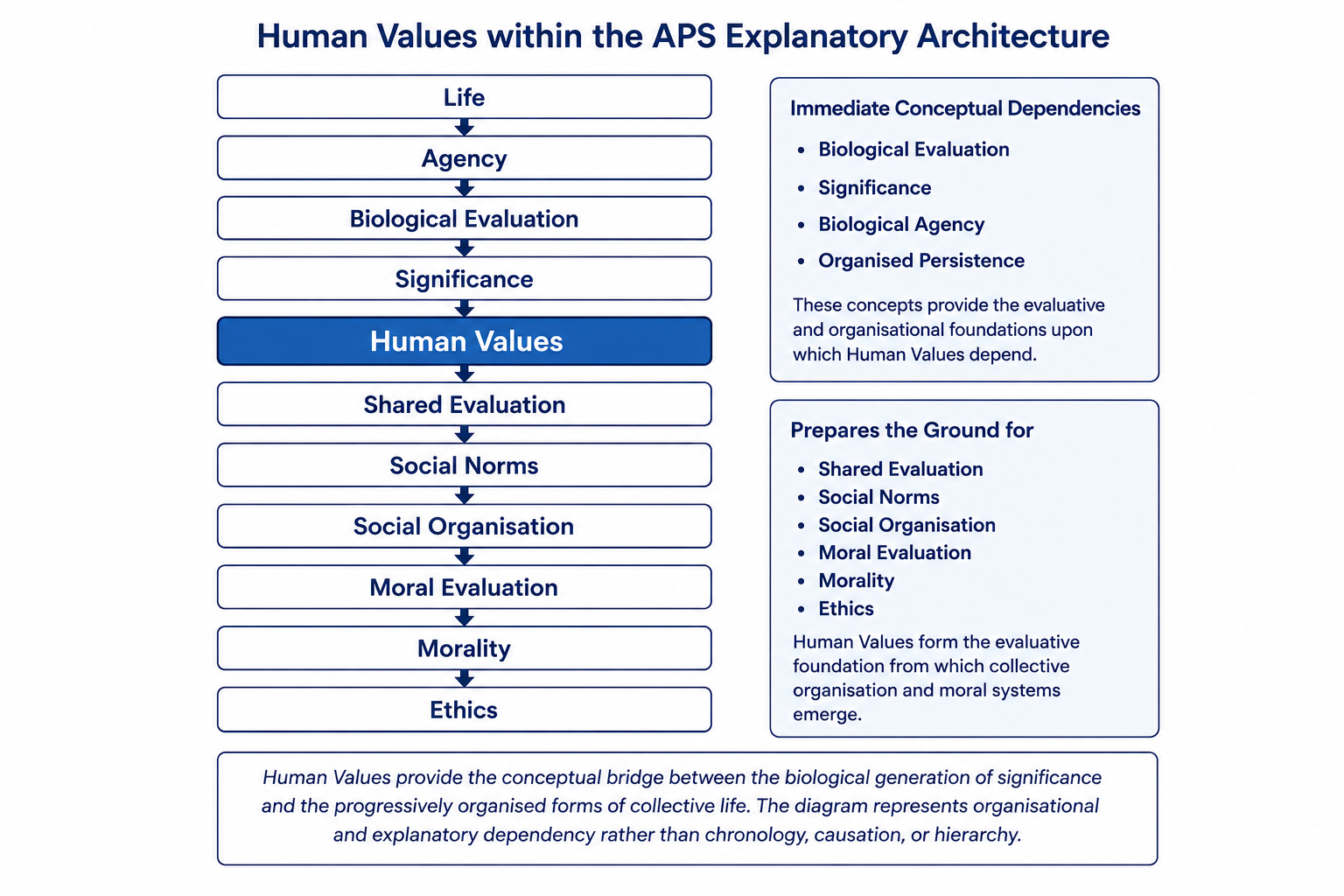
Human Values occupy the transition between the biological and social branches of the APS explanatory architecture. Biological Evaluation generates significance within living systems. Human Values organise that significance within collective life, thereby establishing the foundation upon which Shared Evaluation, Social Norms, Social Organisation, Moral Evaluation, Morality, and Ethics progressively develop. The diagram represents an explanatory architecture rather than a chronological sequence, causal chain, or hierarchy.
Central Question
What are human values, and how do they emerge from biological evaluation while organising collective life?
Architectural Role
This article establishes Human Values as stable patterns of significance organised through shared evaluation that guide the coordination of collective life. It explains how values provide the conceptual bridge between biological significance and social organisation, thereby preparing the foundation for Shared Evaluation, Social Norms, Social Organisation, Moral Evaluation, Morality, and Ethics.
Immediate Conceptual Dependencies
- Biological Evaluation
- Significance
- Communication
- Coordination
Immediate Conceptual Consequences
- Shared Evaluation
- Social Norms
- Social Organisation
- Moral Evaluation
- Morality
- Ethics
Distinguishes
- Biological Evaluation
- Significance
- Preferences
- Social Norms
- Morality
- Ethics
Related Explanatory Questions
- What are human values?
- How do human values emerge from biological evaluation?
- Why are human values organisationally real?
- How do human values coordinate collective life?
- How do human values differ from social norms?
- How do human values provide the foundation for morality?
Position within APS
This is an Anchor article within the Social Organisation cluster. It establishes the canonical APS understanding of Human Values and provides the conceptual bridge between the biological organisation of significance and the social organisation of collective life.
Corpus Significance
Together with Biological Evaluation, Significance, and Shared Evaluation, this article establishes the conceptual foundation of the APS social branch. It explains how biologically generated significance becomes organised within communities, thereby making possible the subsequent emergence of social norms, social organisation, moral evaluation, morality, and ethics.
Conclusion
Human values have traditionally been examined from the perspectives of psychology, anthropology, sociology, philosophy, and political theory. Each discipline has illuminated important aspects of valuing, yet no single account has satisfactorily explained how values relate to the organisation of living systems while also recognising their distinctive role within collective life. APS addresses this gap by situating human values within a unified explanatory architecture that connects biological organisation with social organisation.
This article has argued that human values are neither arbitrary cultural inventions nor timeless moral truths. Nor are they reducible to individual preferences, emotional dispositions, or biological mechanisms alone. Instead, APS interprets human values as stable patterns of significance organised through shared evaluation that guide the coordination of collective life. This definition preserves both their biological foundations and their distinctive social organisation without collapsing one into the other.
The argument has developed progressively through the conceptual architecture of APS. Biological evaluation explains how living systems generate significance through viability-oriented organisation. Human values emerge when that significance becomes organised collectively into relatively enduring orientations that coordinate social life. Values therefore represent a new level of organisational complexity while remaining continuous with the evaluative organisation characteristic of living systems.
This interpretation also clarifies the relationship between human values and adjacent concepts within the APS framework. Values organise collective significance. They do not themselves explain how significance becomes socially stabilised, how behavioural expectations are established, or how moral judgements are formed. Those questions belong respectively to Shared Evaluation, Social Norms, Morality, and Ethics. By distinguishing these explanatory roles, APS provides a coherent architecture in which each concept performs a specific organisational function while contributing to an integrated understanding of collective life.
Human values therefore occupy a pivotal position within APS. They provide the conceptual bridge between biological significance and the wider organisation of human societies. Without values, there is no coherent account of how biological evaluation becomes socially organised. Without this transition, the emergence of social norms, institutions, morality, and ethical reflection cannot be explained within a unified framework.
The next stage of this architecture concerns the organisation of values themselves. Human communities do not simply possess values; they continually communicate, negotiate, reinforce, contest, and transform them through collective activity. APS explains this transition through the concept of Shared Evaluation, which investigates how individual patterns of significance become organised into the enduring structures that sustain collective life.
Human values thus represent not the culmination of the APS social architecture but its point of departure. They establish the organisational foundation from which increasingly complex forms of social coordination emerge, providing the essential link between the organisation of living systems and the organisation of human societies.
The next article, Shared Evaluation, explains how individually generated significance becomes collectively organised into the enduring patterns that sustain human values and prepare the emergence of social norms.
See Also
Related Articles
References
- (2009). Defining Agency: Individuality, Normativity, Asymmetry, and Spatio-temporality in Action. Adaptive Behavior, 17(5), 367–386 . https://doi.org/10.1177/1059712309343819
- (2009). Darwinian Populations and Natural Selection. Oxford University Press. https://doi.org/10.1093/acprof:osobl/9780199552047.001.0001
- (2015). The Secret of Our Success: How Culture Is Driving Human Evolution, Domesticating Our Species, and Making Us Smarter. Princeton University Press.
- (2015). Biological Autonomy: A Philosophical and Theoretical Enquiry. Springer. https://doi.org/10.1007/978-94-017-9837-2
- (2026). Agency as the Defining Activity of Life: A Viability-Oriented Framework Integrating Process and Scale. Biological Theory . https://doi.org/10.1007/s13752-026-00547-6