Cultural Organisation
Culture is often understood as a collection of beliefs, values, customs, symbols, or traditions. APS adopts a broader organisational perspective. Culture is a socially distributed form of organised persistence through which coordinated activities, meanings, practices, and expectations are stabilised and transmitted across generations. Cultural organisation extends continuity beyond the lifespan of individual organisms by preserving and reproducing forms of coordination that contribute to collective persistence. This article develops an APS account of culture as a continuity architecture emerging from communication, normativity, and symbolic coordination.
Key Points
- Culture is a socially distributed form of organised persistence.
- Cultural organisation emerges from communication, norms, and symbolic coordination.
- Culture stabilises and reproduces coordinated activity across generations.
- Cultural systems preserve practices, meanings, expectations, and accumulated knowledge.
- Culture extends continuity beyond individual organisms and immediate interactions.
- Cultural organisation provides the foundation for institutions and many forms of technology.
Introduction
Culture is among the most influential and widely discussed concepts in the human sciences. It is frequently described as a collection of beliefs, values, traditions, customs, symbols, practices, or forms of knowledge shared within a community. While these descriptions capture important aspects of culture, they often leave a deeper explanatory question unanswered.
Why does culture exist?
What organisational role does culture perform?
APS approaches these questions from a different perspective. Rather than beginning with beliefs, ideas, values, or symbolic contents, APS begins with organised persistence. Living systems must continually maintain viability through time. Social organisation extends this persistence through coordination among multiple organisms. Communication, norms, and symbolic systems allow coordination to become increasingly stable, reproducible, and transmissible.
Culture emerges from this process.
APS therefore interprets culture not primarily as a collection of ideas but as a socially distributed form of organised persistence.
The central claim of this article is:
Culture is socially distributed organised persistence.
Culture preserves coordinated activity beyond the lifespan of particular individuals. It stabilises meanings, practices, expectations, and forms of knowledge that contribute to continuity across generations. Through culture, social organisation acquires forms of persistence that exceed the capacities of immediate interaction alone.
Culture is therefore one of the most important continuity architectures within the social domain.
Why Culture Exists
Social coordination creates opportunities for persistence beyond the individual organism. Through communication, organisms can influence one another’s behaviour. Through norms, expectations become stabilised. Through symbolic systems, meanings can be preserved and transmitted. Together, these processes allow increasingly durable forms of collective activity to emerge.
However, coordination alone is insufficient to sustain continuity across generations.
Individuals die. Groups change. Environments fluctuate. Knowledge can be lost. Practices can disappear. Social systems therefore face a fundamental organisational challenge: how can continuity be maintained despite continual turnover among participants?
Culture provides a solution.
By preserving and transmitting coordinated patterns of activity, culture allows social systems to maintain forms of organisation that persist beyond the individuals who temporarily participate in them. What is preserved varies enormously across different cultural systems, but commonly includes:
- behavioural practices
- symbolic systems
- skills and techniques
- social expectations
- accumulated knowledge
- shared forms of meaning
- systems of classification
- collective identities
The specific contents differ from one culture to another. Their organisational significance, however, is remarkably consistent.
Culture contributes to continuity.
It preserves organisational resources that would otherwise disappear with the individuals who possess them. Through cultural organisation, social systems acquire the capacity to reproduce successful forms of coordination across time.
APS therefore explains culture not as an accidental by-product of social life but as an organisational mechanism through which coordinated persistence becomes possible across extended historical periods.
From Symbolic Coordination to Culture
Culture emerges from processes already established in communication, normativity, and symbolic coordination.
Communication allows organisms to influence one another’s behaviour. Norms stabilise expectations concerning how behaviour should be organised. Symbolic systems preserve and transmit meanings beyond immediate interactions. Together, these processes create the conditions under which coordinated activities can persist through time.
As symbolic systems become increasingly stable, practices become reproducible.
As practices become reproducible, behavioural patterns can be transmitted.
As transmission becomes reliable, continuity can extend across generations.
At this point, culture begins to emerge.
Culture is therefore not an independent domain added to social organisation. Rather, it is the continuation and stabilisation of coordinated activity through time. It represents the point at which communication, norms, and symbolic systems become sufficiently organised to support enduring forms of collective continuity.
This perspective helps explain why cultural systems often exhibit remarkable persistence. Practices may survive for centuries. Narratives may persist across generations. Knowledge may accumulate over long historical periods. Institutions may inherit symbolic structures established long before their current participants were born.
Culture functions as a mechanism through which continuity becomes historically extended.
APS therefore interprets culture as a major development within social continuity architecture. Through cultural organisation, coordinated activity becomes increasingly durable, transmissible, and capable of operating across much longer timescales than immediate interaction alone.
Culture as Organised Persistence
APS defines cultural organisation as the socially distributed arrangement of practices, meanings, expectations, knowledge, and symbolic systems through which coordinated activity is preserved and reproduced across time.
This definition shifts attention away from culture as an inventory of contents and toward culture as an organisational process.
The central question therefore becomes:
How does culture contribute to organised persistence?
The answer lies in culture’s capacity to preserve coordination.
Cultural systems maintain behavioural patterns. They stabilise symbolic meanings. They preserve accumulated knowledge. They support social learning. They facilitate cooperation among individuals who may never directly encounter one another. Most importantly, they provide continuity despite continual demographic turnover.
Culture therefore functions as a continuity architecture.
Just as biological organisation maintains viability within organisms, cultural organisation maintains continuity within social systems. The persistence of culture does not depend upon any single individual. Instead, continuity becomes distributed across networks of practices, meanings, relationships, artefacts, institutions, and symbolic systems.
This distributed character is one of culture’s most distinctive organisational features.
Culture persists because participation in cultural systems continually reproduces the conditions required for their continuation.

Cultural Organisation as Socially Distributed Organised Persistence. Communication enables coordination, norms stabilise expectations, and symbolic systems preserve meanings. Culture emerges when these processes become sufficiently organised to maintain continuity across generations, allowing coordinated activity to persist beyond individual participants.
APS therefore interprets culture not primarily as a repository of beliefs or traditions but as an organisational system through which continuity is preserved, reproduced, and transformed across time.
Cultural Organisation and Social Learning
One of the most important mechanisms through which culture maintains continuity is social learning.
Organisms do not need to rediscover every behaviour, skill, technique, or form of knowledge independently. Instead, they can acquire organisational resources from others. Through observation, imitation, instruction, participation, apprenticeship, and symbolic communication, individuals inherit cultural capacities already developed within a community.
This process dramatically expands the continuity available to social systems.
Knowledge accumulates rather than disappearing with individual participants. Practices become refined through repeated transmission. Techniques improve through collective experience. Coordination becomes increasingly sophisticated as organisational resources are preserved and shared across generations.
The result is not merely the transmission of information but the transmission of organised ways of acting within the world.
APS therefore interprets social learning as one of the principal mechanisms through which cultural continuity is achieved. Social learning allows the persistence of practices, skills, expectations, and forms of knowledge that would otherwise need to be repeatedly rediscovered.
Through social learning, organised persistence becomes increasingly distributed across populations and generations.
Culture thereby extends continuity beyond biological inheritance alone.
Culture Across Scales
Cultural organisation operates across multiple scales.
At relatively small scales, culture stabilises interactions among families, friendship networks, local communities, and social groups. Shared practices and expectations help coordinate behaviour within everyday social life.
At larger scales, cultural systems coordinate activities across populations that may be geographically dispersed and historically separated. Shared languages, traditions, educational systems, and symbolic frameworks allow individuals to participate in coordinated activities without requiring direct personal interaction.
At still larger scales, cultural traditions can persist across centuries or even millennia. Cultural systems may continue shaping patterns of behaviour long after the circumstances of their origin have disappeared. Religious traditions, scientific practices, legal customs, and systems of classification often display this remarkable temporal reach.
This multiscale character is one of culture’s most important organisational features.
A learned practice may influence a single interaction.
A cultural tradition may influence generations.
A symbolic system may coordinate entire populations.
A body of accumulated knowledge may shape civilisations.
The persistence of culture therefore extends far beyond immediate social interactions.
Culture allows continuity to operate across scales that would otherwise be inaccessible to direct communication or individual learning alone. Through cultural organisation, coordinated activity becomes capable of spanning large populations, long historical periods, and multiple domains of social life.
APS consequently treats scale as a fundamental dimension of cultural organisation. Understanding culture requires understanding how continuity is maintained across multiple interacting temporal, spatial, and social domains.
Cultural Organisation and Collective Memory
One of the most important consequences of cultural organisation is the emergence of collective memory.
Individual organisms possess limited lifespans and limited capacities for retaining knowledge. Without mechanisms for preserving experience beyond individual lives, social systems would continually lose organisational resources accumulated through past activity.
Culture helps solve this problem.
Practices, narratives, classifications, traditions, symbolic systems, and forms of knowledge preserve information about successful patterns of coordination. These organisational resources remain available even as individual participants are replaced by new generations.
APS therefore interprets collective memory not as a stored record of the past but as an ongoing organisational process.
Communities continually reproduce memories through participation in cultural practices. Knowledge persists because social systems maintain the conditions under which that knowledge can be transmitted, interpreted, and applied. Collective memory therefore depends upon ongoing activity rather than passive storage.
This perspective aligns collective memory with the broader APS account of organised persistence. Memory is not merely preserved. It is continually regenerated through participation in continuity-preserving systems of coordination.
Collective memory thus contributes directly to organised persistence.
It allows continuity to extend beyond the biological lifespan of individual organisms and provides social systems with access to organisational resources accumulated across previous generations.
Through collective memory, the past remains organisationally active within the present.
Cultural Organisation and Institutions
Culture provides much of the foundation upon which institutions emerge.
Institutions depend upon relatively stable expectations, shared meanings, and enduring patterns of coordination. Such conditions do not arise spontaneously. They are typically established and maintained through cultural organisation, which preserves the symbolic and normative resources required for collective activity to remain coherent through time.
Cultural systems preserve normative expectations. They maintain symbolic frameworks. They reproduce shared understandings concerning social roles, responsibilities, identities, obligations, and practices. These forms of continuity create the organisational stability required for institutions to develop and persist.
Institutions therefore do not emerge independently of culture.
Rather, institutions can be understood as highly stabilised forms of cultural organisation. Many institutional structures inherit symbolic systems, normative expectations, and patterns of coordination already established within broader cultural traditions. Educational institutions inherit cultural understandings concerning learning. Legal institutions inherit cultural expectations concerning responsibility and authority. Scientific institutions inherit symbolic systems and practices developed through earlier forms of cultural coordination.
APS consequently interprets institutions as specialised continuity architectures emerging from cultural organisation.
Culture provides the continuity.
Institutions formalise and stabilise that continuity.
This perspective helps explain why institutions often display remarkable historical persistence. Although particular participants come and go, institutions continue because the cultural systems that sustain them remain sufficiently stable to reproduce coordinated expectations across generations.
Culture therefore supplies many of the organisational foundations upon which institutional continuity depends.
Cultural Organisation and Technology
Technology both depends upon and transforms cultural organisation.
Technologies preserve cultural knowledge, extend communication, stabilise symbolic systems, support learning, and expand the capacity of social systems to maintain continuity through time. In this sense, technologies frequently function as important components of cultural continuity architecture.
Writing provides one of the clearest examples.
Through writing, symbolic coordination can persist independently of immediate interaction. Knowledge becomes more durable. Practices become more reproducible. Collective memory becomes increasingly stable. Organisational resources that would otherwise disappear with particular individuals can be preserved and transmitted across generations.
Many other technologies perform similar functions. Maps preserve spatial knowledge. Numerical systems support economic coordination. Printing expands the distribution of cultural information. Digital systems dramatically increase the scale and speed with which symbolic resources can be preserved and shared.
Technology therefore contributes directly to organised persistence.
At the same time, technologies transform culture itself. New technologies alter patterns of communication, learning, coordination, memory, and social organisation. They create new possibilities for continuity while also reshaping existing cultural systems.
Culture and technology therefore co-evolve.
APS interprets this relationship as an interaction between different forms of continuity architecture, each contributing to the maintenance and transformation of organised persistence across time.
Technological systems are not external additions to culture. They increasingly become part of the mechanisms through which cultural continuity is preserved, reproduced, and extended.
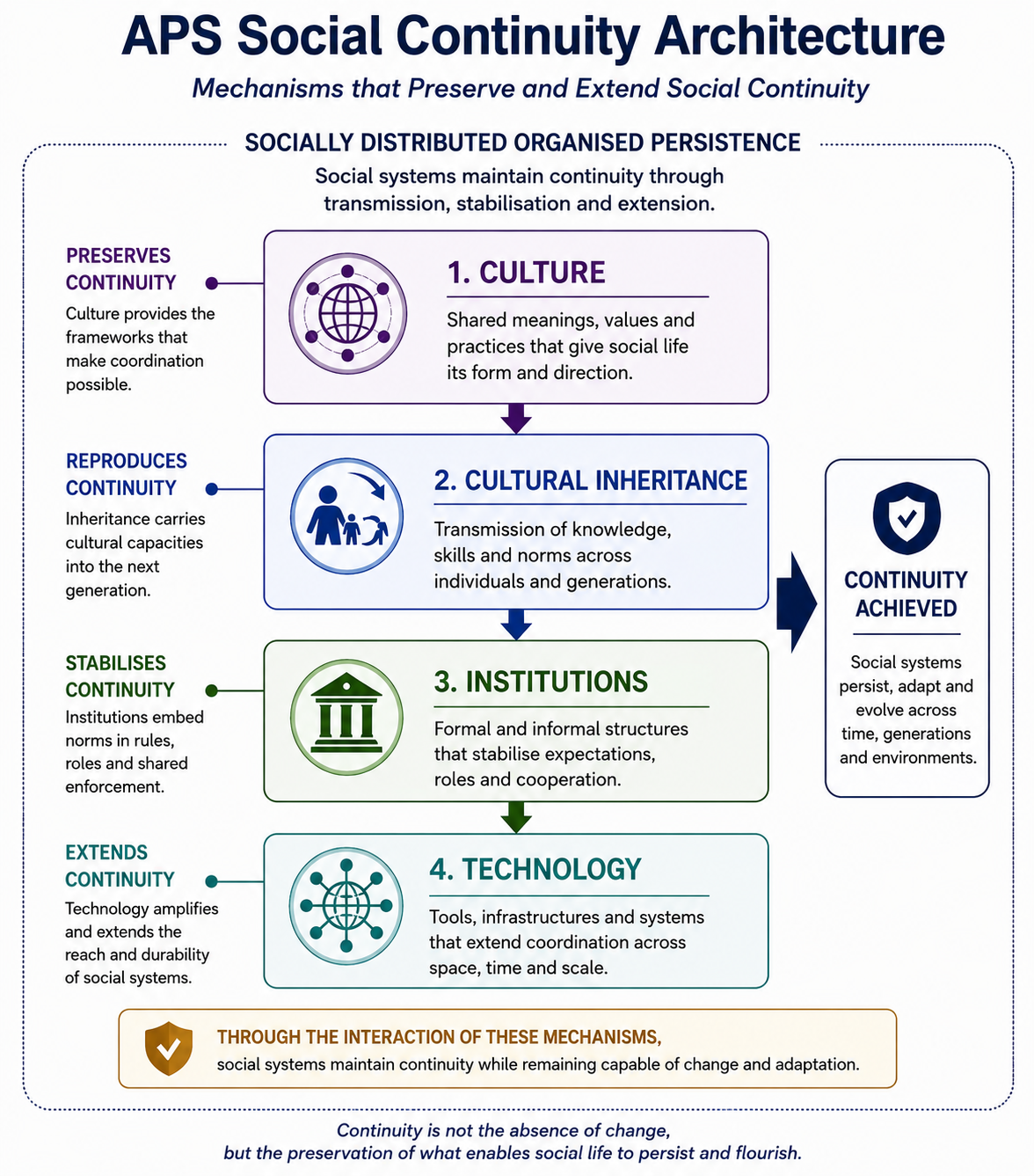
Cultural Continuity and Organised Persistence. Cultural organisation preserves practices, meanings, expectations, and forms of knowledge across generations. Through social learning, collective memory, institutions, and technology, culture extends continuity beyond individual organisms and supports socially distributed organised persistence.
Why Culture Matters
Culture is one of the most powerful mechanisms through which organised persistence extends beyond individual organisms.
It preserves practices. It stabilises meanings. It supports social learning. It maintains collective memory. It enables the accumulation of knowledge. It provides much of the continuity required for institutions and technologies to emerge.
Most importantly, culture allows coordinated activity to persist across generations.
APS therefore interprets culture not primarily as a collection of beliefs, values, customs, or traditions, but as a socially distributed form of organised persistence. Culture extends continuity through time by preserving organisational resources that remain available beyond the lifespan of individual participants.
Through culture, coordination becomes historically extended.
Through historical continuity, increasingly complex forms of social organisation become possible.
This perspective helps explain why culture occupies such a central position within the APS account of social life. Culture is not a secondary feature added to already-existing social systems. Rather, it is one of the principal mechanisms through which social organisation preserves and reproduces itself through time.
Culture allows continuity to become socially distributed, historically extended, and increasingly independent of particular individuals while remaining dependent upon ongoing participation in collective forms of life.
Where to Go Next
Cultural organisation explains how coordinated activity becomes socially distributed and historically extended.
To explore the next stages of this continuity architecture:
- read Social Organisation for the foundations of coordinated organised persistence
- explore Communication and Coordination for the mechanisms through which coordination emerges
- read APS and Norms to understand how expectations become stabilised
- explore Symbolic Coordination to examine the emergence of shared symbolic systems
- read Cultural Inheritance for a detailed account of how continuity is transmitted across generations
- explore Institutions to understand how cultural continuity becomes formalised and stabilised
- read Technology to examine how continuity architectures become increasingly externalised and extended
Culture is not merely something that societies possess.
It is a continuity architecture through which social organisation preserves, reproduces, and transforms itself across time.
Communication enables coordination.
Norms stabilise coordination.
Symbols preserve coordination.
Culture reproduces coordination.
Through culture, organised persistence becomes socially distributed, historically extended, and capable of supporting increasingly complex forms of collective life across generations.
See Also
Related Articles
References
- (1985). Culture and the Evolutionary Process. University of Chicago Press.
- (1922). Human Nature and Conduct. Henry Holt.
- (2018). Everything Flows: Towards a Processual Philosophy of Biology. Oxford University Press.
- (1973). The Interpretation of Cultures. Basic Books.
- (2016). The Secret of Our Success. Princeton University Press.
- (2026). Agency as the Defining Activity of Life: An Organisational Account of Biological Agency. Biological Theory . https://doi.org/10.1007/s13752-026-00547-6
- (2012). The Evolved Apprentice. MIT Press.