Is Evolution Random?
Evolution is often described as either random or non-random, yet this distinction can be misleading. In APS, evolution is understood as the historical transformation of organised persistence through interactions among inheritance, variation, adaptation, fitness, and natural selection. This article explains why evolutionary change cannot be adequately understood as either pure chance or predetermined design.
Key Points
- Evolution is not adequately described as either random or non-random.
- Inheritance reproduces continuity before evolutionary novelty emerges.
- Variation introduces novelty but operates within inherited continuity.
- Adaptation, fitness, and natural selection constrain evolutionary possibilities.
- APS interprets evolution as the historical transformation of organised persistence.
Introduction
Where this article fits: Evolution is often described as either random or non-random, but this distinction can be misleading. APS treats evolution as the historical transformation of organised persistence through interactions among inheritance, variation, adaptation, fitness, and natural selection. This article explains why evolutionary change cannot be adequately understood as either pure chance or predetermined design.
One of the most common questions in biology is whether evolution is random. The question appears straightforward, yet it has generated persistent confusion both within public discussions of evolution and within evolutionary education. Some accounts describe evolution as a fundamentally random process driven by accidental genetic changes. Others emphasise natural selection and conclude that evolution is therefore non-random. Both descriptions capture important aspects of evolutionary change, yet neither provides a complete account of how evolution operates.
Part of the difficulty arises because the word random is used in several different ways. Sometimes it refers to unpredictability. Sometimes it refers to chance events. Sometimes it is used to mean unconstrained, purposeless, or lacking direction altogether. These meanings are not equivalent, and evolutionary processes may satisfy some of them while failing to satisfy others. As a result, discussions about whether evolution is random often combine distinct questions that require different answers.
APS approaches the issue from a different perspective. Rather than asking whether evolution is random in general, APS asks how continuity, novelty, viability, fitness, and selection interact within evolutionary transformation. From this perspective, evolution is neither pure chance nor predetermined design. It is the historical transformation of organised persistence through time.
Understanding evolution therefore requires more than identifying which parts are random and which are not. It requires understanding how inherited continuity, emerging novelty, adaptation, differential continuity, and natural selection together shape the ongoing transformation of living organisation. APS consequently treats the question of randomness as one aspect of a larger evolutionary architecture rather than as the defining feature of evolution itself.
Why the Question Is Difficult
The question “Is evolution random?” is difficult because it compresses several different questions into a single phrase. A person asking the question may be asking whether mutations occur by chance, whether adaptation is accidental, whether natural selection has direction, whether evolutionary history could have unfolded differently, or whether evolution ultimately lacks purpose. These are distinct issues that cannot be resolved by a single yes-or-no answer.
Much of the confusion surrounding evolutionary randomness arises from treating all forms of contingency as equivalent. A process may contain contingent elements while still exhibiting strong patterns, constraints, and regularities. Weather systems, for example, contain unpredictable components while remaining governed by identifiable physical processes. Similarly, evolutionary change may involve contingent events without becoming entirely unconstrained or arbitrary.
The opposite mistake is equally problematic. Recognising that evolution exhibits recurring patterns does not imply that evolution proceeds toward predetermined goals or inevitable outcomes. Evolutionary history depends upon countless interactions among organisms, environments, and historical circumstances. Different conditions can produce different outcomes even when similar processes are operating.
APS therefore treats randomness as only one aspect of evolutionary explanation. Evolutionary change involves both contingency and constraint. Novelty emerges under particular historical conditions, yet that novelty must operate within the organisational requirements of viable persistence. Understanding evolution requires examining how these elements interact rather than asking whether one of them alone characterises the entire process.
The central question is therefore not whether evolution is random in general. The more informative question is how contingency and organisation interact in the transformation of organised persistence through time.
Evolution Begins with Inheritance
Discussions of evolutionary randomness often begin with mutation or variation. APS begins elsewhere. Evolution begins with inheritance because inheritance reproduces the continuity upon which all evolutionary change depends.
Without inheritance there would be no enduring continuity linking one generation to the next. Novelty would have no stable context within which to emerge, accumulate, or transform. Evolution therefore presupposes continuity before it can generate change. The persistence of lineages through time provides the historical framework within which evolutionary processes operate.
Inheritance occupies a foundational position within the APS evolutionary architecture because it reproduces organised persistence across generations. Developmental capacities, physiological organisation, behavioural tendencies, and countless other features of living systems are transmitted through inherited continuity. This continuity does not eliminate evolutionary change. Rather, it provides the stability that makes change possible.
Recognising the priority of inheritance helps clarify why evolution cannot be understood as pure randomness. Randomness alone does not generate enduring evolutionary trajectories. Evolution requires continuity capable of persisting through time while remaining open to transformation. Inheritance supplies this continuity by reproducing the organisational capacities upon which future evolutionary change depends.
APS therefore begins evolutionary explanation with continuity rather than novelty. Evolution is not the replacement of order by chance. It is the transformation of existing organised persistence through historical time.
Variation and the Emergence of Novelty
If inheritance provides continuity, variation provides novelty. Evolutionary transformation becomes possible because inherited continuity is not reproduced with perfect uniformity across generations. Novel differences emerge within ongoing lineages, creating opportunities for evolutionary change.
Variation is often described as random, and in some respects this description is appropriate. Novel variations do not arise because organisms anticipate future adaptive needs or consciously direct evolutionary outcomes. Variation introduces possibilities whose future significance may be unknown at the moment they emerge. In this sense, evolutionary novelty contains contingent elements.
Yet variation should not be equated with unrestricted randomness. Novelty emerges within already existing systems of organised persistence. Developmental organisation, physiological constraints, inherited structures, ecological conditions, and historical circumstances all influence which forms of variation are possible and which are not. Variation therefore occurs within a framework of continuity and constraint rather than in the absence of organisation.
This distinction is important because discussions of randomness often focus exclusively on the origin of novelty while overlooking the organisational context within which novelty appears. Variation does not emerge from nowhere. It arises within evolving lineages whose inherited organisation both enables and constrains future possibilities. The space of evolutionary novelty is therefore structured by the continuity from which it emerges.
APS consequently treats variation as the emergence of novelty within organised persistence. Novelty may be contingent, but it is not unconstrained. Evolutionary possibilities remain shaped by the inherited organisation of living systems and by the historical conditions within which those systems persist and transform.
Adaptation and Viability
Variation alone does not explain evolution. If every novelty persisted equally, evolutionary change would resemble an accumulation of arbitrary differences rather than the transformation of organised persistence. APS therefore places adaptation at the centre of evolutionary explanation because adaptation determines whether novelty can become integrated into viable organisation.
Adaptation concerns the relationship between variation and viability. Novel traits, structures, behaviours, or organisational arrangements contribute to evolutionary continuity only if they can be incorporated into systems capable of maintaining persistence through time. Variations that undermine viability tend to disappear with the systems that express them, whereas variations compatible with viable persistence may become established within evolving lineages.
This relationship introduces an important source of evolutionary structure. Not all forms of change are equally possible because living systems must continue to maintain the conditions required for their own existence. Viability therefore acts as a powerful constraint on evolutionary transformation. Evolutionary possibilities remain shaped by the organisational requirements of persistence itself.
Adaptation should not be understood as a process moving organisms toward predetermined goals. Rather, it reflects the fact that novelty is continually evaluated through its consequences for persistence. Organisational arrangements that contribute to viability can become stabilised within evolving lineages, while those that undermine persistence tend not to endure. Evolutionary change is therefore constrained by the realities of living organisation even when the specific directions of change remain historically contingent.
APS consequently treats adaptation as a bridge between novelty and continuity. Variation introduces new possibilities, but adaptation determines whether those possibilities can become integrated into viable forms of organised persistence. Evolutionary transformation therefore reflects not merely the generation of novelty but the successful incorporation of novelty into living systems capable of enduring through time.
Fitness and Differential Continuity
The concept of fitness is often introduced as a measure of reproductive success, yet APS interprets fitness more broadly as a feature of differential continuity. Fitness concerns the relative capacity of alternative forms of organised persistence to continue through time under particular conditions.
This interpretation helps clarify why evolutionary change cannot be understood as pure chance. Once variation has emerged and adaptation has influenced viability, different forms of organisation exhibit different probabilities of persistence. Some variants contribute more effectively to continuity than others. Fitness therefore introduces a structured relationship between organisational form and historical persistence.
The importance of fitness lies not in predicting a predetermined evolutionary future but in differentiating among viable possibilities. Evolutionary outcomes remain contingent because multiple forms of organisation may be capable of persistence under changing conditions. Nevertheless, continuity is not distributed randomly among those possibilities. Organisational differences influence the likelihood that particular variants will persist, reproduce, and contribute to future evolutionary trajectories.
Fitness therefore represents an important source of evolutionary order. It does not eliminate contingency, but it ensures that evolutionary change is shaped by the differential continuity of viable forms of organisation. Evolutionary history reflects not only what variations arise but also how those variations affect the capacity of living systems to persist through time.
APS consequently treats fitness as a mechanism through which viability acquires historical significance. Adaptation determines whether novelty can be incorporated into viable persistence, while fitness differentiates among viable alternatives according to their continuity through time. Evolutionary transformation is therefore structured by both viability and differential continuity rather than by chance alone.
Natural Selection
Natural selection occupies a central place within evolutionary theory because it contributes to the historical stabilisation of some forms of organised persistence relative to others. APS retains this insight while locating natural selection within a broader evolutionary architecture that includes inheritance, variation, adaptation, and fitness.
Natural selection does not generate novelty. Nor does it create continuity. Instead, it operates upon already existing differences among viable forms of organisation. Variants exhibiting greater continuity under particular conditions tend to become historically more prominent than alternatives exhibiting lower continuity. Selection therefore contributes to the differential stabilisation of evolutionary outcomes across time.
This role makes natural selection fundamentally different from pure randomness. Selection does not occur independently of organisational consequences. The effects of variation on persistence influence which forms of organisation are more likely to continue through future generations. Natural selection therefore introduces historical structure into evolutionary processes without imposing predetermined goals or directions.
At the same time, APS avoids treating natural selection as the sole explanatory principle of evolution. Selection operates within a larger framework of continuity and transformation. Without inheritance there would be no continuity upon which selection could act. Without variation there would be no novelty to differentiate. Without adaptation there would be no integration of novelty into viable persistence. Selection therefore contributes to evolutionary change without exhausting its explanation.
Understanding natural selection in this way helps resolve some of the confusion surrounding evolutionary randomness. Evolutionary history is not random because selection contributes to the differential stabilisation of continuity. Yet neither is it predetermined because selection operates within historically contingent conditions and upon variations whose emergence remains open-ended. Selection introduces order without eliminating contingency.
Evolution Is Neither Pure Chance Nor Predetermined Design
The widespread debate over whether evolution is random often assumes that only two possibilities exist. Either evolutionary change is the product of chance, or it unfolds according to some predetermined design. APS rejects both alternatives because neither adequately captures the structure of evolutionary processes.
Pure chance would imply that evolutionary outcomes emerge without continuity, constraint, or differential persistence. Such a view cannot explain the recurring patterns, adaptive organisation, and historical regularities observed throughout evolutionary history. Evolutionary change is clearly shaped by inheritance, viability requirements, fitness differences, and natural selection. Organised persistence influences which possibilities become historically significant and which do not.
Predetermined design encounters a different problem. Evolutionary history does not unfold according to a fixed blueprint or inevitable destination. Different historical circumstances can produce different outcomes, and evolutionary trajectories remain sensitive to changing conditions, environmental contingencies, and the emergence of novel forms of organisation. The future is not fully specified in advance.
APS therefore occupies a position between these extremes. Evolution combines continuity and novelty, contingency and constraint, openness and structure. Inheritance reproduces continuity. Variation introduces novelty. Adaptation integrates novelty into viable persistence. Fitness differentiates among viable alternatives. Natural selection contributes to their historical stabilisation. Together these processes generate the transformation of organised persistence through time.
Evolution is therefore neither arbitrary nor predetermined. It is a structured historical process through which living organisation continually reproduces, modifies, and transforms itself across generations. Understanding evolution requires understanding how these interacting processes shape continuity and change rather than reducing the entire process to either chance or design.
Does Evolution Have Direction?
Questions about randomness often lead naturally to questions about direction. If evolution is not purely random, does it move toward particular outcomes? Does it possess an inherent trajectory or ultimate goal? APS approaches these questions carefully because the concept of direction can refer to several different phenomena.
Evolution does not proceed according to a predetermined destination. There is no fixed endpoint toward which all evolutionary change converges. Evolutionary history remains open because new variations emerge, environments change, ecological interactions shift, and lineages encounter different historical circumstances. Future evolutionary outcomes cannot be fully specified in advance.
At the same time, the absence of predetermined goals does not imply the absence of all directional tendencies. Living systems are viability-oriented organisations. Their activities contribute to maintaining the conditions required for their own continued existence. Because persistence places constraints on what forms of organisation can endure, evolutionary change often exhibits recurring patterns associated with the maintenance and transformation of viability.
These tendencies emerge from the organisational requirements of persistence rather than from external purposes imposed upon evolution. Organisms do not evolve toward a universal objective, yet evolutionary change remains structured by the conditions under which organised persistence can be maintained. Certain forms of organisation repeatedly emerge because they contribute to continuity under particular circumstances.
APS therefore distinguishes between predetermined direction and viability-generated directionality. Evolution does not move toward a fixed future. However, the requirements of organised persistence can produce local directional tendencies that shape evolutionary trajectories. Evolutionary history remains historically contingent while nevertheless exhibiting recurring organisational patterns generated by the demands of viability.
Understanding this distinction helps clarify why evolution cannot be adequately described as either random or purposive. Evolutionary change is neither arbitrary wandering nor the unfolding of a pre-established plan. It is the historical transformation of organised persistence under conditions that simultaneously permit novelty and constrain what can endure.
Implications for Understanding Evolution
Viewing evolution through the lens of organised persistence changes how evolutionary processes are understood. The traditional debate between randomness and non-randomness gives way to a richer account in which continuity, novelty, viability, fitness, and selection all contribute to evolutionary transformation.
This perspective highlights the central role of inheritance. Evolution does not begin with random change but with the reproduction of continuity across generations. Variation introduces novelty into that continuity, while adaptation, fitness, and natural selection influence which forms of novelty become historically significant. Evolutionary change therefore emerges through interactions among multiple processes rather than through randomness alone.
APS also helps explain why evolutionary outcomes can be both contingent and structured. Historical circumstances matter because different conditions generate different possibilities for transformation. At the same time, evolutionary change remains constrained by the requirements of viable persistence. Organised systems cannot evolve in arbitrary ways if they are to maintain continuity through time.
This interpretation integrates many of the concepts explored elsewhere in the APS evolutionary framework. Inheritance explains continuity. Variation explains novelty. Adaptation explains the incorporation of novelty into viable organisation. Fitness explains differential continuity. Natural selection explains historical stabilisation. Evolution itself emerges from the interaction of these processes across time.
The result is a view of evolution that avoids both reductionism and oversimplification. Evolution is not merely a collection of random events. Nor is it a predetermined progression toward fixed outcomes. It is the ongoing historical transformation of organised persistence through the interplay of continuity and change.
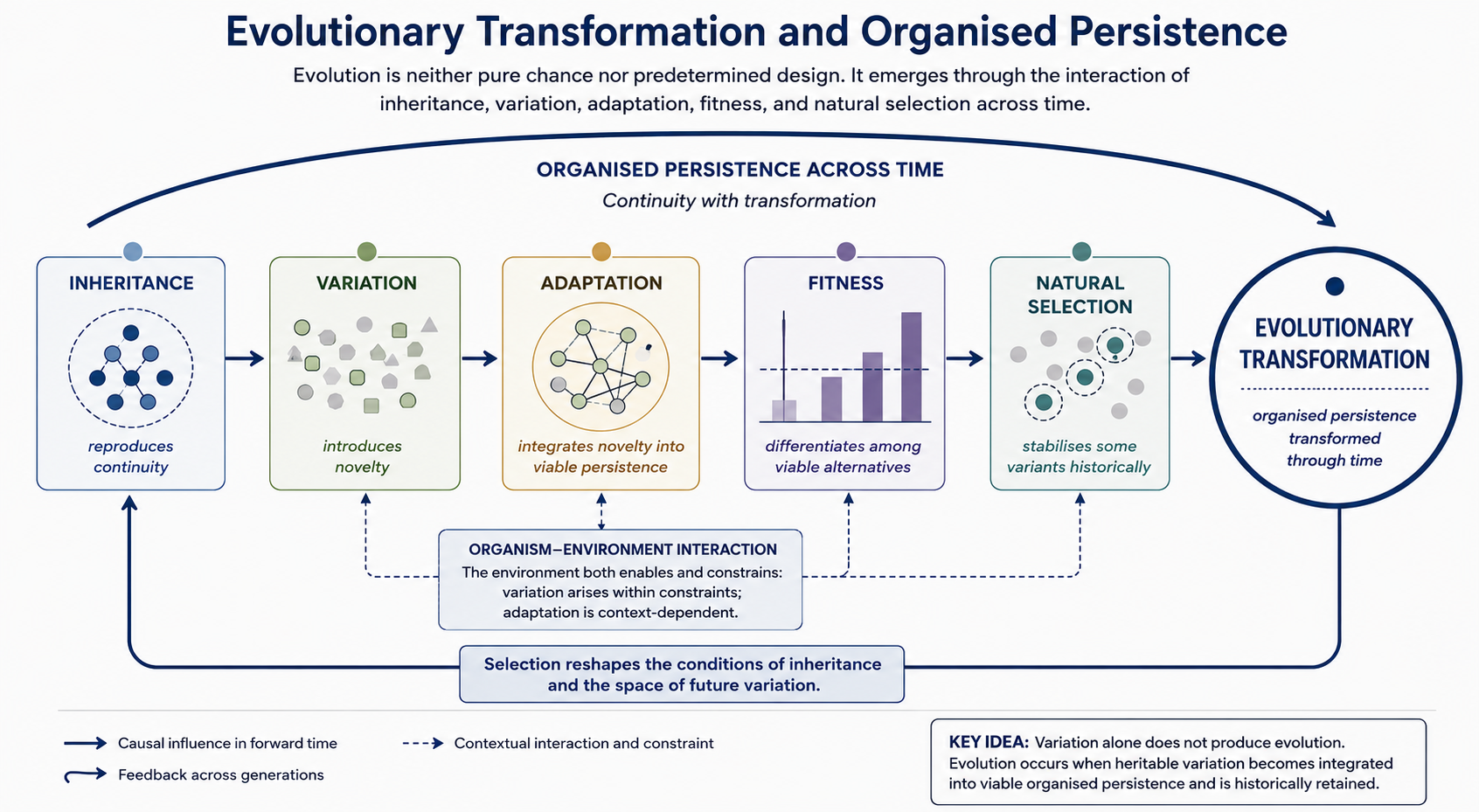
Evolutionary Transformation and Organised Persistence. In APS, evolution is neither pure chance nor predetermined design. Inheritance reproduces continuity, variation introduces novelty, adaptation integrates novelty into viable persistence, fitness differentiates among viable alternatives, and natural selection contributes to their historical stabilisation. Evolutionary transformation emerges from the interaction of these processes across time.
Key Point
In APS, evolution cannot be adequately described as either random or non-random. Evolution begins with inherited continuity and proceeds through the interaction of variation, adaptation, fitness, and natural selection. Novelty emerges within organised persistence, while viability constrains which forms of novelty can endure. Evolutionary change is therefore neither arbitrary nor predetermined. It is the historical transformation of organised persistence through the interplay of continuity, novelty, constraint, and differential continuity across time.
See Also
Related Articles
References
- (1859). On the Origin of Species. John Murray.
- (2018). A Manifesto for a Processual Philosophy of Biology. Oxford University Press.
- (2002). The Structure of Evolutionary Theory. Harvard University Press.
- (1982). The Growth of Biological Thought. Harvard University Press.
- (2026). Agency as the Defining Activity of Life: A Viability-Oriented Framework Integrating Process and Scale. Biological Theory . https://doi.org/https://doi.org/10.1007/s13752-026-00547-6