The Boundaries of Life: How APS Approaches Living, Artificial, and Borderline Systems
Debates about the boundaries of life often focus on identifying traits that distinguish living systems from non-living matter, machines, and other forms of organisation. Yet viruses, dormant organisms, artificial systems, synthetic systems, and other difficult cases resist simple classification. APS approaches these questions through the organisation materially realised in candidate systems rather than through isolated traits, behavioural sophistication, or origin. Its canonical definition of Life as viability-oriented, constraint-closed organisation provides the organising criterion for this inquiry, while evidence, diagnosis, and classification remain distinct tasks. This article develops that investigative approach without assuming that difficult cases are partially living, that Life itself is intrinsically graded, or that APS has established a uniquely decisive or comparator-superior boundary criterion.
Why the Boundaries of Life Matter
Few questions in biology are as persistent, or as difficult, as the question of where Life begins and ends. The distinction between living and non-living systems is fundamental to biological inquiry, yet attempts to define and diagnose that distinction repeatedly encounter difficult cases. Organisms provide familiar examples of living systems, while many forms of non-living matter present little classificatory difficulty. Between such relatively straightforward cases, however, lie viruses, dormant organisms, protocells, synthetic biological constructs, artificial systems, and hypothetical unfamiliar systems whose biological status may be more difficult to determine.
These difficulties are often approached as problems of classification. The task is assumed to be the identification of criteria that allow systems to be assigned to one category or another. From this perspective, the central question becomes which properties distinguish members of the category “living” from those outside it.
But definition, evidence, diagnosis, and classification are not the same scientific task.
Different accounts of Life emphasise metabolism, reproduction, information, complexity, adaptation, autonomy, evolution, or other properties. Each can identify scientifically important features of biological systems, yet difficult cases expose the limitations of treating any familiar trait as an automatically sufficient boundary criterion.
APS approaches the problem organisationally. Rather than beginning with a checklist of characteristic traits, it asks what organisation is materially realised in a candidate system and whether the evidence warrants understanding that organisation as viability-oriented and constraint-closed.
Within APS:
Life is viability-oriented, constraint-closed organisation.
This definition establishes the APS object of investigation. It does not classify every difficult case by itself.
The boundaries of Life are therefore important because they force biological inquiry to make explicit what organisation is being investigated, what evidence bears upon it, and what would warrant one classification rather than another.
Borderline cases are demanding tests of that inquiry. They should not be treated as demonstrating in advance that Life is graded, that ambiguous systems instantiate partial forms of Life, or that APS possesses a uniquely decisive boundary criterion.
Why Trait-Based Boundaries Become Difficult
Many attempts to define Life identify properties strongly associated with living systems. Metabolism, reproduction, growth, responsiveness, adaptation, information processing, and evolution have all played important roles in biological investigation.
Such properties remain scientifically relevant. The difficulty arises when one is expected to function as a universal discriminator independently of the organisation in which it occurs.
Dormancy illustrates one problem. Biological activity may be substantially reduced without this alone establishing that living status has been lost. Reproduction presents another: individual organisms can be sterile while remaining living organisms. Evolution is fundamental to biology but concerns populations and lineages in ways that cannot simply be converted into a criterion for the current living status of every individual system.
Information processing and complexity pose different problems because both occur outside biology. Their presence alone therefore cannot establish living status.
The lesson is not that metabolism, reproduction, evolution, information, adaptation, or complexity are unimportant. It is that their biological significance depends upon the organisation in which they participate and the explanatory question being asked.
This becomes especially important with unfamiliar cases. Viruses depend extensively upon host organisation. Artificial systems may exhibit sophisticated information processing and adaptive behaviour. Protocells can realise some forms of organisation associated with biological systems while leaving their biological status scientifically contestable. Hypothetical extraterrestrial systems might differ substantially from familiar terrestrial organisms.
Such cases motivate organisational investigation. They do not by themselves demonstrate that one organisational theory has solved the boundary problem.
APS and the Organisational Investigation of Biological Boundaries
APS begins from the proposition that Life is viability-oriented, constraint-closed organisation.
This shifts attention from the mere possession of traits to the relations through which a system maintains and re-establishes the conditions required for its continued functioning.
Metabolism, regulation, repair, development, adaptation, and other biological processes can then be investigated in relation to the organisation they help enact and sustain. Their significance is not determined simply by their presence but by the contribution they make within the system under investigation.
This provides APS with an organisational way of approaching biological boundaries.
It does not follow, however, that viability orientation or constraint closure has been demonstrated to provide a uniquely APS or comparator-superior discriminator between every living and non-living system. Nor does application of the APS definition eliminate the need for evidence.
The relevant questions therefore include:
- What activities and constraints are materially realised?
- Which conditions required for continued functioning are maintained or re-established by the system?
- How are relevant dependencies distributed across the system and its environment?
- What happens when important organisational relations are perturbed?
- What capacities for regulation, restoration, and continuity are actually observed?
- What evidence warrants interpreting these relations as viability-oriented and constraint-closed?
Boundary analysis thus becomes an investigation before it becomes a classification.
Viruses, dormant organisms, synthetic systems, artificial systems, and other difficult cases are valuable because they place these questions under unusual pressure. Their significance does not depend upon assigning them a biological status in advance.
Organisational and Material Boundaries
Biological systems often possess conspicuous physical boundaries. Membranes, skins, shells, and other structures regulate relations between organisms and their surroundings.
Such structures matter biologically because of what they do within living organisation.
A cell membrane, for example, is not biologically important merely because it separates one volume of matter from another. It participates in exchanges, regulation, signalling, energetic relations, and other activities relevant to continued cellular functioning.
APS therefore distinguishes physical demarcation from organisational analysis.
This does not mean that organisational boundaries are immaterial. Biological organisation is materially realised. Nor does it mean that an organisational boundary can always be located independently of the particular explanatory target.
Living systems also depend upon environmental conditions and resources. Some biological activities extend through ecological, developmental, symbiotic, or constructed relations beyond an obvious physical surface.
Consequently, external dependence cannot by itself disqualify a system from living status, just as physical enclosure cannot establish living status.
The task is to determine which materially realised relations constitute or support the organisation under investigation and what evidence those relations provide for a biological diagnosis.
Within APS, the canonical Life definition supplies a way of structuring that inquiry. It should not be converted into the prior assumption that every difficult boundary has already been empirically settled.
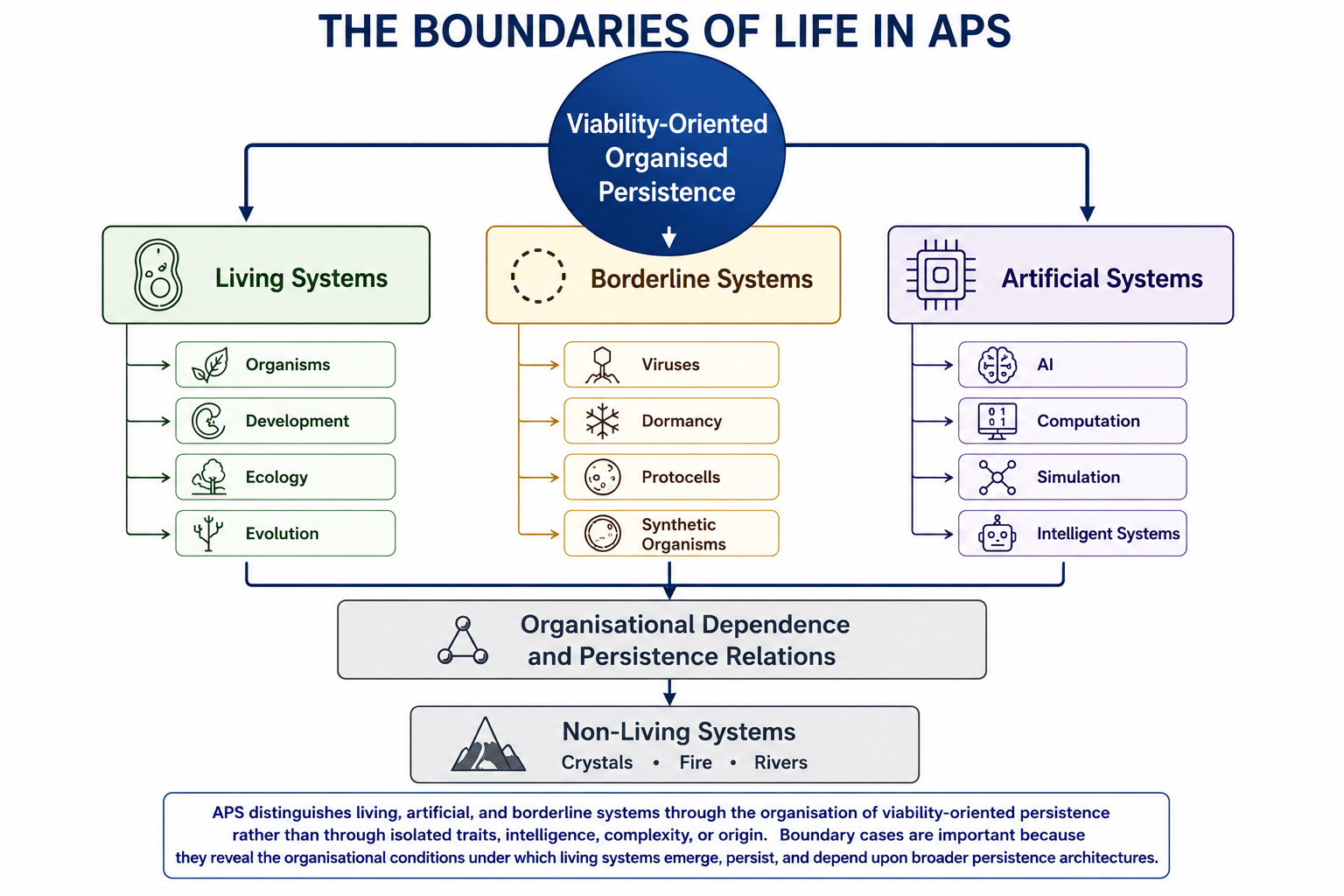
APS approaches biological boundaries through organisational investigation rather than isolated traits, intelligence, complexity, behaviour, or origin. Candidate systems are assessed by examining viability orientation, constraint closure, dependence, persistence, restoration, regulation, and material organisation; classification follows from the evidence rather than being assumed in advance.
Organisational Dependence and Difficult Cases
Difficult cases make dependence especially visible.
All living systems depend upon conditions and resources beyond themselves. Dependence is therefore not a simple test of biological status. The important questions concern what a system depends upon, how those dependencies participate in its organisation, and which conditions the system itself maintains or re-establishes.
Viruses provide a familiar example. They exhibit biological continuity across generations, participate in evolutionary processes, and depend extensively upon host systems for replication. These facts make them important cases for examining the location and organisation of relevant dependencies. They do not, by themselves, settle whether viruses should be classified as living.
Dormancy presents a different issue. Seeds, spores, cysts, and other dormant biological systems show why living continuity should not simply be equated with continuous overt activity. The relevant question concerns what organisation is materially preserved and how active functioning can subsequently be re-established under appropriate conditions.
Protocells provide experimentally important cases for investigating the emergence and integration of organisational capacities associated with living systems. But possessing some such capacities does not automatically place a protocell at a predetermined point on a Life continuum. Its status depends upon what organisation has actually been realised and what conclusions the evidence warrants.
Synthetic biological systems similarly separate questions of origin from questions of organisation. Artificial construction does not determine whether a system is living. A synthetic system must be assessed according to the organisation it materially realises, just as other candidate systems must.
These cases therefore reveal different forms of dependence without requiring those forms to be translated directly into degrees of living status.
[[box:slug: borderline-cases-viruses-sterile-organisms-artificial-systems
]]
Artificial Systems and Biological Status
Artificial systems are particularly useful for separating behavioural sophistication from biological organisation.
Contemporary computational and artificial systems can process information, adapt outputs, pursue specified objectives, and display behaviour that observers may describe as intelligent or life-like.
None of these capacities, by itself, establishes living status.
Within APS, biological agency is viability-oriented organisational activity. It should therefore not be inferred simply from intelligence, problem-solving ability, apparent goal-directedness, or computational sophistication.
At the same time, APS does not make artificial origin an exclusion criterion.
An engineered or synthetic system cannot be classified as non-living merely because it was designed or constructed. The relevant question is what organisation it materially realises.
This produces an important symmetry:
life-like behaviour does not establish Life, and artificial origin does not exclude Life.
The same caution applies to computation. Computational description may illuminate aspects of biological activity, but computation by itself does not establish viability-oriented, constraint-closed organisation. Conversely, the fact that a system contains computational processes does not prevent it from participating in biological organisation.
Artificial systems therefore function as candidate and contrast cases. They help separate questions about intelligence, behaviour, computation, origin, and material organisation that can otherwise become conflated.
Their scientific value lies in sharpening diagnosis, not in demonstrating in advance what all artificial systems are.
Life Beyond Familiar Biology
Questions about biological boundaries become especially difficult when candidate systems differ substantially from familiar terrestrial organisms.
Known Life shares an evolutionary history and many biochemical features. Those features provide powerful empirical resources for identifying familiar biological systems, but a general investigation of Life cannot simply assume that every possible living system must reproduce every terrestrial implementation.
APS is compatible with this substrate and origin neutrality.
Its definition identifies viability-oriented, constraint-closed organisation rather than a particular chemical substance, morphology, intelligence, or origin as its explanatory target.
That does not mean that any unfamiliar system displaying persistence or adaptation should therefore be classified as living.
Nor does it establish that viability orientation can already be operationally detected in every unfamiliar context.
Instead, unfamiliar candidate systems intensify the evidential problem. Investigators must determine what organisation is materially realised, which observations bear upon its maintenance, how relevant dependencies are organised, and what alternative explanations remain available.
The same principle applies to synthetic biology. A system constructed through deliberate intervention is not excluded from living status by its history of production. Equally, sophisticated engineering does not confer living status.
Life detection therefore requires a distinction between the definition being investigated, the evidence available, the diagnostic inference, and the resulting classification.
APS can organise these questions without presuming that its criterion has already achieved uniquely superior discrimination across terrestrial, synthetic, artificial, and extraterrestrial cases.
Boundaries as Explanatory and Diagnostic Problems
The significance of biological boundaries extends beyond assigning labels.
Difficult cases can expose assumptions about what a theory treats as biologically important. A reproductive account, a metabolic account, an evolutionary account, an autonomy account, and an organisational account can direct attention toward different evidence and different dependencies.
Boundary cases can therefore be used comparatively.
They may reveal where an account classifies systems differently, which observations drive those differences, and whether those differences produce additional explanatory or diagnostic consequences.
This makes boundaries potentially important explanatory tools, but it does not guarantee explanatory gain.
For APS, the appropriate question is not simply whether its organisational vocabulary can be applied to a case. The stronger question is what the APS analysis enables investigators to explain, discriminate, constrain, or infer relative to the strongest relevant comparator.
That requirement matters because applicability and explanatory gain are not equivalent.
Borderline cases therefore provide opportunities to test the APS account rather than exceptions that automatically confirm it.
Variation in integration, dependence, autonomy, persistence, regulation, or restoration can be scientifically informative. Such variation does not itself establish that Life is intrinsically graded or that a particular case occupies an intermediate biological category.
The outcome of investigation may be living, non-living, or unresolved, depending upon the evidence and the diagnostic question.
Definition, Evidence, Diagnosis, and Classification
The APS boundary approach depends upon keeping four operations distinct.
Definition specifies what is being investigated. Within APS:
Life is viability-oriented, constraint-closed organisation.
Evidence consists in the observations, measurements, perturbations, comparisons, and other empirical findings relevant to whether that organisation is materially realised.
Diagnosis is the reasoned assessment of what the evidence warrants concerning the organisation of the candidate system.
Classification is the resulting judgement about living status.
This sequence prevents the definition from functioning as its own evidence.
It also prevents difficult cases from being classified merely because they resemble familiar organisms, possess selected biological traits, display sophisticated behaviour, or have a particular natural or artificial origin.
An unresolved classification is therefore a legitimate scientific outcome. It can identify where evidence is inadequate, where the relevant organisational relations remain uncertain, or where competing interpretations have not yet been discriminated.
This is especially important for viruses, protocells, synthetic systems, artificial systems, and unfamiliar possible forms of Life.
APS supplies an organisational criterion and an investigative structure. The scientific burden remains to establish what organisation the candidate system actually realises and what classification the evidence warrants.
Explanatory Architecture
Central Question
How should the boundary between living and non-living systems be investigated when familiar traits, behavioural capacities, physical boundaries, or origins do not by themselves determine biological status?
Architectural Role
This article provides the principal APS anchor for the investigation of Life boundaries.
Its role is to connect the canonical APS definition of Life with the evidential, diagnostic, and classificatory work required when that definition is applied to particular systems.
It does not establish that APS has already identified a uniquely decisive biological boundary, that viability orientation or constraint closure provides comparator-superior discrimination, or that difficult systems instantiate graded forms of Life.
Preceding Explanatory Dependencies
This article depends upon:
- the APS definition of Life as viability-oriented, constraint-closed organisation;
- viability as a system-relative condition rather than mere continued existence;
- Constraint Closure as a feature of materially realised living organisation rather than an independent generator of Life;
- organised persistence as an explanatory target concerning continuity through change;
- biological agency as viability-oriented organisational activity; and
- the distinction between an APS conceptual commitment and demonstrated comparator-relative explanatory gain.
Subsequent Explanatory Developments
The boundary framework developed here supports subsequent investigation of:
- borderline biological cases;
- biological diagnosis;
- life detection;
- biosignatures;
- viruses and protocells;
- synthetic and artificial systems;
- unfamiliar possible forms of Life; and
- comparative testing of competing Life criteria.
These later applications must preserve the distinction between using APS to organise investigation and demonstrating that APS provides additional explanatory or discriminatory gain.
Related Explanatory Questions
This article connects directly to questions including:
- What evidence warrants classification of a candidate system as living?
- How can viability orientation and Constraint Closure be investigated empirically?
- Which forms of dependence are compatible with living organisation?
- How should viruses and protocells be investigated without assigning their biological status in advance?
- How should synthetic or engineered origin bear upon classification?
- What distinguishes behavioural sophistication from biological agency?
- When should a Life classification remain unresolved?
- What comparative evidence would demonstrate that APS provides explanatory or diagnostic gain over the strongest relevant alternative?
Position Within APS
Within APS, this article stands between the canonical definition of Life and the more specialised materials concerned with borderline cases, diagnosis, life detection, biosignatures, and artificial or synthetic systems.
Its function is methodological as well as conceptual: it specifies how the APS Life definition should enter an investigation without allowing the definition itself to predetermine the evidential result.
The article therefore establishes an APS approach to Life-boundary inquiry, not a claim that every Life boundary has already been settled.
Closing Perspective
The boundaries of Life remain scientifically difficult because definition, evidence, diagnosis, and classification cannot be collapsed into a single operation.
APS approaches the problem through viability-oriented, constraint-closed organisation.
That approach directs attention toward materially realised relations of dependence, regulation, persistence, restoration, and constraint maintenance. It also provides a way of separating biological organisation from intelligence, complexity, behavioural sophistication, computation, or origin considered in isolation.
But an organisational definition does not classify difficult systems automatically.
Viruses, protocells, synthetic systems, artificial systems, dormant biological systems, and unfamiliar candidate forms of Life must be investigated according to the organisation they materially realise and the evidence available.
Some cases may warrant clear classification. Others may remain unresolved.
The value of boundary cases is therefore not that they demonstrate the correctness of APS or reveal a predetermined continuum of Life. Their value is that they force biological explanation to state what organisation matters, what evidence bears upon it, and what would justify a classificatory judgement.
Key Point. APS approaches the boundaries of Life through organisational investigation: the definition identifies what must be investigated, evidence bears upon whether that organisation is materially realised, diagnosis evaluates what the evidence warrants, and classification follows rather than being assumed in advance.
See Also
Related Articles
References
- (2010). The Nature of Life. Cambridge University Press.
- (2002). Defining 'Life'. Origins of Life and Evolution of the Biosphere, 32(4), 387–393 . https://doi.org/10.1023/A:1020503324273
- (2010). Defining Life: The Virus Viewpoint. Origins of Life and Evolution of Biospheres, 40(2), 151–160 . https://doi.org/10.1007/s11084-010-9194-1
- (2006). The Emergence of Life. Cambridge University Press.
- (2009). Biological Autonomy. Springer.
- (2015). An Organizational Account of Biological Functions. British Journal for the Philosophy of Science, 66(4), 813–841 . https://doi.org/10.1093/bjps/axt040
- (2018). Everything Flows. Oxford University Press.
- (2026). Agency as the Defining Activity of Life: A Viability-Oriented Framework Integrating Process and Scale. Biological Theory . https://doi.org/10.1007/s13752-026-00547-6