Are Viruses Alive?
Viruses occupy one of the most debated boundary regions in biology. They evolve, inherit, adapt, and undergo natural selection, yet they do not exhibit the autonomous viability-oriented organisation characteristic of living systems. This article uses viruses as a test case for the APS definition of life, showing why participation in biological processes is not sufficient for biological organisation.
Key Points
- Viruses participate in evolution, inheritance, adaptation, and natural selection.
- Participation in biological processes is not the same as constituting a living system.
- APS defines life through viability-oriented, constraint-closed organisation.
- Viruses do not independently maintain their own viability or organised persistence.
- Viral boundary cases help clarify what distinguishes living systems from non-living biological entities.
Introduction
Where this article fits: Viruses occupy one of the most debated boundary regions in biology. They evolve, inherit, adapt, and undergo natural selection, yet they do not exhibit the autonomous viability-oriented organisation characteristic of living systems. This article uses viruses as a test case for the APS definition of life and explores what viral boundary cases reveal about the nature of life itself.
Few questions in biology generate as much discussion as whether viruses are alive. Viruses possess genetic material, evolve through time, adapt to changing conditions, and undergo natural selection. These characteristics seem closely associated with life, leading many people to regard viruses as living entities. At the same time, viruses lack many of the features traditionally associated with living organisms. They do not maintain their own metabolism, they do not independently regulate their internal conditions, and they cannot reproduce without exploiting the organisation of host cells.
The result is a persistent debate. Some biologists regard viruses as highly simplified forms of life. Others regard them as non-living biological entities. Still others argue that the distinction itself is misguided because viruses occupy a position somewhere between living and non-living systems.
APS approaches the question differently. Rather than beginning with a list of viral characteristics, APS begins with a definition of life. The central question is not whether viruses resemble organisms in some respects. The central question is whether viruses exhibit the organisational characteristics that define living systems.
This distinction is important because viruses provide an unusually demanding test case. If a definition of life cannot explain why viruses appear biologically significant while remaining different from living organisms, the definition may be incomplete. Viral boundary cases therefore offer an opportunity to examine what life actually is rather than merely deciding how viruses should be classified.
From an APS perspective, the question becomes: Do viruses exhibit the viability-oriented, constraint-closed organisation characteristic of living systems? Answering this question requires distinguishing participation in biological processes from the organisation that makes life possible.
Why Viruses Challenge Definitions of Life
Viruses present a challenge because they possess several properties commonly associated with life while lacking others that seem equally important. They carry genetic material, undergo inheritance, generate variation, adapt to changing environments, and participate in evolutionary processes. Viral lineages exhibit continuity through time and can undergo substantial evolutionary transformation.
These characteristics make viruses appear life-like. In many respects, viruses behave as evolutionary entities. They mutate, diversify, and respond to selective pressures. Entire fields of biology are devoted to understanding viral evolution and the role viruses play in ecological and evolutionary systems.
At the same time, viruses differ fundamentally from organisms such as bacteria, plants, and animals. Outside a suitable host environment, viral particles do not actively maintain themselves. They do not regulate metabolic processes, sustain internal organisation through ongoing activity, or reorganise themselves in response to changing conditions. Their persistence depends upon access to the organisational capacities of living cells.
This combination of similarities and differences explains why viruses occupy such an ambiguous position within biological thought. Definitions of life based primarily on evolution, reproduction, or genetic inheritance often appear to include viruses. Definitions based on metabolism, self-maintenance, or autonomous organisation often exclude them. The debate therefore reflects deeper disagreements about what features are most fundamental to life itself.
APS addresses this problem by asking a different question. Rather than searching for a checklist of characteristics, APS asks what kind of organisation distinguishes living systems from other biological entities. Viruses become important not because they blur a boundary, but because they help reveal what that boundary actually consists of.
What Counts as Life in APS?
APS defines life in terms of viability-oriented organisation. Living systems are not simply collections of biological components, nor are they defined solely by reproduction, evolution, or genetic inheritance. They are organised systems whose activities contribute to maintaining the conditions required for their own continued existence.
This perspective places organised persistence at the centre of biological explanation. Living systems continually maintain, repair, regulate, and reorganise themselves in ways that support their ongoing viability. Their activities contribute to preserving the organisational conditions that make those activities possible. APS describes this relationship in terms of constraint closure and viability-oriented organisation.
Agency emerges from this organisational structure. Living systems are agents because their activities contribute to sustaining their own persistence. They actively maintain the conditions required for continued existence rather than merely persisting as passive objects within their environments.
These criteria provide a framework for evaluating difficult boundary cases. The question is not whether a system evolves, reproduces, or contains genetic material. The question is whether the system itself exhibits viability-oriented organised persistence. Does it maintain itself? Does it regulate the conditions required for its own continuation? Does it actively contribute to preserving its own organisation?
APS therefore approaches viruses by examining their relationship to these organisational criteria rather than by counting how many characteristics associated with life they possess.
Viruses Clearly Participate in Evolution
Any adequate account of viruses must acknowledge their profound evolutionary significance. Viruses evolve. They generate variation, undergo inheritance, adapt to changing conditions, and experience natural selection. Viral populations can change rapidly, producing evolutionary patterns that are often easier to observe than those occurring in larger organisms.
This evolutionary capacity is not incidental. Viruses participate deeply in the evolutionary history of life. They influence ecological systems, contribute to genetic exchange, affect host evolution, and help shape biological diversity across multiple scales. Their evolutionary importance is therefore beyond dispute.
Recognising this importance is essential because APS does not seek to minimise the biological significance of viruses. Viral evolution is real. Viral adaptation is real. Viral participation in evolutionary processes is real. Any satisfactory account of viruses must fully acknowledge these facts.
At the same time, participation in evolutionary processes does not by itself determine whether something is alive. Evolution explains how forms of organised persistence transform through time, but participation in evolutionary change is not identical to exhibiting the organisation characteristic of living systems. This distinction becomes particularly important when evaluating viral boundary cases.
Viruses therefore provide an opportunity to separate two questions that are often conflated. One question concerns whether viruses participate in biological and evolutionary processes. The answer is clearly yes. The second question concerns whether viruses themselves exhibit the viability-oriented organisation characteristic of living systems. APS treats these as distinct questions requiring distinct answers.
Participation Is Not the Same as Organisation
The distinction between participation and organisation lies at the centre of the APS interpretation of viruses. Viruses unquestionably participate in biological processes. They inherit genetic material, generate variation, adapt to changing conditions, and undergo natural selection. In this respect they are deeply embedded within the evolutionary dynamics of life.
Participation alone, however, does not establish that an entity is itself a living system. Many entities participate in biological processes without independently exhibiting the organisation characteristic of life. Nutrients participate in metabolism. Oxygen participates in respiration. Environmental structures participate in ecological organisation. Yet participation in these processes does not make such entities living systems.
APS therefore distinguishes between involvement in biological processes and the possession of viability-oriented organisation. Living systems are not merely things that take part in biological activity. They are systems whose activities contribute to maintaining the conditions required for their own persistence. Biological organisation is not defined by participation alone but by the capacity to sustain organised persistence through ongoing activity.
This distinction helps clarify why viral evolution does not automatically resolve the question of life. Viruses clearly participate in evolutionary processes, but participation in evolution is not identical to exhibiting the organisational characteristics that define living systems. The existence of viral evolution demonstrates biological significance. It does not by itself establish biological organisation.
Viruses therefore occupy an illuminating position. They reveal that evolution and life, although closely related, are not identical concepts. A system may participate in evolutionary processes without independently exhibiting the viability-oriented organisation characteristic of living systems. Understanding this distinction is essential for understanding why the question of viral life remains so challenging.
Do Viruses Maintain Their Own Viability?
The APS definition of life directs attention toward a specific question: Do viruses independently maintain the conditions required for their own continued existence?
For living systems, the answer is clearly yes. Bacteria regulate internal conditions, maintain metabolic activity, repair damage, respond to environmental changes, and continuously sustain the organisation upon which their persistence depends. Similar principles apply across the diversity of life. Living systems remain viable because their activities contribute to preserving the conditions necessary for continued existence.
Viruses operate differently. Viral particles do not actively maintain themselves in the way living cells do. Outside a host environment they do not engage in metabolism, regulate internal conditions, repair damage through self-generated activity, or reorganise themselves in response to changing circumstances. Their persistence depends upon the organisational capacities of host systems rather than upon their own viability-oriented activity.
This distinction is fundamental. Viruses can persist through time, but persistence alone is not equivalent to viability-oriented persistence. APS defines viability in terms of the active maintenance of organisational conditions required for continued existence. Viral particles do not independently perform this function. They rely upon living cells whose organisational capacities they exploit during replication.
The issue is therefore not whether viruses persist historically. They clearly do. Nor is it whether they can reproduce under appropriate circumstances. They clearly can. The issue is whether viruses themselves constitute systems that actively maintain the conditions required for their own continuation. APS concludes that they do not exhibit this form of autonomous organisational activity.
This conclusion does not diminish the importance of viruses. Rather, it clarifies the distinction between entities that participate in living processes and systems that independently sustain organised persistence. Viruses remain biologically significant while differing in a fundamental organisational respect from living organisms.
Viruses and Agency
The distinction becomes even clearer when examined through the concept of agency. APS defines agency as the activity through which living systems contribute to maintaining the conditions required for their own continued existence. Agency is therefore not simply activity or complexity. It is viability-oriented activity directed toward organised persistence.
Living systems continually exhibit this form of organisation. They regulate internal conditions, respond to environmental changes, reorganise in the face of perturbation, and maintain the organisational relationships upon which their persistence depends. Their activities contribute directly to sustaining their own viability.
Viruses do not exhibit agency in this sense. Viral particles do not actively regulate themselves, maintain viability, or reorganise in response to changing circumstances. They do not contribute to preserving the organisational conditions required for their own persistence through self-generated activity. Instead, they depend upon host systems whose agency and organisational capacities make viral replication possible.
This distinction is important because viruses can appear highly effective from an evolutionary perspective. They spread, diversify, adapt, and persist across immense spans of evolutionary time. Yet evolutionary success should not be confused with agency. A system may be evolutionarily successful without independently exhibiting viability-oriented activity.
APS therefore treats viruses as dependent participants within the organisation of living systems rather than as autonomous agents in their own right. Their persistence depends upon their ability to exploit the organisational capacities of living hosts rather than upon organisational capacities they independently maintain.
Understanding this distinction helps explain why viruses occupy a boundary region between life and non-life. They participate intimately in biological processes while lacking the autonomous agency characteristic of living systems themselves.
Boundary Cases Matter
Boundary cases often reveal more about biological concepts than straightforward examples. Few people doubt that bacteria, plants, or animals are alive. Such cases fit comfortably within most biological frameworks. The real challenge comes from entities that possess some characteristics associated with life while lacking others.
Viruses are valuable precisely because they occupy this kind of boundary position. They force biologists to clarify which features of living systems are fundamental and which are secondary. A definition of life that cannot address viruses leaves important questions unresolved. A definition that successfully explains why viruses appear both biologically significant and organisationally distinct provides a deeper understanding of life itself.
This is why viral debates have persisted for so long. The disagreement is rarely about viruses alone. It is ultimately about what life is. Different answers to the viral question often reflect different assumptions about whether life is primarily defined by evolution, reproduction, metabolism, information, organisation, or some combination of these features.
APS uses boundary cases as opportunities for clarification rather than as problems to be eliminated. Viruses help reveal the distinction between participation in biological processes and the organisation characteristic of living systems. By examining where viruses fit, the nature of life itself becomes clearer.
For this reason, the significance of viruses extends beyond virology. They serve as conceptual probes that test the adequacy of biological definitions and explanatory frameworks. Their importance lies not only in what they are, but in what they teach us about the organisational foundations of life.
Why Viruses Remain Biologically Important
Recognising that viruses do not independently exhibit viability-oriented organisation does not diminish their biological significance. On the contrary, viruses remain among the most important entities in biology because they participate extensively in evolutionary, ecological, and developmental processes.
Viruses influence the evolution of their hosts, contribute to ecological dynamics, shape population structures, and affect the distribution of biological diversity across multiple scales. Viral interactions have played important roles throughout evolutionary history and continue to influence living systems today. Their significance therefore derives not from their status as living organisms but from their profound involvement in the processes through which living systems evolve and persist.
APS consequently treats viruses as biologically important participants within the broader organisation of life. Their dependence upon living systems does not render them irrelevant. Instead, it highlights the extent to which biological organisation extends beyond the boundaries of individual organisms and encompasses complex networks of interaction across multiple scales.
Viruses are therefore important not despite their boundary status but because of it. Their existence helps reveal how living systems interact with entities that participate in biological processes without themselves exhibiting the full organisational characteristics of life. They illuminate the relationship between evolutionary participation and viability-oriented organisation in ways that few other biological entities can.
What Viruses Teach Us About Life
The enduring fascination of the viral question arises because it ultimately concerns the nature of life itself. Viruses force biologists to ask which characteristics are fundamental to living systems and which are merely associated with them.
Many traditional discussions of life begin with properties such as reproduction, inheritance, genetic information, or evolution. Viruses possess many of these characteristics. If such properties alone defined life, viruses would appear to qualify as living systems. Yet many biologists remain reluctant to describe viruses as alive because something important seems to be missing.
APS identifies that missing element as viability-oriented organisation. Living systems do not merely evolve or reproduce. They actively maintain themselves. Their activities contribute to preserving the organisational conditions required for their continued existence. They exhibit organised persistence through ongoing self-maintenance and regulation.
Viruses help reveal the importance of this distinction because they separate evolutionary participation from autonomous organisational activity. They demonstrate that evolution, inheritance, and genetic continuity can occur in entities that do not independently sustain viability-oriented organisation. In doing so, they clarify why life cannot be adequately defined by evolutionary participation alone.
The viral boundary case therefore supports rather than challenges the APS conception of life. By applying APS criteria to a difficult biological example, the distinction between living systems and biologically significant non-living entities becomes clearer. The result is not a rigid classification scheme but a deeper understanding of the organisational foundations of life.
Viruses therefore teach an important lesson. Life is not defined simply by what evolves, reproduces, or carries genetic information. Life is defined by the organisation through which systems actively maintain and reproduce the conditions of their own persistence.
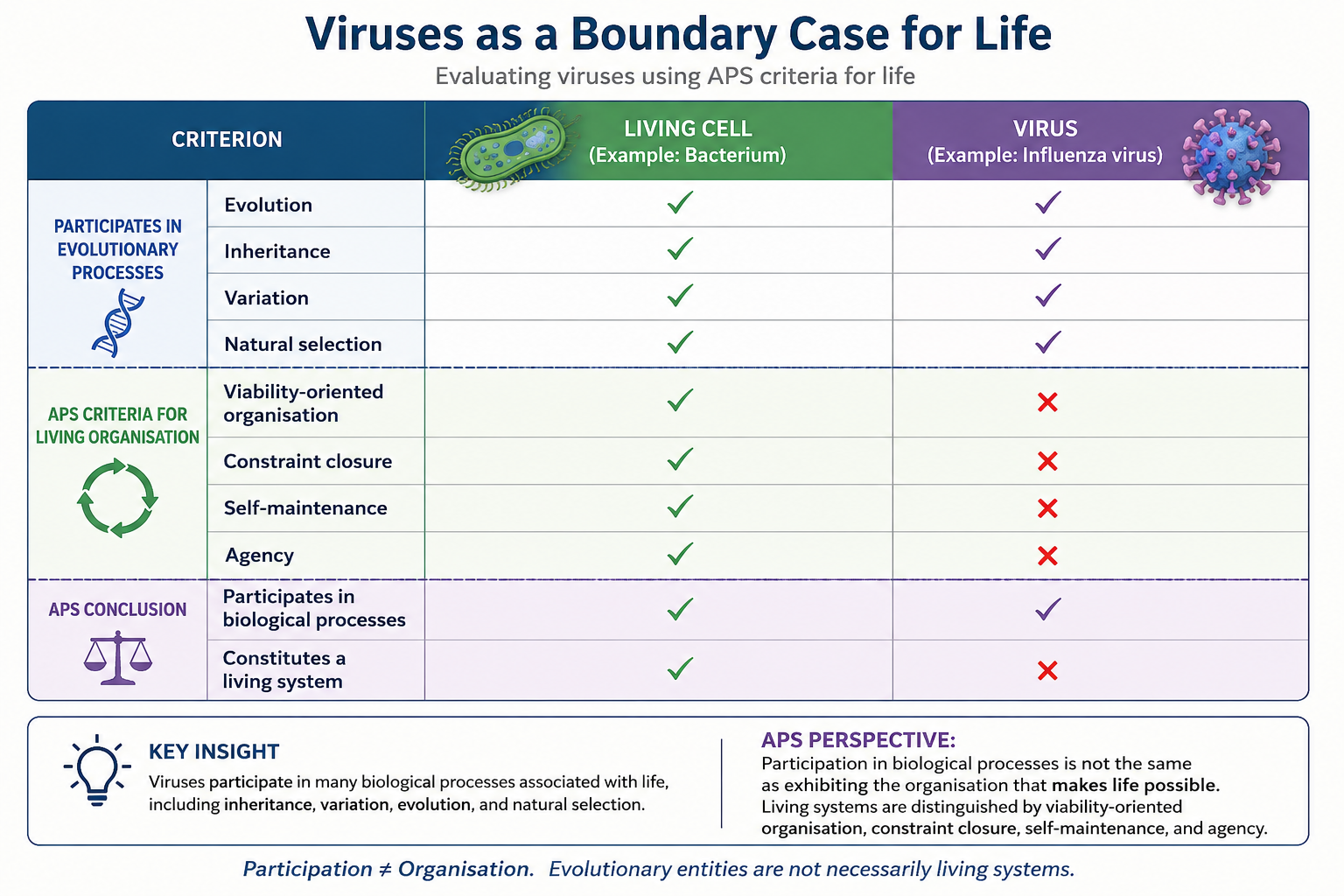
Viruses as a Boundary Case for Life. Viruses participate in many biological processes associated with life, including inheritance, variation, evolution, and natural selection. APS argues that participation alone is insufficient for life. Living systems are distinguished by viability-oriented organisation, constraint closure, self-maintenance, and agency.
Are Viruses Alive?
APS approaches this question by examining whether viruses exhibit the organisational characteristics that define living systems. The answer depends not upon whether viruses evolve, reproduce, or contain genetic material, but upon whether they independently exhibit viability-oriented, constraint-closed organisation.
Viruses clearly participate in biological and evolutionary processes. They inherit genetic information, generate variation, adapt to changing conditions, and undergo natural selection. In these respects they are deeply integrated into the dynamics of life.
Yet viruses do not independently maintain their own viability. They do not sustain themselves through ongoing self-maintaining activity, regulate the conditions required for their continued existence, or exhibit the autonomous agency characteristic of living systems. Their persistence depends upon the organisational capacities of host organisms rather than upon viability-oriented activity they perform themselves.
APS therefore does not treat viruses as fully living systems. At the same time, APS does not regard viruses as biologically insignificant non-living objects. Viruses occupy an important boundary region between biological participation and biological organisation. They are evolutionary entities whose existence helps clarify what distinguishes living systems from other participants in biological processes.
The answer is therefore more informative than a simple yes or no. Viruses are not best understood as miniature organisms, nor as inert objects unrelated to life. They are biologically significant participants in evolutionary processes that illuminate the organisational criteria through which life itself can be understood.
Key Point
Viruses evolve, inherit, adapt, and undergo natural selection, yet they do not independently exhibit the viability-oriented, constraint-closed organisation characteristic of living systems. In APS, viruses therefore occupy an important boundary region between biological participation and biological organisation. Their significance lies not only in what they are, but in what they reveal about the nature of life itself. By distinguishing participation in biological processes from organised persistence, viruses help clarify the organisational foundations upon which living systems depend.
See Also
Related Articles
References
- (2018). A Manifesto for a Processual Philosophy of Biology. Oxford University Press.
- (2012). Are Viruses Alive? The Replicator Paradigm Sheds Decisive Light on an Old but Misguided Question. Studies in History and Philosophy of Biological and Biomedical Sciences, 43(2), 379–381 .
- (1957). The Concept of Virus. Journal of General Microbiology, 17(2), 239–253 .
- (2026). Agency as the Defining Activity of Life: A Viability-Oriented Framework Integrating Process and Scale. Biological Theory . https://doi.org/https://doi.org/10.1007/s13752-026-00547-6