How Did Evolution Transform Biological Explanation?
This historical essay traces how evolutionary explanation developed from debates over species transformation and extinction through Darwin and Wallace, genetics, population thinking and the Modern Synthesis. It concludes by distinguishing contemporary debates over the Extended Evolutionary Synthesis from APS's qualified organisational perspective, without claiming explanatory superiority.
Before evolution had a mechanism
In the early nineteenth century, a naturalist looking at a collection of shells, birds or fossil bones could ask a question that classification alone could not settle: were species permanent kinds, or had living forms changed during the long history of the Earth? Collections brought order to diversity. Fossils brought a more unsettling fact: organisms once present were no longer living. Geology suggested that the Earth had a history far deeper than ordinary human experience. The difficult task was to connect these observations in a convincing explanation.
This was not a simple contest between people who believed in change and people who did not. Naturalists disagreed about what species were, how fossils should be interpreted, and what counted as an acceptable cause. The question was not merely whether the living world had a history. It was how such a history could be reconstructed from present-day evidence.
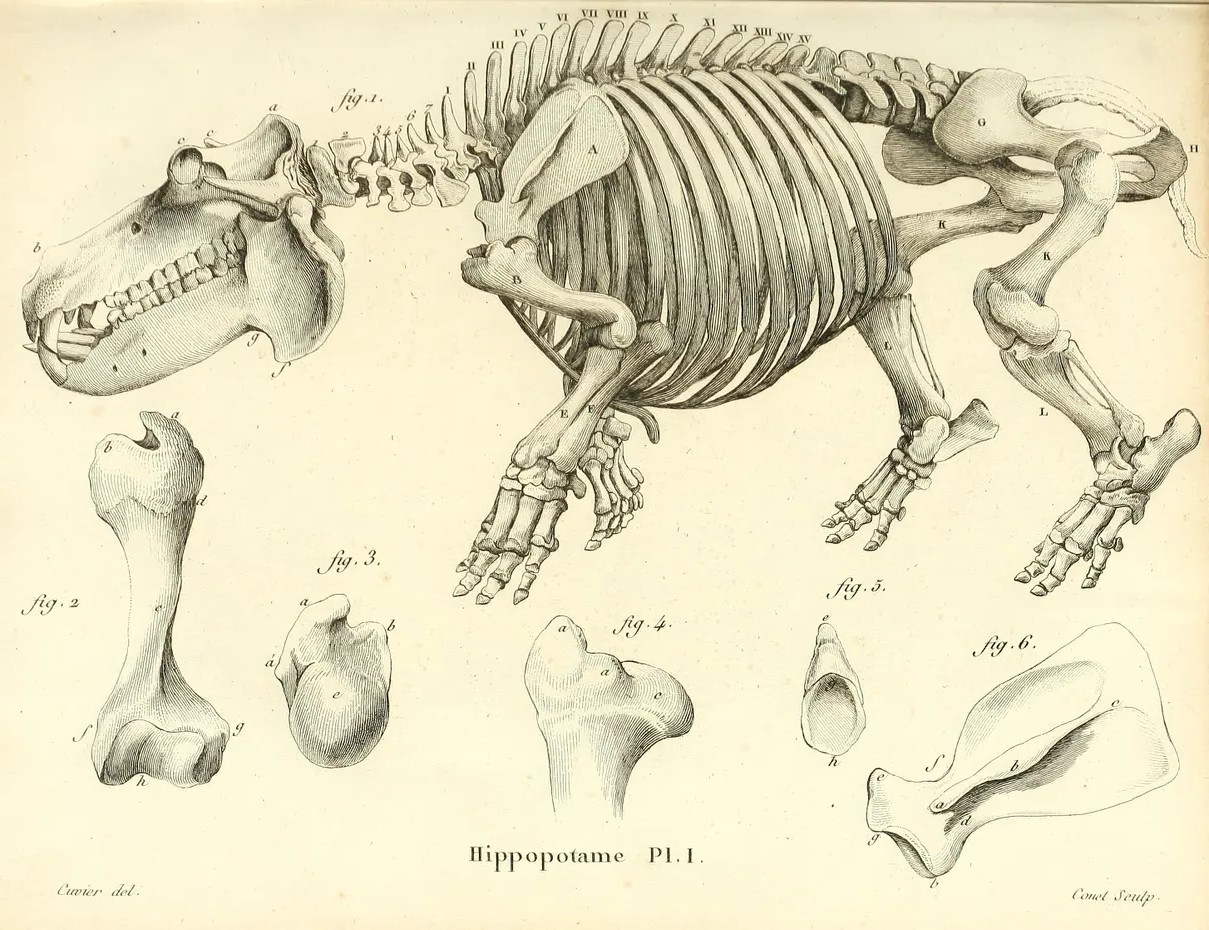
Figure 1. Comparative anatomy in early nineteenth-century natural history. Hippopotamus skeletal anatomy and individual bone structures illustrated in Georges Cuvier’s Recherches sur les ossemens fossiles de quadrupèdes (1812), vol. II, Memoir VI, Plate I. Engraved by Couet. Cuvier’s comparative-anatomical investigations helped establish the importance of fossil evidence in reconstructing the history of life. Source: Smithsonian Libraries and Archives / Biodiversity Heritage Library. Public domain.
Competing accounts of change
Jean-Baptiste Lamarck made species transformation a sustained scientific proposal. In Philosophie zoologique (1809), he treated living forms as historically changeable and sought to explain patterns of complexity and adaptation through natural processes. His account included ideas about use and disuse and the inheritance of acquired modifications. These mechanisms have not survived as a general explanation of evolutionary change, but reducing Lamarck to a story about giraffes stretching their necks misses his larger achievement: he tried to make the transformation of living forms a subject of causal biological inquiry.
Georges Cuvier, by contrast, used comparative anatomy and fossils to establish the reality of extinction while rejecting the transformation of species as Lamarck proposed it. Extinction itself was a major explanatory challenge. If organisms had vanished, the history of life could not simply be read from the living species of the present. The dispute demonstrated that a shared body of evidence could support different historical interpretations.
Meanwhile, geologists developed ways to interpret rock layers and processes acting over immense periods. Charles Lyell’s Principles of Geology, beginning in 1830, argued for the importance of causes observable in the present in understanding the geological past. His views were influential but should not be mistaken for a complete theory of biological evolution. Geological time made change conceivable; it did not by itself explain how species diverged.
These earlier arguments mattered because they established a new explanatory ambition. Biological diversity could be investigated as the result of historical processes rather than described only as an arrangement of fixed kinds.
Darwin and Wallace: a historical explanation takes shape
Charles Darwin’s voyage aboard HMS Beagle from 1831 to 1836 supplied observations that became important to his thinking, but he did not return with a finished theory of natural selection. Over subsequent years he examined domesticated animals, geographical distribution, fossils and the relations among living species. His notebooks explored branching descent. A historical account must allow for this prolonged work rather than treating a single island encounter as a moment of instant revelation.
Alfred Russel Wallace independently developed an explanation involving differential survival and the preservation of favourable variations. Working in the Malay Archipelago, he sent Darwin an essay in 1858. The ensuing joint presentation of Darwin’s and Wallace’s materials to the Linnean Society on 1 July 1858 became a landmark in the public history of natural selection. Their contributions were not identical, and the circumstances of priority and presentation deserve accurate treatment. Neither scientist should disappear into the other’s biography.
The central explanatory move was powerful. Organisms vary. Some differences can be inherited. In particular environments, differences may affect survival and reproduction. Over generations, such differences can become more common, and lineages may diverge. This was a proposal about a process that could connect observable differences among organisms to long-term historical change. It did not require organisms to foresee what would be advantageous. Nor did it claim that every feature was necessarily produced by natural selection.
Darwin and Wallace therefore helped transform a question about the arrangement of life into a question about its causes and history. A species could be understood not only by its distinguishing characters but also through ancestry, variation and divergence.
The argument of the Origin
Darwin’s On the Origin of Species appeared in 1859. Its force lay not in one dramatic observation but in the convergence of different kinds of evidence. Artificial selection showed that heritable differences could be accumulated under sustained selection. Geographical distribution posed questions about why related forms occurred in particular regions and on islands. Comparative anatomy, embryology and classification offered patterns that descent with modification could help interpret. Fossils placed living organisms within an incomplete but revealing historical record.
The familiar branching image of descent is important here. A tree does not merely arrange organisms by resemblance; it proposes that their similarities and differences have a history. Classification could thus become evidence relevant to common ancestry, while geographical and fossil evidence could test historical relationships. The value of the explanation depended on whether a single historical account illuminated observations that had previously seemed disconnected.
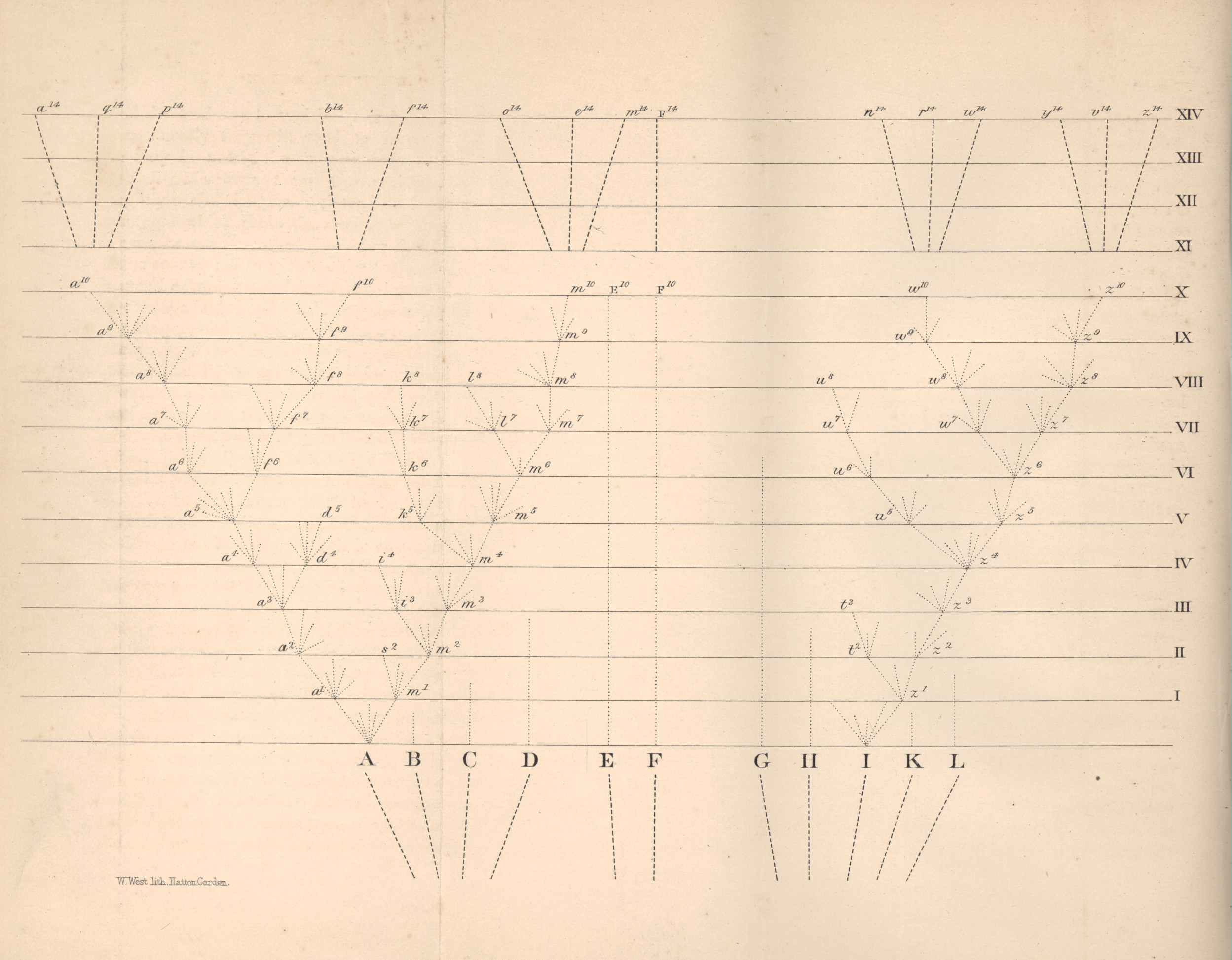
Figure 2. Darwin’s diagram of divergence and common descent (1859). The folding diagram published in the first edition of On the Origin of Species illustrates how ancestral forms may give rise to diverging lineages over successive generations. Diagram by Charles Darwin; lithographed by William West. Source: Darwin (1859), folding plate facing p. 117. Public domain.
The theory did not settle everything. Darwin lacked an adequate account of the physical basis of heredity. The mechanisms of variation remained uncertain. Fossil sequences were incomplete, and the timing and rate of evolutionary change were contested. Some scientists accepted common descent without accepting natural selection as its main cause. The historical importance of the Origin should not be confused with immediate consensus on every part of its argument.
What changed was the standard of explanation. A plausible account of biological diversity increasingly had to connect patterns of relationship to historical processes and to evidence capable of discriminating among competing histories.
Inheritance and the problem of mechanism
Natural selection requires variation and some form of transmission across generations. Yet nineteenth-century scientists did not possess the genetic framework now familiar to biology students. Gregor Mendel’s experiments with peas, published in 1866, provided a distinctive account of inheritance in the traits he studied, but their wider significance emerged only later. The history of genetics is not simply a tale of a discovery made, forgotten and triumphantly rediscovered. Different experimental traditions and questions had to be brought into relation.
Around 1900, renewed attention to Mendelian results sharpened questions about particulate inheritance. Some biologists emphasised discontinuous variation; others studied small differences in populations. These approaches initially appeared difficult to reconcile. Chromosome research, experimental breeding and statistical analysis gradually helped connect them.
The difficulty was both scientific and explanatory. How could the transmission of relatively discrete hereditary factors account for the gradual change of populations? And how could observations from breeding experiments be related to species in the wild? Evolutionary theory needed an account linking inheritance in individuals to changes in populations over generations. That bridge was built through sustained theoretical and experimental work, not by one decisive discovery.
Population genetics and a wider synthesis
During the 1920s and 1930s, Ronald Fisher, J. B. S. Haldane and Sewall Wright developed mathematical approaches to evolutionary change. Their work differed in assumptions and emphasis, but it showed how Mendelian inheritance could be studied alongside selection, mutation, migration and chance changes in populations. Natural selection could now be expressed through models with explicit conditions and consequences. Such models did not replace natural history; they created new ways of asking what evidence from populations could establish.
Theodosius Dobzhansky’s Genetics and the Origin of Species (1937) helped connect genetic theory with variation in natural populations and the emergence of species. Ernst Mayr’s Systematics and the Origin of Species (1942) placed classification, geographical variation and speciation into the conversation. Julian Huxley’s Evolution: The Modern Synthesis (1942) gave an influential name to the broader movement. George Gaylord Simpson and G. Ledyard Stebbins brought palaeontological and botanical perspectives into an expanding synthesis.
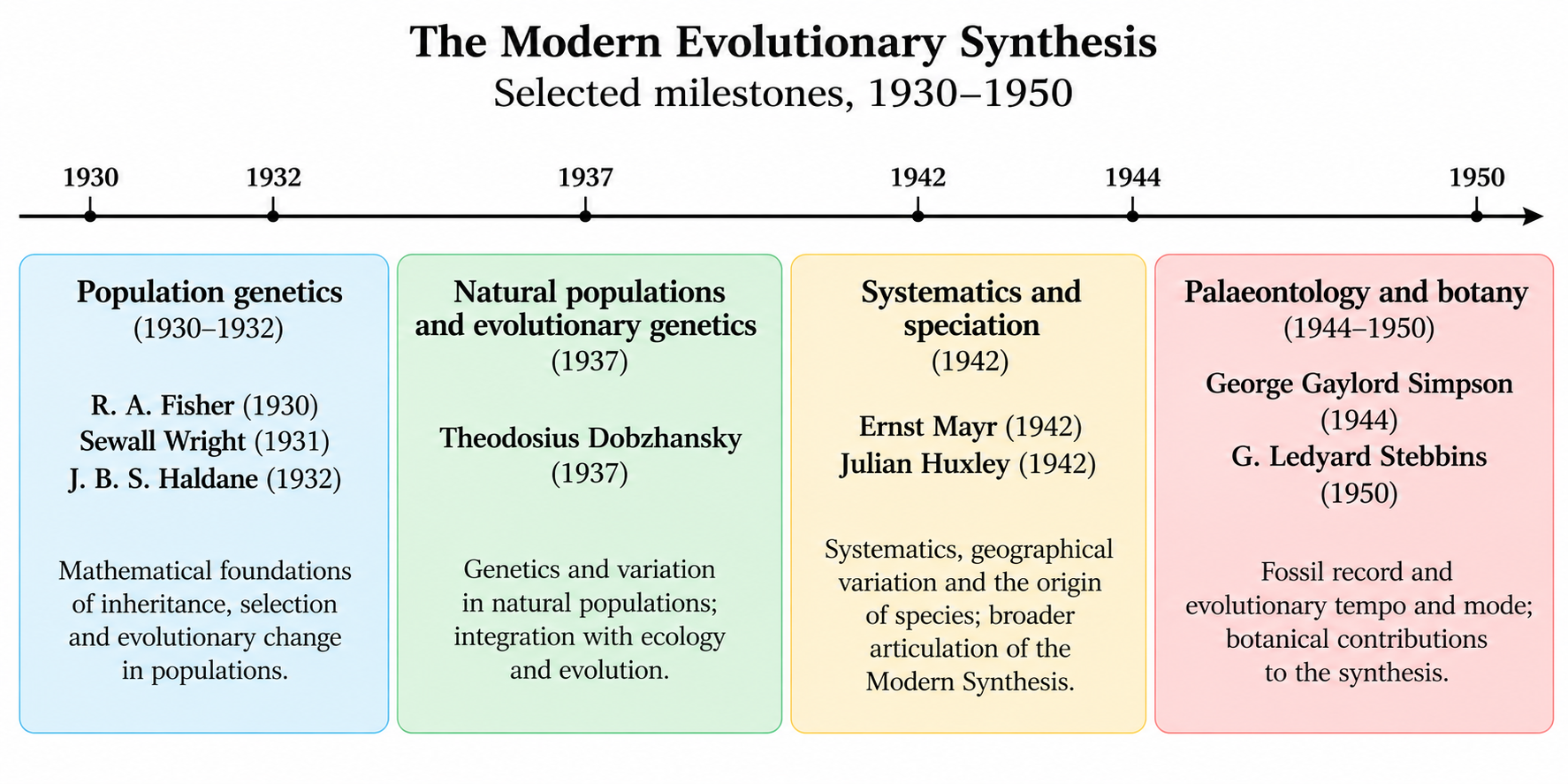
Figure 3. Selected milestones in the development of the Modern Evolutionary Synthesis, 1930–1950. Contributions to population genetics, natural-population research, systematics, palaeontology and botany helped connect previously distinct approaches to evolutionary explanation. The dates identify influential publications rather than the beginnings or completion of research programmes. These developments overlapped and involved continuing scientific disagreements. Original editorial diagram prepared for the APS Framework.
The new quantitative framework also made its own limitations visible. A model might predict changes in gene frequencies under specified assumptions, but an explanation of an actual species or fossil lineage needed evidence about the organisms, environments and historical conditions involved. Population genetics provided tools for investigating evolutionary processes, not a substitute for observing nature. This distinction remains important whenever a mathematical possibility is mistaken for a demonstrated historical cause.
The phrase modern synthesis can make this history sound more uniform than it was. Researchers disagreed about evolutionary rates, the importance of chance, the nature of species and the relations between small-scale population change and large-scale patterns. Not all areas of biology were equally represented. The synthesis is best understood as a consequential, evolving set of connections among research programmes rather than a treaty that ended disagreement.
Its significance was nevertheless profound. Questions about evolution could be investigated through mathematics, field observation, genetics, experiments, systematics and fossils. These approaches could challenge as well as reinforce one another. Evolutionary explanation had become more quantitative, more testable in specific settings and more closely integrated across biological disciplines.
The molecular revolution and the genetic interpretation of life
A further transformation followed the discovery of DNA’s double-helical structure in 1953 and the deciphering of the genetic code during the 1960s. Molecular biology connected heredity to identifiable chemical structures and processes. Genetic information could be investigated through DNA replication, RNA transcription and protein synthesis, while mutations could increasingly be examined in terms of changes to DNA and their molecular consequences. The explanatory possibilities were extraordinary: questions previously addressed through breeding experiments, comparative anatomy and population statistics could now also be investigated through the molecular mechanisms of inheritance and development.
These developments stimulated an enormous expansion of molecular genetics, microbiology and biotechnology. Techniques for analysing, modifying and sequencing DNA transformed research on microorganisms, heredity, disease, development and evolutionary relationships. Molecular comparisons supplied new evidence for common ancestry and phylogenetic reconstruction, while genetic engineering opened practical possibilities that earlier evolutionary biologists could scarcely have anticipated.
The success of molecular explanation also encouraged strongly gene-centred interpretations of biological phenomena. Genes became prominent explanatory units in accounts of development, adaptation and evolution, sometimes encouraging the view that processes involving cells, organisms and populations could ultimately be explained through their molecular constituents.Yet the explanatory power of genetics does not establish the sufficiency of genetic reductionism. Gene expression depends on cellular organisation, developmental conditions and environmental interactions; evolutionary outcomes depend on population processes and historical circumstances. The molecular revolution therefore introduced indispensable new explanatory resources without eliminating the need to investigate how molecular, cellular, organismal and population processes interact across spatial and temporal scales.
What evolutionary explanation changed
The history of evolutionary theory is not a straight line from ignorance to a completed picture. It is a history of changing questions, evidence and explanatory standards. Earlier naturalists asked how to classify the forms of life and how to interpret extinction. Nineteenth-century evolutionists asked whether species had changed and by what processes. Darwin and Wallace provided a mechanism that made inherited variation and differential reproduction central to historical explanation. Later geneticists and field biologists connected those processes to measurable changes in populations and to the formation of species.
It also changed the meaning of disagreement. A proposed account could be challenged through comparative evidence, inheritance experiments, population measurements or the distribution of fossils. Disagreement was not abolished, but competing accounts could increasingly be compared by asking what each predicted, what observations would count against it, and which processes were actually documented. This shift towards linked, revisable explanations is as significant as any single theory in the story.
This transformation did not make every biological problem an evolutionary problem. Physiological regulation, development, ecology and cellular processes retain their own explanatory questions. Nor does natural selection exhaust evolutionary causation. Drift, mutation, migration, developmental processes and environmental interactions matter in different ways and at different scales. Which factors explain a particular outcome must be established from the case, not inferred from allegiance to a preferred framework.
What evolution added was an indispensable historical dimension. Organisms could be understood as products of lineages whose features and relationships had developed through time. Similarities could indicate ancestry; differences could arise through divergence; adaptation could be investigated as a possible historical outcome rather than assumed from appearance alone. Evidence from different fields could be assembled to reconstruct, revise or reject explanations of those histories.
That is the enduring intellectual change. Biology gained a set of methods for explaining how living diversity arose, how populations and lineages change, and why present-day organisms bear the marks of histories they did not choose. The achievement lies not in a final answer to every question about life, but in making the history of life itself an object of disciplined scientific explanation.
Contemporary debates: the Modern Synthesis, the EES and APS
The modern synthesis did not end debate about evolutionary causes. From the later twentieth century onward, research on development, ecology, inheritance and organism–environment interactions renewed questions about the range of processes that evolutionary explanations should include. These debates concern the interpretation and extension of a successful scientific tradition, not simply whether evolution occurs.
Advocates of an Extended Evolutionary Synthesis (EES) argue that processes such as developmental bias, phenotypic plasticity, niche construction and forms of non-genetic inheritance deserve a more prominent role in evolutionary theory. Other evolutionary biologists accept the importance of these processes but maintain that established population-genetic and evolutionary approaches can accommodate them without a fundamental reconstruction. The disagreement therefore concerns explanatory emphasis, causal organisation and the extent of theoretical revision, rather than a straightforward choice between an obsolete and a modern theory.
The Agency–Process–Scale (APS) framework enters this discussion from a different direction. It asks how living organisation sustains its viability and how forms of organised persistence are maintained and transformed through historical time. That perspective invites comparisons with the EES, particularly concerning development, organismal activity and environmental modification. It does not establish that APS replaces, completes or provides a more fundamental explanation than either the Modern Synthesis or the EES. Its explanatory usefulness must be tested against the strongest relevant alternatives for a clearly specified biological question.
The continuing discussion illustrates the central historical lesson of this essay: evolutionary explanation is not a finished inventory of causes. It is a developing practice of bringing evidence, mechanisms and models into accountable relation. The APS article “APS and the Extended Evolutionary Synthesis — Organisation, Evolution, and Explanatory Comparison” examines the contemporary comparison in greater detail.
Related Articles
References
- (2009). Evolution: The History of an Idea. University of California Press.
- (1812). Recherches sur les ossemens fossiles de quadrupèdes. Deterville.
- (1859). On the Origin of Species. John Murray.
- (1858). On the Tendency of Species to Form Varieties; and on the Perpetuation of Varieties and Species by Natural Means of Selection. Journal of the Proceedings of the Linnean Society of London. Zoology, 3(9), 45–62 . https://doi.org/10.1111/j.1096-3642.1858.tb02500.x
- (1937). Genetics and the Origin of Species. Columbia University Press.
- (1930). The Genetical Theory of Natural Selection. Clarendon Press.
- (1932). The Causes of Evolution. Longmans, Green & Co..
- (1942). Evolution: The Modern Synthesis. George Allen & Unwin.
- (2015). The Extended Evolutionary Synthesis: Its Structure, Assumptions and Predictions. Proceedings of the Royal Society B, 282(1813) . https://doi.org/10.1098/rspb.2015.1019
- (2014). Does Evolutionary Theory Need a Rethink?. Nature, 514(7521), 161–164 . https://doi.org/10.1038/514161a
- (1809). Philosophie zoologique. Dentu et l’Auteur.
- (1830). Principles of Geology: Being an Attempt to Explain the Former Changes of the Earth’s Surface, by Reference to Causes Now in Operation. John Murray.
- (1942). Systematics and the Origin of Species from the Viewpoint of a Zoologist. Columbia University Press.
- (1982). The Growth of Biological Thought: Diversity, Evolution, and Inheritance. Belknap Press of Harvard University Press.
- (1866). Versuche über Pflanzen-Hybriden. Verhandlungen des naturforschenden Vereines in Brünn, 4, 3–47 .
- (2010). Evolution: The Extended Synthesis. MIT Press.
- (1944). Tempo and Mode in Evolution. Columbia University Press.
- (1950). Variation and Evolution in Plants. Columbia University Press.
- (1931). Evolution in Mendelian Populations. Genetics, 16(2), 97–159 . https://doi.org/10.1093/genetics/16.2.97