APS Cognitive Lexicon
Cognitive terminology is widely used across biology, but the use of terms such as memory, learning, attention, decision-making, and anticipation does not by itself establish that a system is cognitive. APS therefore distinguishes the translation of cognitive vocabulary into descriptions of biological organisation from the separate question of cognitive attribution. This lexicon provides a disciplined framework for identifying the organisational functions tracked by cognitive terminology without importing assumptions derived from human psychological experience. Shared vocabulary may identify comparable organisational roles without implying identical mechanisms, experiences, minds, or cognitive status. The lexicon therefore functions as a conceptual guardrail supporting comparative biological inquiry while preventing mentalistic drift and category errors.
Key Points
- APS interprets cognitive language through viability-oriented organisation.
- Shared terminology does not imply shared psychological capacities.
- Cognition and consciousness are distinct concepts.
- Vocabulary alone cannot establish cognitive status.
Where This Article Fits
This article is a terminological and interpretive guide within the APS cognition corpus. It explains how familiar cognitive vocabulary can be translated into descriptions of biological organisation without treating that vocabulary as evidence that cognition is present.
The substantive question of cognitive attribution is addressed elsewhere in the APS cognition framework. There, cognition is assessed in relation to the organisation of biological significance across time and against adequate non-cognitive explanations of the same phenomenon.
The Cognitive Lexicon therefore has a narrower role. It helps keep vocabulary, organisational description, and cognitive attribution distinct so that terms such as memory, learning, attention, decision-making, intelligence, and anticipation can be used comparatively without predetermining the cognitive status of the systems being investigated.
Introduction
Biology routinely employs a vocabulary that appears, at first glance, to belong to psychology. Researchers speak of memory, learning, communication, decision-making, intelligence, anticipation, and even problem-solving across a remarkable diversity of living systems. Such language occurs in studies of animals, plants, microbes, developmental systems, immune systems, and collective biological organisation. Yet the meaning of these terms often changes substantially across contexts.
This creates a persistent interpretive challenge. Readers naturally encounter cognitive language through human experience, where terms such as memory, attention, or decision-making are closely associated with conscious awareness, subjective experience, and reflective thought. When similar language is applied to non-human systems, it can therefore appear either misleadingly anthropomorphic or unexpectedly provocative.
APS neither rejects cognitive terminology nor extends it indiscriminately. Instead, it provides a framework for interpreting cognitive language in ways that remain consistent with biological organisation. The first question is not whether a system resembles a human mind but what organisational role the relevant cognitive term is being used to identify. A second and separate question is whether the phenomenon warrants cognitive attribution. Organisational translation can clarify the first question without settling the second.
This lexicon serves as a conceptual guide for that task. It explains how cognitive terminology is interpreted within APS and provides a stable reference point for readers encountering cognitive language throughout the APS framework.
Why APS Needs a Cognitive Lexicon
The need for a cognitive lexicon arises from a tension within contemporary biology. On the one hand, cognitive terminology has become increasingly common across multiple domains of biological research. Scientists routinely describe organisms as learning from experience, storing information, communicating with one another, anticipating future conditions, or making decisions under uncertainty. Such language often captures important features of biological organisation and can illuminate how living systems regulate their activity.
On the other hand, cognitive vocabulary carries conceptual baggage. Terms that originated within human psychology frequently evoke assumptions about consciousness, intentionality, reasoning, or subjective experience. When these assumptions are imported into biological discussions without clarification, misunderstandings quickly arise. Critics may accuse researchers of anthropomorphism, while proponents may unintentionally overstate the implications of their findings.
APS addresses this problem by distinguishing between vocabulary and interpretation. The use of a cognitive term does not determine how that term should be understood. What matters is the organisational role that the relevant process performs within a living system. Cognitive language therefore requires a disciplined interpretive framework rather than either unrestricted adoption or outright rejection.
The purpose of this lexicon is to provide that framework. It offers a consistent way of understanding cognitive terminology while preserving the conceptual distinctions necessary for rigorous biological explanation.
Language, Cognition, and Mentalistic Drift
One of the most common sources of confusion in discussions of cognition is the tendency to move too quickly from description to interpretation. A biological process may be described using cognitive language, yet the strongest psychological interpretation of that language does not automatically follow. The resulting slippage can generate what APS describes as mentalistic drift: the gradual importation of assumptions about minds, consciousness, or subjective experience into contexts where such assumptions have not been established.
Mentalistic drift often occurs because familiar words carry familiar associations. Terms such as memory or decision-making may evoke images of conscious recollection or deliberate choice. Yet biological systems can retain information or select among alternative responses without exhibiting the forms of awareness associated with human cognition. Treating these distinct phenomena as equivalent obscures rather than clarifies biological organisation.
The problem is particularly significant in comparative contexts. Discussions of plant cognition, microbial cognition, collective intelligence, or synthetic biological systems frequently rely on cognitive terminology because organisms genuinely process information, regulate activity, and respond adaptively to changing conditions. Nevertheless, these observations do not justify immediate conclusions about consciousness, subjective experience, or human-like mentality.
APS therefore treats cognitive language as a useful but potentially misleading tool. The challenge is not to abandon such language but to use it with sufficient conceptual discipline that organisational similarities can be recognised without collapsing important differences.
Translation Rather Than Attribution
The central interpretive principle of the APS cognitive lexicon is simple: cognitive language should be translated rather than attributed.
Traditional debates about cognition often focus on whether a particular system genuinely possesses a cognitive property. APS approaches the issue differently. Instead of beginning with assumptions about mental states, it begins with questions about organisation. When cognitive terminology is employed, the relevant task is to identify the organisational role performed by the process in question.
Under this interpretation, memory refers to the retention of information in forms that can influence future activity. Learning refers to persistent modification of organisational structure or regulatory behaviour resulting from previous interactions. Attention refers to the prioritisation of information relative to viability-relevant conditions. Decision-making refers to the differential selection among alternative responses whose consequences affect ongoing organisation. These translations identify organisational functions. They do not by themselves establish that the system or process is cognitive. Cognitive attribution remains a separate explanatory question requiring evidence that satisfies the APS boundary for cognition.
These interpretations do not deny richer forms of cognition in humans or other animals. Their purpose is more limited: they identify organisational referents that allow familiar terminology to be used comparatively without building cognitive attribution into the vocabulary itself.
APS therefore treats cognitive terminology as a potentially useful language for describing biological organisation, provided that translation is kept distinct from attribution. A term may identify an important organisational function without establishing that the function, organism, or system is cognitive.
Naturalising Cognitive Language in APS
APS interprets cognitive vocabulary by identifying the biological organisation to which a term refers. Terms such as memory, learning, attention, and decision-making may therefore be translated into descriptions of retention, organisational modification, prioritisation, or differential response selection without assuming that those processes are themselves sufficient for cognition.
This provides a common interpretive framework for comparative biological inquiry while preserving a separate attribution question. Organisational description asks what a process does within viability-oriented organisation; cognitive attribution asks whether the organisation of biological significance across time contributes explanatory dependencies not exhausted by an adequate non-cognitive account.
The following visual summarises this interpretive structure and illustrates how APS naturalises cognitive language while avoiding anthropomorphic and mentalistic assumptions.
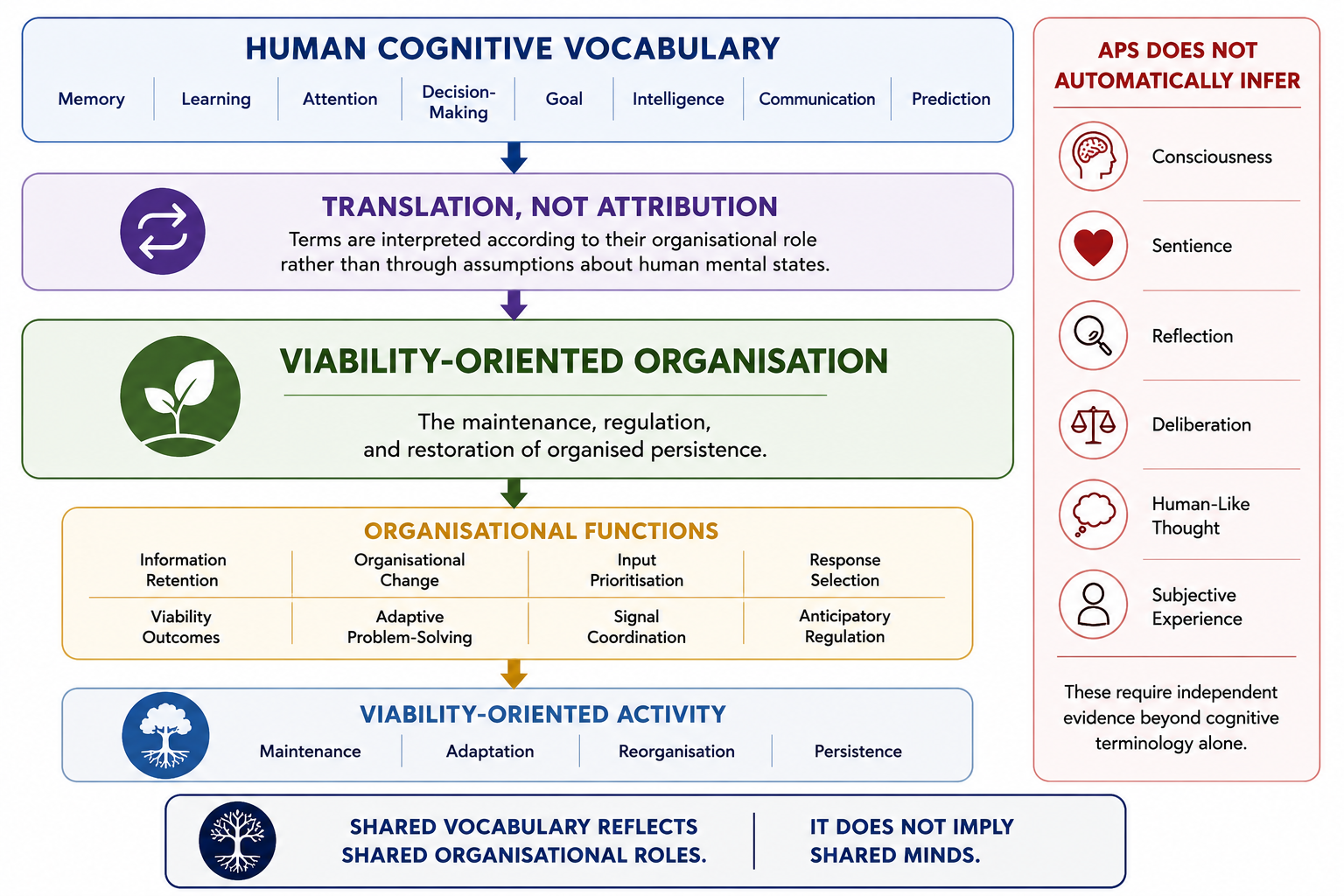
Naturalising Cognitive Language in APS. APS interprets cognitive vocabulary through viability-oriented organisation rather than assumptions about human mental states. Cognitive terms are translated into organisational functions that contribute to maintenance, adaptation, reorganisation, and persistence. Shared cognitive vocabulary therefore reflects shared organisational roles rather than shared minds. Such translation does not by itself establish cognitive status.
The visual highlights the interpretive purpose of the lexicon. Cognitive vocabulary can be translated into organisational terms without deriving its meaning from assumptions about human psychology. Terms such as memory, learning, attention, and decision-making may identify biologically important functions contributing to organised persistence, but identifying those functions does not by itself establish cognition. Translation clarifies what is being compared; attribution requires further explanatory and empirical warrant.
Functional Equivalence Without Sameness
One of the most important distinctions maintained by APS is the difference between functional equivalence and organisational sameness. Living systems may exhibit comparable forms of information use, regulation, learning, memory, or anticipation while differing profoundly in their underlying mechanisms, architectures, and capacities. Shared terminology therefore identifies similarities of organisational role rather than identities of structure or experience.
This distinction is particularly important when cognition is discussed across diverse biological systems. A bacterium may modify future behaviour on the basis of past environmental conditions. A plant may alter developmental trajectories in response to previous stress. An animal may learn through neural plasticity. A human may combine memory, language, and abstract reasoning. These processes differ enormously in complexity and implementation, yet all involve the retention and use of information in ways that influence future activity.
APS therefore employs cognitive language comparatively rather than uniformly. Comparison can identify organisational similarities and differences across living systems, but comparable organisational roles do not themselves establish a common cognitive status. Similar terminology may be useful where its organisational referent is made explicit, while the question of cognition remains independently assessable.
This principle is especially important for avoiding two opposite errors. One error is anthropomorphism, which projects human capacities onto non-human systems. The other is anthropocentrism, which assumes that terms such as memory, learning, or anticipation can only apply to organisms possessing human-like forms of cognition. APS rejects both positions. Organisational continuity exists across life, but continuity does not imply identity.
Human Cognition and Biological Uses of Cognitive Vocabulary
Human cognition includes capacities such as symbolic reasoning, language-based thought, abstract representation, self-reflection, deliberate planning, and complex forms of social cognition. These capacities should not be assumed whenever familiar cognitive terminology is applied elsewhere in biology.
At the same time, biological research may legitimately use terms such as memory, learning, communication, anticipation, or decision-making to identify organisational phenomena that do not depend upon human-like psychological capacities. APS therefore distinguishes the biological use of cognitive vocabulary from the attribution of cognition itself.
Within APS, cognition is the organisation of biological significance across time. Biological Agency, Biological Evaluation, Significance, and Integration provide pre-cognitive explanatory dependencies, but none independently establishes cognition. Likewise, information use, regulation, memory-like effects, learning, anticipation, and adaptive flexibility may be relevant to cognitive investigation without individually being sufficient for cognitive attribution.
Questions about plant cognition, microbial cognition, minimal cognition, or other disputed cases therefore cannot be settled by vocabulary or organisational analogy alone. They require comparison with adequate non-cognitive explanations of the same phenomenon. This allows continuity in biological organisation to be investigated without converting continuity into an automatic cognition verdict.
Terms Requiring Special Caution
Some cognitive terms carry particularly strong psychological associations and therefore require additional care when used outside human contexts. Although APS does not prohibit the use of such language, it emphasises that these terms cannot be extended across living systems merely because other cognitive capacities have been identified.
Consciousness and sentience are the clearest examples. The presence of information-guided regulation, learning, memory, anticipation, or adaptive behaviour does not by itself establish the existence of subjective experience. Demonstrating consciousness requires evidence beyond organisational responsiveness alone. APS therefore treats consciousness and sentience as questions that remain open and empirical rather than as automatic consequences of cognitive organisation.
Similar caution applies to terms such as reflection, deliberation, imagination, and self-awareness. In ordinary usage these concepts typically imply sophisticated forms of internal organisation associated with particular classes of organisms. Their extension beyond those contexts requires positive evidence rather than analogy or metaphor.
This caution should not be mistaken for scepticism about biological cognition. APS recognises the widespread importance of information-guided regulation throughout life. What it rejects is the assumption that all cognitive language carries the same implications in every context. Conceptual discipline requires distinguishing carefully among different forms of organisation and avoiding conclusions that exceed available evidence.
The purpose of the APS cognitive lexicon is therefore not to expand cognitive terminology indefinitely but to stabilise its interpretation. By clarifying how cognitive language is used, APS seeks to support comparative inquiry while preserving the distinctions necessary for rigorous biological explanation.
The APS Cognitive Lexicon
The following lexicon provides a reference framework for interpreting cognitive terminology within APS. It should be understood as a guide to usage rather than as a set of definitions that independently establish cognitive status. The lexicon explains how familiar cognitive terms are translated into descriptions of organisational functions grounded in viability-oriented organisation.
Agency and Normativity
The first group of terms concerns agency, goal-directedness, and biological normativity. These concepts describe how living systems regulate activity relative to viability and organised persistence. Although several of these terms possess strong psychological associations in everyday language, APS interprets them through their organisational role within viability-oriented activity.
Agency, goals, values, and adaptation are not treated as projections of human intentionality onto nature. Instead, they describe organisational features through which living systems maintain, regulate, and restore themselves through time. The resulting vocabulary provides a way of discussing biological purposiveness without requiring assumptions about conscious intention or reflective thought.
|
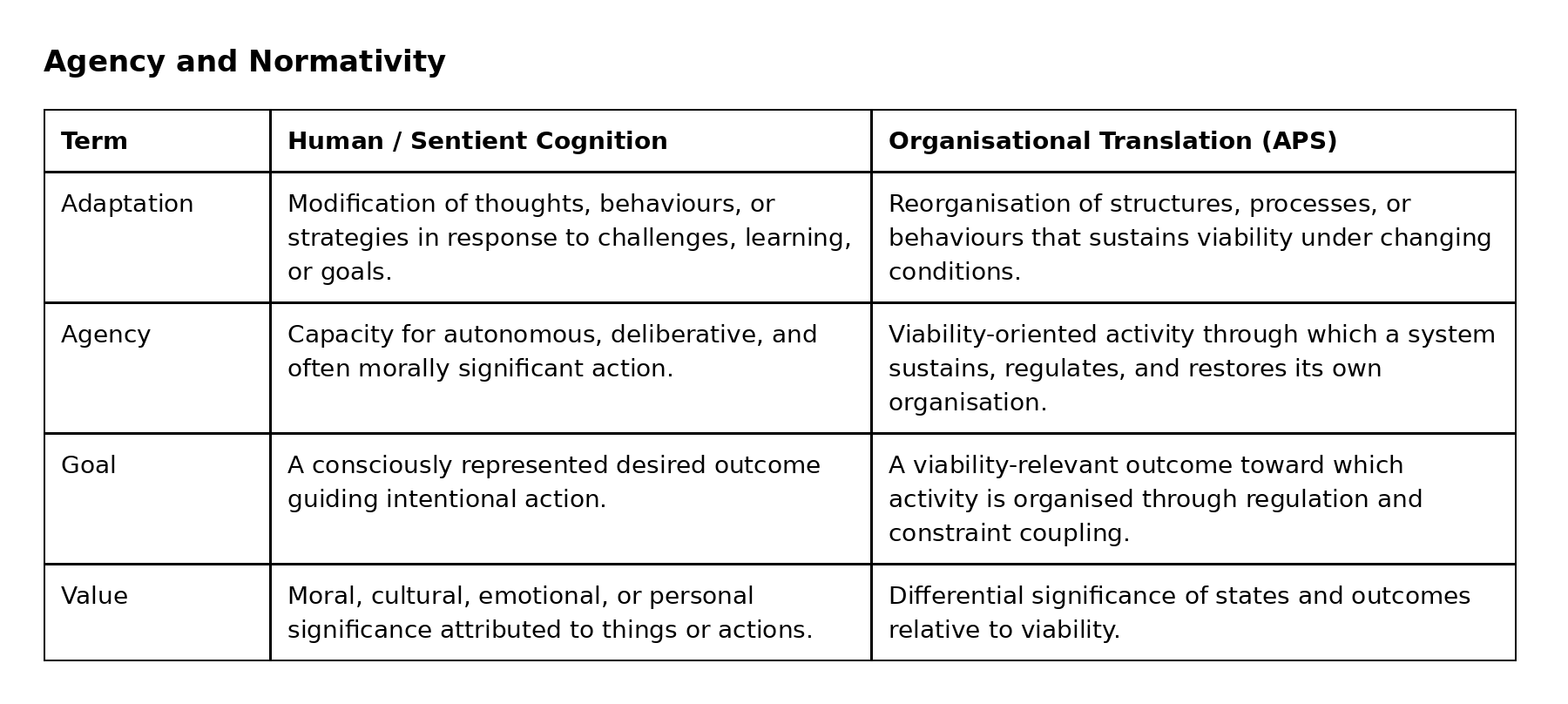
Agency and Normativity. Comparison of familiar human or sentient uses of agency-related terminology with their organisational translation within APS.
Information and Regulation
Many cognitive terms concern the acquisition, processing, and use of information. APS interprets these concepts through their contribution to viability-oriented regulation rather than through assumptions about conscious awareness, symbolic representation, or subjective interpretation.
Information becomes biologically meaningful when it influences the organisation of activity relative to viability. Cognitive language in this domain therefore concerns how organisms detect, evaluate, communicate, and employ information in ways that support organised persistence.
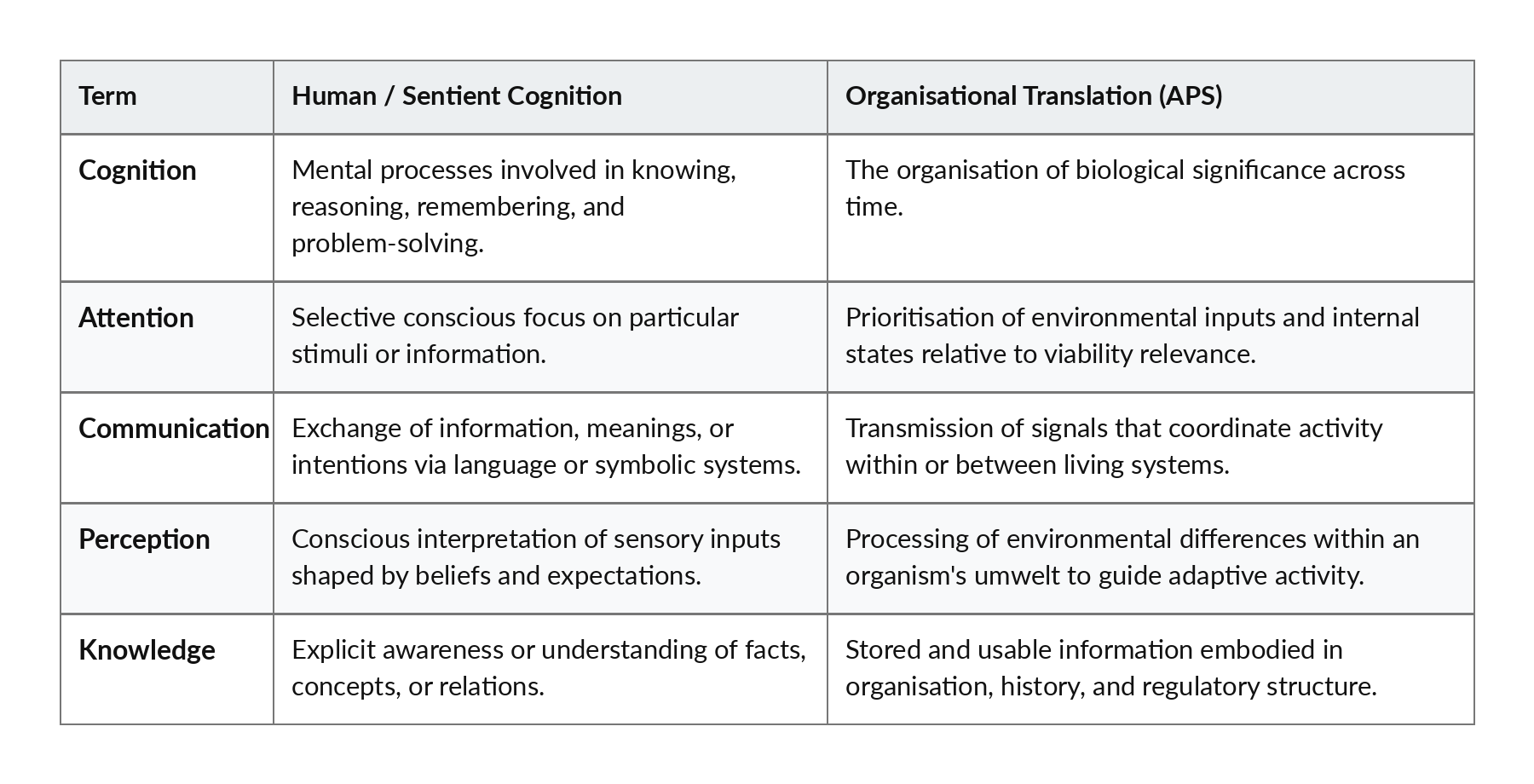
Table 7. Organisational translations of cognition-related terms. APS distinguishes familiar human or sentient meanings of cognition, attention, communication, perception, and knowledge from their biologically grounded organisational counterparts.
Persistence and Change
Living systems persist partly because information from past interactions can influence future activity. Terms in this section concern the retention, modification, and cumulative effects of organisational states through time.
APS interprets memory, learning, and experience as aspects of ongoing biological organisation. These processes allow organisms to carry information forward, modify future responses, and maintain continuity despite changing internal and external conditions.
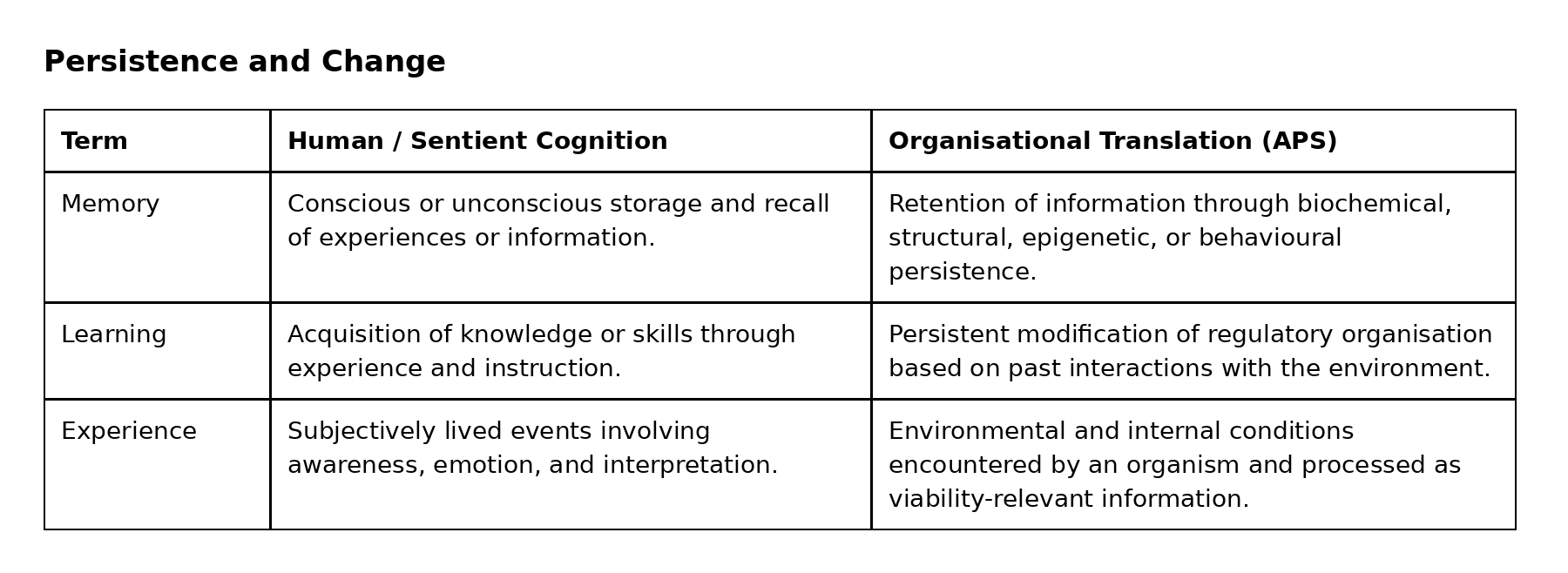
Persistence and Change. APS translations of memory, learning, and experience as organisational phenomena through which past conditions can influence future activity.
Anticipation and Action
Living systems frequently alter activity in ways that reflect expected future conditions or anticipated consequences. APS interprets these capacities through the organisational dynamics of anticipation, response selection, and viability-oriented regulation.
Terms such as decision-making, prediction, foresight, and problem-solving therefore refer to ways in which organisms coordinate present activity relative to future possibilities. Although these concepts often carry strong psychological associations, their biological interpretation concerns organisation rather than conscious deliberation.
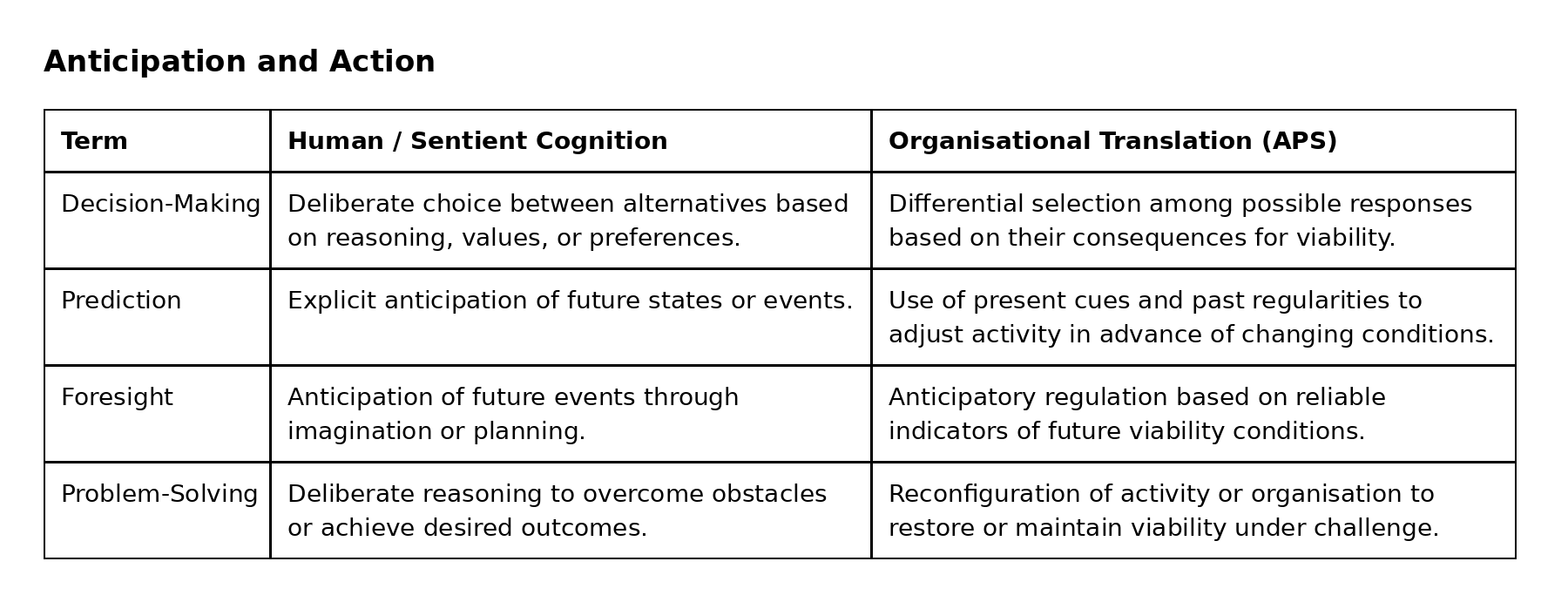
Anticipation and Action. APS translations of decision-making, prediction, foresight, and problem-solving in terms of viability-oriented organisation.
Higher Cognitive Terms
Some cognitive terms carry especially strong associations with human cognition and are therefore particularly vulnerable to anthropomorphic interpretation. APS does not prohibit their use, but it employs them cautiously and interprets them through organisational function rather than assumptions about subjective mental life.
These concepts often describe highly elaborated forms of information-guided regulation in humans and other animals. When applied more broadly, their meaning must remain grounded in organisational role and empirical evidence rather than analogy alone.
For these higher cognitive terms, an organisational comparison is not an attribution rule. Their application beyond established contexts requires proposition-specific evidence; viability-oriented regulation alone does not establish intelligence, creativity, intention, or reason.
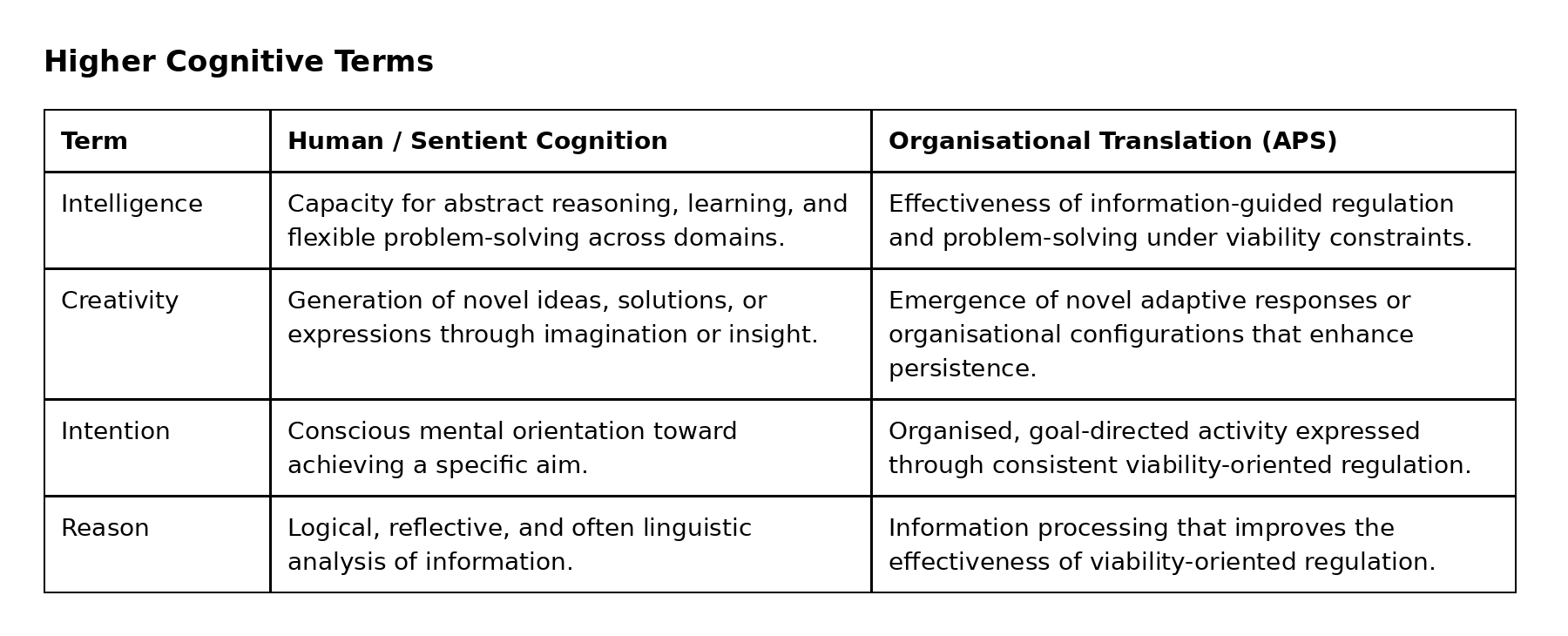
Higher Cognitive Terms. Organisational comparisons for intelligence, creativity, intention, and reason. These translations identify possible organisational referents and do not by themselves establish cognitive attribution.
What the Lexicon Does Not Do
The APS cognitive lexicon is a guide to interpretation rather than a criterion of classification. Its purpose is to clarify how cognitive terminology is used within the framework, not to determine which systems should or should not be regarded as cognitive. Vocabulary alone cannot settle questions about cognition because cognition is ultimately a matter of organisation rather than language. Nor does organisational translation settle that question. Within APS, cognitive attribution requires materially implemented explanatory dependencies concerning the organisation of biological significance across time that are not exhausted by an adequate non-cognitive account of the same phenomenon.
The lexicon therefore does not define life, agency, or cognition independently of the broader APS framework. These concepts are grounded in viability-oriented organisation, organised persistence, and biological agency. Understanding the meaning of a term does not eliminate the need for empirical investigation into the systems to which that term may apply.
Nor does the lexicon imply consciousness, sentience, subjective experience, or human-like mentality. The use of cognitive language may highlight important organisational functions, but such functions do not automatically establish the presence of psychological capacities. Questions concerning consciousness remain separate questions requiring their own forms of evidence.
Finally, the lexicon does not resolve borderline cases. Disputes concerning minimal cognition, plant cognition, microbial cognition, collective cognition, or synthetic systems cannot be settled through terminology alone. These remain empirical and theoretical questions concerning the organisation of particular systems and the forms of information-guided regulation they exhibit.
Conclusion
APS does not reject cognitive language. On the contrary, it recognises that terms such as memory, learning, communication, anticipation, and decision-making often capture important features of biological organisation. What APS rejects is the assumption that such language carries identical implications in every context in which it is used.
The cognitive lexicon therefore functions as a conceptual guardrail. It provides a disciplined framework for interpreting cognitive terminology through viability-oriented organisation while preventing mentalistic drift, anthropomorphic inflation, and category errors. In doing so, it supports comparative inquiry across the diversity of living systems without erasing the differences that distinguish them.
The result is a vocabulary that remains biologically meaningful while preserving conceptual clarity. Cognitive language becomes a tool for describing organisational functions rather than a source of confusion about minds, experiences, or psychological capacities.
Shared vocabulary reflects shared organisational roles. It does not imply shared minds.
See Also
Related Articles
References
- (2017). Sensorimotor Life: An Enactive Proposal. Oxford University Press.
- (2018). Everything Flows: Towards a Processual Philosophy of Biology. Oxford University Press.
- (2006). The Biogenic Approach to Cognition. Cognitive Processing, 7(1), 11–29 . https://doi.org/https://doi.org/10.1007/s10339-005-0018-6
- (2021). The Cognitive Cell: Bacterial Behavior Reconsidered. Frontiers in Psychology, 12 . https://doi.org/https://doi.org/10.3389/fpsyg.2021.650726
- (1980). Autopoiesis and Cognition: The Realization of the Living. D. Reidel Publishing Company.
- (2026). Agency as the Defining Activity of Life: A Viability-Oriented Framework Integrating Process and Scale. Biological Theory . https://doi.org/https://doi.org/10.1007/s13752-026-00547-6