What Is a Taxon in APS?
Biological classification depends on taxa, but a taxon, a taxonomic rank, and a classification are not the same thing. APS interprets taxonomic practice by asking what biological entities, relationships, or recurring patterns a taxon is intended to identify, what evidence supports that identification, and over what spatial, temporal, and organisational extent the relevant relations hold. This does not determine the ontology of taxa, prescribe a uniquely correct classification, or replace established systematic and phylogenetic methods.
Key Points
- A taxon, a taxonomic rank, and a taxonomic classification are related but distinct.
- Species are taxa, but not every taxon is a species, and different taxa need not share a single biological ontology.
- Taxonomic claims are constrained by biological evidence; classification is not identical with the biological entities or relationships it represents.
- Taxonomic rank is not APS Scale: relevant biological relations may extend across different spatial, temporal, and organisational extents.
- APS does not infer a universal causal pathway generating taxa or taxonomic boundaries from its evolutionary architecture.
Where This Article Fits
*This article extends APS into biological taxonomy and systematics. It follows the distinction developed in What Is a Species in APS? between biological history, species, and species classification, but addresses the broader question of taxa at different taxonomic ranks. APS does not propose an alternative taxonomic system, species concept, or method of phylogenetic inference. Its narrower purpose is to clarify what is being identified when a taxon is recognised, how that identification relates to biological evidence and historical continuity, and where classification ends and biological explanation begins.
Introduction — What Is the Taxon Question?
Taxonomy is indispensable to biology. Biologists identify, name, compare, and classify organisms and other biological groups so that biological diversity can be investigated and communicated. Yet the familiar language of taxonomy can conceal several different questions. When a biologist identifies a taxon, what exactly is being identified? Is it a biological entity or relationship, a named group, a taxonomic rank, or a position within a system of classification?
These questions should not be collapsed. A taxon is not the same thing as the rank assigned to it, and neither is identical with the classificatory system through which it is represented. Modern systematics also draws on multiple forms of biological evidence and on phylogenetic reconstruction rather than deriving classifications from a single defining property or method.
APS approaches this situation through its concern with organised persistence and transformation. It asks what biological continuity or organisation a taxonomic claim is intended to track, what evidence warrants that claim, and over what spatial, temporal, and organisational extent the relevant relations hold. These questions can supplement taxonomic and systematic investigation, but they do not determine the answers in advance.
Taxa, Ranks, and Classification
Three terms must first be distinguished.
A taxon is a biologically grounded unit recognised within taxonomy. A named species is therefore a taxon, but taxa also occur at other recognised taxonomic ranks.
A taxonomic rank is the classificatory category or position at which a taxon is treated—for example, species, genus, or family. The taxon and its rank are consequently not interchangeable. A biological group recognised as a particular taxon is not identical with the general category to which it is assigned.
Taxonomic classification is broader again. It concerns the scientific practices and representational systems through which taxa are identified, delimited, named, compared, ranked, and related. Systematics additionally investigates biological diversity and relationships using relevant evidence and methods.
The distinction can therefore be expressed schematically as:
biological target ≠ taxon ≠ taxonomic rank ≠ taxonomic classification
The symbols do not imply that these are independent. Taxa are recognised through scientific investigation; ranks and classifications organise them; and classifications are constrained by evidence concerning the biological entities and relationships being investigated. The point is simply that representation should not be confused with what is represented.
What Does a Taxon Identify?
The question becomes more difficult when we ask what a taxon identifies biologically.
There is no need for APS to answer this by stipulating that every taxon is the same kind of entity. Taxonomic practice can concern historical relationships, populations, species, lineages, clades, or other biologically warranted groupings. Different taxonomic questions may therefore involve different biological relations and different evidential requirements.
This matters because the former APS formulation—treating a taxon simply as a classificatory designation applied to organised persistence—answered the ontological question too quickly. A scientific classification is certainly a representation, but it does not follow that whatever it represents is merely classificatory. Nor does the fact that APS investigates organised persistence establish that organised persistence is itself a complete ontology of taxa.
The more restricted APS question is therefore: what biological entity, relationship, or recurring pattern is this taxonomic claim intended to identify, and what warrants treating it as such?
Organised persistence can be relevant to that inquiry where historical continuity through change is part of the explanandum. It does not substitute for the biological evidence by which the taxon is recognised.
Species and Other Taxa
Species are among the most familiar taxa, but they do not exhaust taxonomy. Every species is a taxon, whereas not every taxon is a species.
That simple relation should not be turned into the stronger claim that species and higher taxa differ merely by representing narrower and broader versions of the same biological thing. Nor should species be defined simply as classifications of lineages. As discussed in the APS treatment of species, historical lineage continuity, species, and species classification are related but analytically distinguishable.
The same caution applies more broadly. The word taxon does not by itself tell us what sort of biological entity has been identified. Recognising something as a taxon therefore does not establish that species, genera, families, and other taxa must all possess the same ontology, causal status, or mode of historical continuity.
Taxonomy supplies an organised means of identifying and relating biological diversity. The biological interpretation of particular taxa remains a substantive scientific question.
The APS Interpretation — Continuity, Organisation, and Historical Change
APS contributes to taxonomy by making a particular set of questions explicit.
Where taxonomic relationships concern historical continuity, APS asks what persists through change. Where a biological grouping remains recognisable despite variation among its members or transformation through time, APS asks what relations support that continuity. Where taxonomic evidence spans different organisms, populations, lineages, environments, or periods, APS asks over what spatial, temporal, and organisational extent the relevant relations must be investigated.
These are questions about Agency, Process, and Scale as analytic projections of living organisation, not alternative taxonomic categories. Agency concerns viability-oriented activity in living systems; Process concerns the maintenance and transformation of organisation through time; Scale concerns the extent over which the relevant relations are organised and investigated.
None of this supplies a universal mechanism for the production of taxa. Inheritance, variation, development, adaptation, fitness, natural selection, ecological interaction, and other processes can all matter to evolutionary histories. Their relevance and relationships must nevertheless be established for the particular biological case and explanandum. Their ordering within APS does not constitute a universal causal or temporal sequence generating taxa, taxonomic boundaries, or classifications.
APS therefore contributes an organisational question to taxonomy without converting its conceptual architecture into a taxonomic theory.
Evidence for Taxonomic Relationships
Taxonomic and systematic claims depend upon evidence. Morphological characters, molecular and genetic data, developmental features, ecological relationships, reproductive evidence, geographical distributions, and phylogenetic analyses can contribute to systematic investigation in different circumstances. Modern systematic practice therefore cannot be reduced to sorting organisms according to superficial similarity.
APS does not replace these forms of evidence with “organised persistence.” Instead, it asks what each source of evidence warrants about the biological target under investigation.
A morphological character may contribute to recognising or diagnosing a taxon. Molecular evidence may bear on relationships or historical divergence. Phylogenetic analysis can provide hypotheses about ancestry and branching relationships. Different evidence may converge, conflict, or address different aspects of the taxonomic problem.
This gives us another useful distinction:
evidence ≠ taxon ≠ classification
Evidence supports claims about biological entities and relationships. Taxa identify biologically grounded units within taxonomic practice. Classifications represent and organise those taxa. None of these should be substituted for the others.
<a href=“/assets/diagrams/evolution-taxon.png” target=“_blank” rel=“noopener noreferrer” class=“aps-diagram”
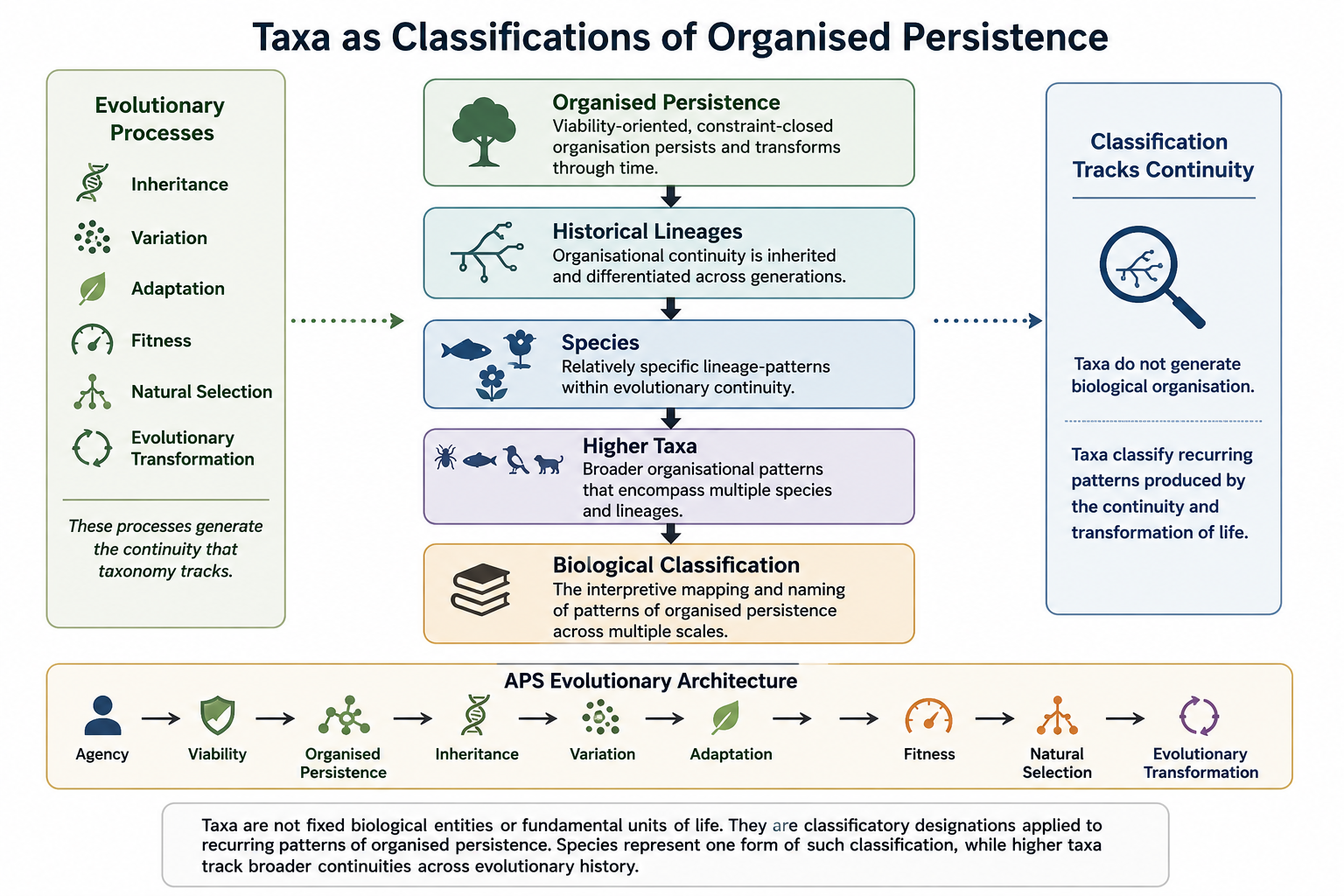
Taxa, Ranks, and Classification in APS. Biological evidence, taxa, taxonomic ranks, and scientific classifications are related but distinct. Systematic evidence supports the recognition and comparison of taxa; ranks provide classificatory positions; and classifications organise and represent taxa and their relationships. APS Scale concerns the spatial, temporal, and organisational extent relevant to an investigation and should not be identified with taxonomic rank.
This also provides an important comparator control on APS. Existing systematics already integrates multiple forms of evidence and explicitly investigates evolutionary relationships. APS therefore cannot claim explanatory gain merely by insisting that taxonomy should be historical, relational, or evidence-sensitive.
Taxa, Biological Individuals, and Evolutionary Roles
Taxonomic status should not be confused with biological individuality.
A taxonomic name, rank, or classification does not become a biological individual or agent merely because scientists use it to represent a biological group. In APS, biological agency concerns viability-oriented organisational activity. A classificatory category as such does not maintain viability, regulate itself, or act.
But the converse inference is equally unwarranted. It does not follow that whatever biological entity a taxon denotes cannot be an individual, historical entity, causal participant, or evolutionary unit. The longstanding discussion of species as individuals illustrates why these questions require independent argument rather than resolution by terminology alone.
APS therefore leaves taxon ontology open. Particular taxa may need to be investigated as individuals, kinds, classes, lineages, clades, historical entities, evolutionary units, or in other terms appropriate to the scientific question. The framework’s contribution is to prevent the scientific representation from being mistaken for the biological organisation represented—and equally to prevent a classificatory label from deciding that organisation’s ontology in advance.
Boundaries, Delimitation, and Change
Taxonomic practice requires decisions about delimitation: where one recognised taxon ends and another begins. The difficulty of those decisions varies greatly among biological cases.
APS does not predict that taxonomic boundaries must be fuzzy merely because life is processual. Nor does it predict that boundaries must be sharp. Boundaries may be comparatively clear, graded, contested, or historically changing depending on the biological relationships involved, the evidence available, the criteria being applied, and the scientific question being addressed.
This is particularly important when classification concerns evolving biological systems. Historical transformation can alter the relations on which classifications depend, but the existence of change does not itself determine how taxa should be delimited.
The relevant question is therefore not whether APS prefers fixed or fluid boundaries. It is what biological evidence warrants the proposed delimitation in the case concerned.
Scale and Explanatory Extent
Taxonomic rank is not APS Scale.
A genus is not simply a larger biological scale than a species, and a family is not automatically a still higher organisational level. Moving through taxonomic ranks therefore should not be represented as moving through a hierarchy of APS scales.
Scale concerns the spatial, temporal, and organisational extent over which the relations relevant to an explanandum are investigated. A taxonomic problem may require attention to relations among organisms within populations, patterns extending through lineages over long periods, geographical distributions, ecological interactions, developmental organisation, or combinations of these. Which extent matters depends on the question being asked.
This distinction prevents classificatory breadth from being mistaken for biological organisation. A higher taxonomic rank may encompass a broader set of included taxa, but that fact alone establishes neither a higher organisational scale nor greater causal or explanatory priority.
APS Scale is therefore relevant to taxonomy only when it helps specify where and over what extent the biological relations pertinent to a taxonomic question are organised.
Classification as Scientific Representation
Classification is a scientific representational practice. This does not make it arbitrary.
Taxonomists make judgements about evidence, delimitation, relationships, nomenclature, and classificatory organisation. Those judgements are constrained by the biological phenomena being investigated and by the methods and criteria appropriate to the problem. Different classificatory proposals can therefore be assessed against evidence rather than treated merely as alternative naming conventions.
At the same time, a classification should not be identified with biological reality itself. Scientific representations select, organise, and make explicit relationships for particular purposes. Different questions can make different aspects of biological diversity salient, and competing classifications may sometimes disagree about which relations should govern delimitation or organisation.
APS contributes by asking whether the representation adequately tracks the organisation, continuity, or transformation relevant to the specified explanandum. It does not establish objectivity by requiring taxonomic practice to adopt APS vocabulary. The adequacy of a taxonomic claim remains answerable to biological evidence and appropriate systematic comparison.
What APS Adds — and What It Does Not Establish
APS can help keep several questions apart that are easily conflated in discussions of taxonomy.
It distinguishes the biological phenomena being investigated from the taxa used to identify them, the ranks assigned to those taxa, and the classifications through which they are represented. It directs attention to continuity through change and to the organisation supporting biologically relevant persistence. It asks which processes matter in the particular case and over what spatial, temporal, and organisational extent the relevant relations hold. And it emphasises that explanatory claims must be assessed relative to a specified explanandum and an appropriate comparator.
These distinctions can be useful without implying that existing taxonomy lacks them. Contemporary systematics already employs historical and phylogenetic reasoning, multiple forms of biological evidence, and explicit methods for identifying and comparing taxa. Processual approaches likewise already challenge static accounts of biological entities.
APS can therefore claim explanatory gain only where its organisational analysis distinguishes relevant dependencies, resolves an explanatory problem, or otherwise improves explanation relative to the strongest comparator addressing the same explanandum. Merely redescribing taxa as manifestations of organised persistence would not meet that standard.
Accordingly, APS does not establish a universal ontology of taxa, a uniquely correct classification, a universal species concept, universally graded taxonomic boundaries, a hierarchy of biological scales corresponding to taxonomic ranks, or a fixed evolutionary sequence through which taxa are produced.
Its more limited contribution is methodological and organisational: to make explicit what biological continuity or organisation is being investigated, what evidence bears on it, what classificatory representation is being used, and what explanatory work the resulting taxonomic claim is expected to perform.
Conclusion — Taxa Within Evolutionary Biology
Taxa are indispensable to the scientific investigation of biological diversity, but taxa, taxonomic ranks, and classifications should not be treated as interchangeable. Classification represents and organises biological findings; it does not by itself determine the ontology of the biological entities or relationships represented.
APS approaches taxonomy through questions of organised persistence, historical continuity, transformation, and explanatory extent. It asks what a taxonomic claim identifies biologically, what evidence warrants that identification, which processes are relevant to the case, and over what extent the relevant relationships hold.
This interpretation leaves the substantive work of taxonomy and systematics intact. It neither replaces phylogenetic inference nor supplies species or taxon boundaries from APS principles. Instead, it provides a framework for distinguishing biological target, evidence, taxon, rank, and representation while keeping their relationships explicit.
Taxonomic classification can therefore be both interpretive and empirically constrained. Its scientific value lies not in converting evolving life into fixed categories, nor in treating every taxon as the same kind of biological entity, but in providing warranted and revisable ways of identifying, comparing, and representing biological diversity through evolutionary history.
Key Point
A taxon, its taxonomic rank, and its scientific classification are not the same thing. APS asks what biological entity, relationship, or pattern a taxonomic claim identifies, what evidence warrants it, and over what extent the relevant relations hold—without determining taxon ontology or classification in advance.
See Also
Related Articles
References
- (1998). The General Lineage Concept of Species, Species Criteria, and the Process of Speciation: A Conceptual Unification and Terminological Recommendations. Oxford University Press. https://doi.org/10.1093/oso/9780195109009.003.0005
- (2018). A Manifesto for a Processual Philosophy of Biology. Oxford University Press. https://doi.org/10.1093/oso/9780198779636.003.0001
- (1976). Are Species Really Individuals?. Systematic Zoology, 25(2), 174–191 . https://doi.org/10.2307/2412744
- (2026). Common Ancestry, Contemporary Phylogenetics, and Process Ontology. Systematic Biology . https://doi.org/10.1093/sysbio/syag053
- (2010). Plant Systematics. Academic Press. https://doi.org/10.1016/C2009-0-02260-0
- (2026). Agency as the Defining Activity of Life: A Viability-Oriented Framework Integrating Process and Scale. Biological Theory . https://doi.org/10.1007/s13752-026-00547-6