From Viability to Normativity
This article explains how biological normativity arises within the APS framework. APS explains biological normativity as an emergent consequence of viability-oriented organised persistence. Norms, functions, purposes, and meanings are not externally imposed upon living systems but arise through the evaluative organisation required to maintain viability across time. Because biological agents must maintain the conditions of their own persistence, they must evaluate states, actions, and outcomes as more or less supportive of continued organisation. Viability grounds agency, agency requires evaluation, and evaluation generates biological normativity.
From Viability to Normativity - Why This Connection Matters
Biology routinely employs concepts that appear normative. Organisms are described as functioning well or poorly, adapting successfully or unsuccessfully, regulating effectively or ineffectively, and responding appropriately or inappropriately to changing conditions. Functions can succeed or fail. Adaptations can be advantageous or maladaptive. Biological systems can malfunction, recover, or break down.
Yet the origin of these normative distinctions remains a persistent question within theoretical biology and the philosophy of biology. Why should living systems support distinctions between better and worse states at all? Where do biological norms come from? Are they imposed by observers, inherited from evolutionary history, or grounded in the organisation of life itself?
APS approaches these questions from a different direction. Rather than beginning with function, purpose, adaptation, or normativity, it begins with the more fundamental problem that every living system must solve: maintaining itself as a viable organisation through time. From this perspective, normativity is not a starting point but an outcome. To understand where biological norms come from, it is first necessary to understand why living systems must remain viable and how that requirement gives rise to agency.
Viability as the Fundamental Biological Constraint
Living systems exist only because they continuously maintain forms of organisation that would otherwise decay. Unlike many non-living systems, organisms do not persist simply because they remain unchanged. They persist by continually reorganising themselves while preserving the organisational conditions necessary for continued existence.
APS describes this condition as organised persistence. Living systems survive because they actively maintain the relationships, processes, and constraints that constitute them as living systems. Their continuity therefore depends not upon static structure but upon the ongoing preservation of viability.
Viability refers to the conditions under which organised persistence remains possible. These conditions vary across organisms, environments, and scales of organisation, but the principle remains the same. A living system must remain within ranges compatible with the continued maintenance of its organisation. When those conditions can no longer be sustained, persistence fails and the organisation breaks down.
This requirement is more fundamental than any particular biological mechanism. Metabolism, regulation, development, behaviour, and reproduction all contribute to viability, but none define it. Viability is the organisational condition that makes these activities biologically significant in the first place.
For APS, viability therefore occupies a foundational explanatory role. Biological explanation begins not with information, computation, goals, or norms, but with the organisational conditions required for continued persistence.
Agency as Viability-Oriented Activity
Viability cannot be maintained passively. Living systems exist within changing environments and are continually exposed to internal and external disturbances. Nutrients become depleted, temperatures fluctuate, structures degrade, and conditions shift across multiple temporal and spatial scales. Persistence therefore requires ongoing activity.
This activity is not merely motion, metabolism, or behavioural output considered in isolation. What matters is the organisation of activity relative to the maintenance of viability. Biological systems act in ways that contribute to sustaining the conditions under which their continued persistence remains possible.
APS describes such activity as biological agency. Agency is not defined by intelligence, deliberation, consciousness, or representation. Nor is it restricted to complex organisms. Instead, agency refers to the organised capacity of a living system to generate and regulate activity in ways that contribute to the maintenance of its own viability.
Seen in this way, agency emerges naturally from the requirements of organised persistence. A system organised around maintaining viability must continually produce activities that support that maintenance. Agency is therefore not an additional property layered upon life. It is a consequence of viability-oriented organisation itself.
This relationship can be expressed in a simple formulation:
Viability grounds agency.
Living systems must remain viable in order to persist. Maintaining viability requires organised activity. Agency emerges as the expression of that viability-oriented activity.
Understanding this connection provides the first step toward explaining the origin of biological normativity. Once living systems are understood as agents organised around maintaining viability, a further question immediately arises: how can such agents distinguish between activities that support persistence and those that undermine it? The answer to that question introduces the next step in the sequence—evaluation.
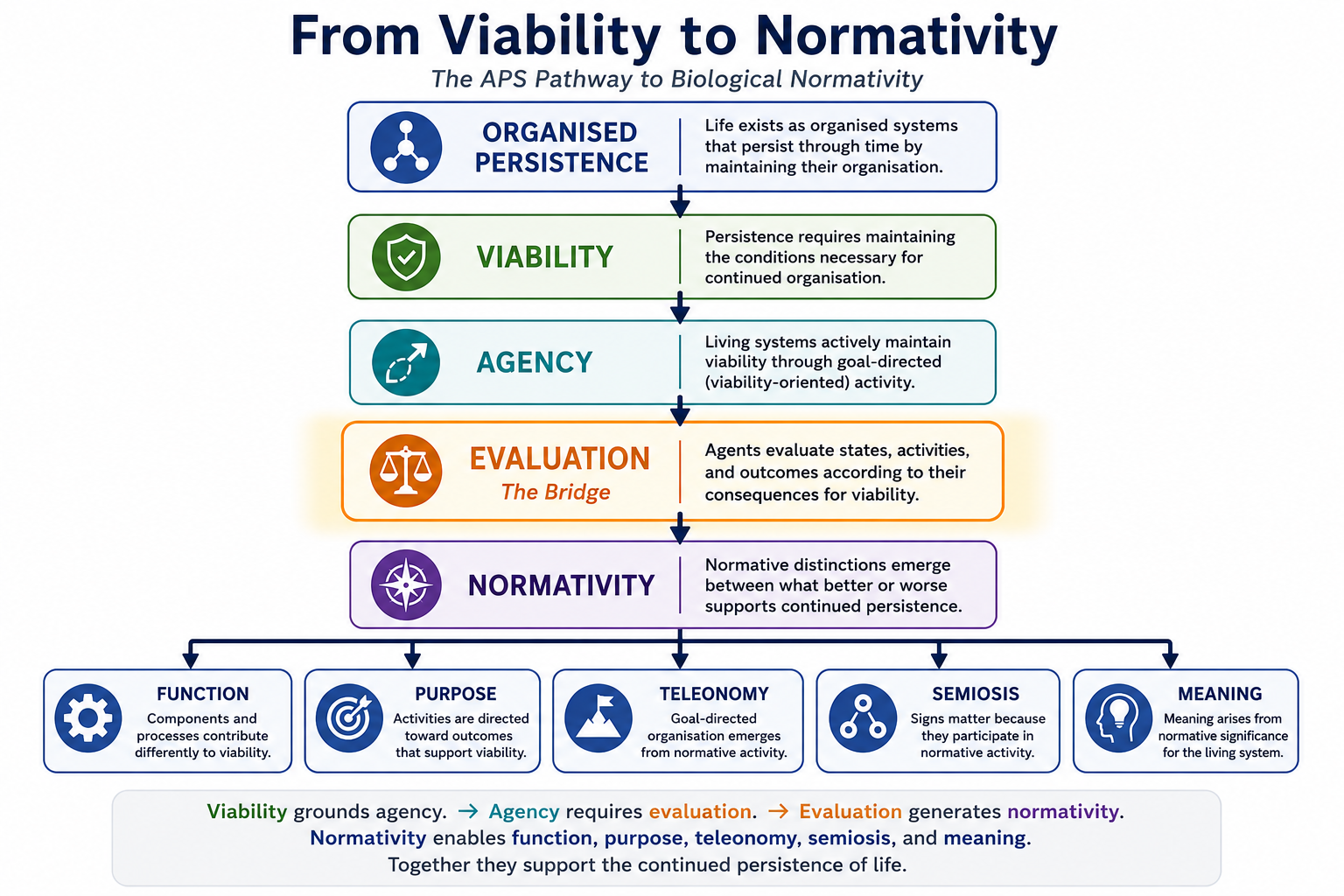
Figure. The APS explanatory pathway from organised persistence to biological normativity. Living systems maintain viability through agency. Agency requires evaluation, and evaluation generates the normative distinctions that support function, purpose, teleonomy, semiosis, and meaning.
Agency Requires Discrimination
If agency is viability-oriented activity, then agency alone is not sufficient to explain how living systems maintain themselves. Activity can contribute to persistence, but it can also undermine it. A system organised around viability must therefore do more than act. It must, in some manner, distinguish between conditions that support continued persistence and those that threaten it.
This requirement follows directly from the nature of organised persistence. Living systems exist in changing environments and continually encounter fluctuations, perturbations, and challenges. The same action may contribute to viability under one set of conditions and diminish it under another. Activity must therefore be sensitive to differences that matter for continued persistence.
At this point a further organisational requirement becomes apparent. A viability-oriented agent must be capable of discriminating between states, conditions, and outcomes relative to their consequences for viability. Without such discrimination, activity would be organisationally blind. Persistence could not be maintained because the system would possess no basis for responding differently to conditions that support or undermine its continued existence.
Agency therefore implies a capacity for discrimination. To act in ways that contribute to persistence, a living system must distinguish between organisationally significant alternatives.
Evaluation as an Organisational Requirement
APS describes this capacity as evaluation.
Evaluation does not refer primarily to conscious judgement, reflective thought, or explicit decision-making. Nor does it require symbolic representation or sophisticated cognition. Evaluation is a more fundamental organisational phenomenon. It consists in the capacity of a viability-oriented system to differentiate conditions, activities, and outcomes according to their significance for continued persistence.
This distinction is important because evaluation is often associated with higher cognitive processes. APS instead treats evaluation as a general feature of living organisation. Wherever a system regulates its activity relative to conditions that support or threaten viability, evaluation is already present in an organisational sense.
A bacterium moving up a nutrient gradient, an immune system responding differently to compatible and incompatible conditions, a developing organism correcting perturbations during development, and a complex animal modifying behaviour in response to changing circumstances all exhibit forms of evaluation. The mechanisms differ enormously, but the underlying organisational principle remains the same: activity is differentiated relative to viability.
Evaluation therefore occupies a pivotal position within the APS framework. Without evaluation there is no basis for distinguishing successful from unsuccessful activity and therefore no foundation for biological function. It links agency to the broader explanatory phenomena traditionally associated with biological normativity. A viability-oriented agent cannot remain indifferent to the consequences of its activities. To maintain persistence, it must organise activity in relation to distinctions that matter for viability.
Evaluation thus emerges as a necessary consequence of agency itself.
Evaluation and Biological Regulation
The significance of evaluation becomes particularly clear when examining biological regulation. Living systems continually modify their activities in response to changing internal and external conditions. They repair damage, compensate for disturbances, adjust developmental trajectories, reorganise behaviour, and alter physiological processes.
Such regulation cannot be understood solely as mechanical reaction. Regulatory activity depends upon organisational distinctions between conditions that are more or less compatible with continued persistence. The system must respond differently because different conditions have different implications for viability.
Evaluation therefore underlies many phenomena already discussed elsewhere within APS. Adaptation depends upon evaluation because adaptive change requires differential responses to varying conditions. Resilience depends upon evaluation because recovery from perturbation requires distinguishing between organisationally stabilising and destabilising pathways. Development depends upon evaluation because developmental organisation must continually maintain continuity despite ongoing transformation. Even repair presupposes distinctions between conditions that preserve organisational integrity and those that compromise it.
Across these diverse examples, evaluation functions as a unifying explanatory principle. It provides the organisational bridge linking viability-oriented agency to the regulatory capacities that characterise living systems.
The Emergence of a New Question
The introduction of evaluation changes the explanatory landscape. Once a living system differentiates states, activities, and outcomes relative to viability, distinctions begin to emerge between what contributes to persistence and what undermines it, between successful and unsuccessful activity, and between organisationally favourable and unfavourable conditions.
At this point the question is no longer how living systems act, but how such distinctions acquire normative significance. Why do some states count as better than others? Why can biological activities succeed or fail? Why do concepts such as function, malfunction, adaptation, and error become meaningful within living systems?
These questions lead directly to the next stage of the argument.
Agency requires evaluation.
If viability grounds agency, then agency in turn requires evaluation. The capacity to distinguish between conditions relative to persistence is not an optional addition to biological organisation. It is a necessary consequence of viability-oriented agency itself.
The emergence of evaluation therefore establishes the foundation upon which biological normativity can arise.
Normativity should not be confused with viability itself. Viability specifies the organisational conditions under which persistence remains possible. Normativity emerges only when a viability-oriented agent evaluates conditions, activities, and outcomes relative to those requirements.
Normativity Emerges from Evaluation
Evaluation introduces a distinction that was not present at the level of viability or agency alone. Once a living system differentiates states, activities, and outcomes according to their consequences for persistence, some possibilities become organisationally preferable to others. Certain conditions support viability, while others undermine it. Certain activities contribute to continued persistence, while others increase the likelihood of breakdown.
At this point normative distinctions emerge naturally from the organisation of the system itself. Conditions can be better or worse relative to viability. Activities can be more or less successful in maintaining organised persistence. Outcomes can contribute to or detract from the continuation of life.
APS therefore does not treat normativity as an externally imposed feature of biological description. Normativity does not originate in human judgement, observer preference, or conceptual convention. Nor is it introduced as a primitive property of living systems. Instead, normativity emerges from the evaluative organisation required by viability-oriented agency.
This emergence does not imply conscious awareness or reflective judgement. A living system need not represent norms in order to embody them. Normative distinctions arise because the organisation of the system itself establishes differences between states and activities that support persistence and those that do not.
Evaluation thus provides the bridge from agency to normativity. Once activities and outcomes are differentiated relative to viability, normative distinctions become unavoidable consequences of biological organisation.
Function, Purpose, and Malfunction
The emergence of normativity helps explain several concepts that have long occupied central positions within biological explanation.
Function becomes intelligible because biological activities can contribute differently to organised persistence. A structure or process can be described as functioning when it participates in maintaining the viability of the system within which it is organised. Function is therefore not merely a description of what a component does, but an account of its role within a viability-oriented organisation.
Purpose can likewise be understood without invoking external design or intentional planning. Biological systems are organised around the maintenance of viability. Activities directed toward sustaining that organisation therefore exhibit purposive character, not because they are guided by explicit intentions, but because they are organised around conditions necessary for persistence.
Malfunction becomes possible for the same reason. If activities and structures can contribute to persistence, they can also fail to do so. A malfunction is not simply an unexpected event or an observer-defined abnormality. It is a disruption of activities or relationships that normally contribute to maintaining organised persistence.
Normativity therefore explains why biological systems support distinctions between proper functioning and malfunction, successful and unsuccessful regulation, adaptive and maladaptive outcomes. These distinctions are not imposed from outside biological organisation. They arise from the evaluative structure of viability-oriented agency itself.
Teleonomy and Normative Organisation
Teleonomy occupies an important position within the sequence developed in this article. Biological systems frequently appear goal-directed. Organisms regulate internal conditions, repair damage, acquire resources, avoid threats, and coordinate activities in ways that seem oriented toward particular outcomes. The challenge has long been to explain this apparent purposiveness without appealing to external design, conscious intention, or mysterious vital forces.
APS approaches this problem through the concepts of viability, agency, evaluation, and normativity. Living systems do not exhibit teleonomic organisation because they possess externally imposed goals. Rather, they exhibit teleonomic organisation because they are organised around maintaining the conditions necessary for continued persistence. Activities become directed toward particular outcomes insofar as those outcomes contribute to viability.
Evaluation provides the crucial link. A viability-oriented agent must differentiate between conditions that support persistence and those that undermine it. As these distinctions emerge, some outcomes become organisationally preferable to others. Regulatory activity, adaptive responses, developmental processes, and behavioural adjustments are therefore organised in ways that tend to preserve viability. The resulting organisation appears goal-directed because activity is systematically oriented toward persistence-supporting states.
From this perspective, teleonomy is neither an independent principle nor a primitive feature of life. It emerges from the evaluative organisation of viability-oriented agency. Goal-directedness is not imposed upon living systems from outside but arises from the way living systems maintain themselves through time.
APS therefore situates teleonomy within a broader explanatory sequence. Viability grounds agency. Agency requires evaluation. Evaluation generates normativity. Teleonomic organisation emerges as one expression of these normative distinctions, appearing wherever living systems organise activity around outcomes that contribute to continued persistence.
Teleonomy is thus best understood not as the starting point of biological explanation but as a consequence of the organisational logic of life itself.
The concepts of function, purpose, teleonomy, semiosis, meaning, adaptation, and malfunction can therefore be understood as interconnected expressions of a shared evaluative organisation grounded in viability-oriented persistence.
Meaning and Semiosis
The implications of this framework extend beyond function and regulation. APS argues that semiosis and meaning also depend upon the emergence of biological normativity.
Signs become biologically significant only when they matter to a living system. A chemical cue, environmental signal, or internal indicator acquires meaning because it participates in the organisation of activities that contribute to persistence. Meaning therefore does not arise from information considered in isolation. It arises from the relationship between evaluative organisation and viability-oriented activity.
Semiosis similarly depends upon the capacity of a system to differentiate conditions according to their significance for persistence. Signs are meaningful because they participate in evaluative processes that influence activity relative to viability. Without evaluation there can be sensitivity and interaction, but there is no basis for distinguishing biologically meaningful from biologically irrelevant differences.
APS therefore situates semiosis and meaning within the broader organisational sequence developed throughout this article. Viability gives rise to agency. Agency requires evaluation. Evaluation generates normativity. Meaning and semiosis emerge within systems already organised according to these normative distinctions.
What APS Adds
Many accounts of biological normativity begin with function, evolutionary history, autonomy, or representational content. APS instead begins with organised persistence.
This shift changes the explanatory order. Rather than treating normativity as foundational, APS treats it as emergent. Normative distinctions arise because living systems must maintain viability through organised activity. Agency emerges from this requirement. Evaluation emerges from agency. Normativity emerges from evaluation.
This approach does not replace evolutionary explanation, autonomy theory, or existing accounts of biological function. Instead, it provides a broader organisational framework within which these phenomena can be understood. Evolution explains how viability-oriented organisations arise and change through time. Functional analysis explains the contributions of components within such organisations. Semiosis explains how signs participate in biological activity. APS seeks to clarify the organisational conditions that make all of these explanatory domains possible.
The result is an integrated account in which normativity is neither imposed from outside biology nor assumed as an unexplained primitive. It emerges as a consequence of the evaluative organisation required by living systems that persist through active maintenance of viability.
APS therefore reverses a common explanatory order. Rather than beginning with norms and asking how living systems acquire them, APS begins with organised persistence and shows how normativity emerges as a consequence of viability-oriented agency.
Why This Matters
The origin of biological normativity has long been a central problem within theoretical biology and the philosophy of biology. Concepts such as function, purpose, adaptation, malfunction, meaning, and regulation all appear to depend upon normative distinctions, yet the source of those distinctions has often remained unclear.
APS addresses this problem by tracing normativity back to the organisational requirements of life itself. Living systems persist only by maintaining viability. Maintaining viability requires agency. Agency requires evaluation. Evaluation generates normative distinctions between conditions that support persistence and those that undermine it.
The resulting explanatory sequence can be summarised simply:
Viability grounds agency.
Agency requires evaluation.
Evaluation generates biological normativity.
From this perspective, normativity is not an additional feature layered upon living systems. It is a consequence of the way living systems persist. Function, purpose, meaning, semiosis, adaptation, and malfunction all become intelligible as expressions of a deeper organisational logic grounded in viability-oriented organised persistence.
Normativity is therefore not the starting point of biological explanation. It is one of its most important consequences.
See Also
Related Articles
References
- (2016). A Critical Overview of Biological Functions. Springer. https://doi.org/10.1007/978-3-319-31072-5
- (1984). Language, Thought, and Other Biological Categories. MIT Press.
- (2015). Biological Autonomy. Springer. https://doi.org/10.1007/978-94-017-9837-2
- (2023). Biological Normativity. Cambridge University Press. https://doi.org/10.1017/9781009239462
- (2017). What Makes Biological Organisation Teleological?. Synthese, 194(4), 1089–1114 . https://doi.org/10.1007/s11229-014-0594-z
- (1991). Functions as Selected Effects. Philosophy of Science, 58(2), 168–184 . https://doi.org/10.1086/289610
- (2018). Everything Flows: Towards a Processual Philosophy of Biology. Oxford University Press. https://doi.org/10.1093/oso/9780198779636.001.0001
- (2026). Autonomy and Development: Distinguishing Teleological Development from Teleological Physiology. PhilSci Archive.
- (2026). Agency as the Defining Activity of Life: A viability-oriented framework integrating process and scale.. Biological Theory . https://doi.org/10.1007/s13752-026-00547-6
- (2002). Life after Kant: Natural Purposes and the Autopoietic Foundations of Biological Individuality. Phenomenology and the Cognitive Sciences, 1(2), 97–125 . https://doi.org/10.1023/A:1020368120174
- (1973). Functions. Philosophical Review, 82(2), 139–168 . https://doi.org/10.2307/2183766