Theoretical Biology and Philosophy of Biology: Boundary, Overlap, and Division of Explanatory Labour
Theoretical biology and philosophy of biology substantially overlap in subject matter, concepts, methods, and explanatory concerns, making their boundary difficult to locate through disciplinary identity alone. This article develops a comparative account of their division of explanatory labour by classifying epistemic products rather than disciplines, authors, or publication venues. It evaluates six discriminating cases using intended product, evidential responsibility, documented biological consequence, and functional non-redundancy, while retaining uptake, co-production, and null contribution as explicit controls. The comparison distinguishes second-order analysis, clarificatory contribution, ambiguous boundary cases, direct theoretical contribution, co-produced direct contribution, and null direct contribution. The results support a functional and product-relative boundary: philosophical work can contribute directly to theoretical biology when it participates in a biologically answerable explanatory or theoretical product, assumes responsibility to relevant biological evidence, and has documented consequences for biological inquiry. The article does not claim novelty for philosophy-in-science or interdisciplinary co-production; its narrower contribution is a comparative architecture for discriminating among these different forms of explanatory labour.
Key Points
- Theoretical biology and philosophy of biology substantially overlap in subject matter, concepts, methods, and explanatory concerns.
- Their boundary is better treated as a functional division of explanatory labour among epistemic products than as a fixed disciplinary division.
- Intended product, evidential responsibility, documented biological consequence, and functional non-redundancy provide the principal comparative discriminators.
- Uptake, conceptual sophistication, or interdisciplinary collaboration do not by themselves establish direct theoretical-biological contribution.
- The same comparative architecture permits second-order, clarificatory, ambiguous, direct, co-produced direct, and null direct-contribution outcomes.
1. Introduction: The Boundary Problem
Theoretical biology and philosophy of biology are recognisably different intellectual enterprises, yet the boundary between them is surprisingly difficult to state. Institutional location, disciplinary training and publication venue often provide practical indicators, but none reliably identifies the kind of explanatory work being performed. Nor does subject matter provide a clean distinction. Both fields address biological explanation, causation, mechanism, function, individuality, modelling, evidence and the interpretation of biological theory. Philosophers of biology routinely analyse problems internal to biological science, while theoretical biologists necessarily employ concepts, assumptions and standards of explanatory adequacy whose articulation can itself become philosophically consequential. The problem is therefore not whether the two fields differ, but what kind of difference is explanatorily significant when their activities overlap.
Method does not resolve the problem. Mathematical and computational modelling remain important forms of theoretical-biological work, but theoretical biology cannot plausibly be identified with formal modelling alone. Conversely, conceptual analysis is strongly associated with philosophy of biology, yet conceptual work also occurs within biological theory construction itself. Mechanistic explanation illustrates the difficulty particularly clearly. Philosophical analyses of mechanisms have reconstructed the organisation of biological explanation and scientific practice in ways deeply informed by actual biological research (Machamer et al. 2000). Whether such work should nevertheless remain classified as philosophy, or under some circumstances become part of theoretical biology, cannot be determined simply by noting that it is conceptual rather than experimental.
A similar problem arises when philosophical analysis is taken up within biological inquiry. Conceptual distinctions may affect what scientists treat as evidence, how biological categories are operationalised, which questions become tractable, or how explanatory alternatives are organised. Such consequences make a simple contrast between philosophy as reflection and biology as scientific production increasingly difficult to maintain. Recent work on philosophy within science has made this point explicit by examining cases in which philosophical tools participate in addressing scientific problems and producing scientific proposals (Pradeu et al. 2024). The existence of such interaction is therefore not itself the unresolved issue. The harder question concerns how different forms of contribution should be distinguished once substantial overlap is admitted.
The present article addresses that question by shifting the unit of analysis. Instead of attempting to assign whole disciplines, institutions or professional identities to mutually exclusive territories, it asks what the principal epistemic product of particular work is. The relevant question is therefore not simply whether an author is a philosopher or a biologist, whether a paper appears in a philosophical or biological journal, or whether its methods are conceptual, mathematical or empirical. It is what that work is principally trying to accomplish and what kind of responsibility its resulting claims assume.
This shift permits a more differentiated possibility space. Some work may remain principally second-order, analysing biological concepts, reasoning or explanatory practice. Other work may clarify biological inquiry by improving problem formulation, evidential distinctions or model interpretation. In still other cases, conceptual work may participate directly in constructing, revising or assessing a biologically answerable explanatory or theoretical product. These possibilities should not be collapsed either into a rigid disciplinary separation or into the opposite claim that philosophy and theoretical biology become indistinguishable wherever they interact.
The governing question of this article is accordingly:
When does philosophy of biology remain second-order analysis, when does it clarify biological inquiry, and when does it contribute directly to theoretical biology?
The thesis developed here is that the boundary is better understood as a functional division of explanatory labour among epistemic products than as a fixed division of subject matter, method, institution or professional identity. Theoretical-biological work characteristically constructs, revises or assesses biologically answerable explanatory or theoretical proposals. Philosophy of biology characteristically analyses the concepts, reasoning, assumptions and explanatory practices involved in biological inquiry. But these are characteristic functions rather than exclusive jurisdictions. Philosophical work can cross into direct theoretical contribution when its epistemic product becomes answerable to biological evidence and participates consequentially in biological inquiry. Equally importantly, conceptual sophistication, interdisciplinary collaboration or scientific uptake cannot by themselves establish that such a crossing has occurred.
The argument is therefore comparative rather than jurisdictional. Six deliberately contrasting cases are used to examine work ranging from second-order analysis and clarification through ambiguous boundary cases to direct and collaboratively produced theoretical contribution. The purpose is not to estimate how frequently each kind of work occurs or to establish exceptionless necessary and sufficient conditions. The cases instead test whether a common product-centred framework can discriminate among importantly different forms of explanatory labour. The architecture must therefore be capable not only of identifying direct contribution but also of returning qualified, ambiguous and null verdicts. The six-case design is explicitly diagnostic rather than statistically representative.
This contribution is deliberately limited. The article does not seek to demonstrate for the first time that philosophy can participate in science, influence scientific reasoning or contribute to interdisciplinary research. Nor does it propose that theoretical biology and philosophy of biology should be institutionally reorganised around a new demarcation. Its narrower aim is to determine whether their overlapping activities can be distinguished more adequately by attending to what epistemic product is being produced, what biological responsibilities it assumes, and what follows for biological inquiry. Before developing that account, however, it is necessary to establish how much of this territory has already been occupied by existing accounts of philosophy in science, scientific practice and interdisciplinary collaboration.
2. What Existing Accounts Already Establish
Any attempt to distinguish theoretical biology from philosophy of biology must begin by acknowledging how much of the surrounding territory has already been mapped. It would be misleading to motivate the boundary problem by assuming that philosophy is necessarily external to scientific inquiry and then presenting cases of philosophical participation in biology as evidence against that assumption. Contemporary philosophy of science already provides substantially more demanding accounts of philosophical involvement in science. The question for the present article is therefore not whether philosophy can contribute to scientific inquiry, but what remains to be distinguished once such contribution is conceded.
The clearest anticipation is the account of Philosophy in Science (PinS) developed by Pradeu et al. (2024). PinS explicitly concerns philosophical work directed toward scientific problems rather than philosophical reflection on science alone. Its core conditions combine a scientific problem, philosophical tools and a scientific proposal, thereby allowing philosophical activity to participate in the production of scientific knowledge. Just as importantly, Pradeu et al. distinguish intervention, visibility and contribution. Philosophers may intervene in science without their work becoming visible to scientists, and visibility through citation does not itself establish substantive contribution. Contribution is correspondingly treated as a demanding and graded matter rather than as a consequence of disciplinary interaction alone.
This distinction already blocks several possible novelty claims for the present article. Neither scientific uptake nor direct philosophical participation can be treated as sufficient evidence that a new boundary account has been discovered. PinS also employs criteria concerned with how philosophical work is used, including operational use and non-redundancy. The generic idea that a philosophical contribution should do something that is not already being supplied independently is therefore not new here. Nor can close engagement with scientific practice itself provide the novelty claim: PinS explicitly situates itself in relation to philosophy-of-science-in-practice and treats participation in scientific problem-solving as continuous with that broader practical orientation.
A second line of work shows that philosophical contribution need not take the form of a separable philosophical intervention imported into an otherwise biological project. Collaborative scientific practice can incorporate philosophical reflection from within. Eigenbrode et al. (2007), for example, developed philosophical dialogue as a practical resource for interdisciplinary science. On this account, clarification of concepts, assumptions and disciplinary perspectives can facilitate collaboration among scientists confronting complex problems. The important precedent is not merely that philosophers can speak to scientists, but that philosophical reflection can function within the organisation of collaborative research itself. The present account therefore cannot claim novelty for the proposition that philosophical clarification can improve interdisciplinary scientific practice.
More recent work makes this integration stronger still. Kaiser et al. (2026) describe reflective interdisciplinarity and inquiry-embedded integration in collaborations involving philosophy and biology. In these cases, participants pursue shared research questions, combine complementary forms of expertise and jointly produce epistemic products. Philosophical contributions can help structure questions, clarify concepts and assumptions, and provide common reference points within biological research rather than merely commenting on completed scientific products. The resulting epistemic work may therefore be genuinely co-produced.
This finding removes another tempting but untenable novelty claim. Co-production is not itself a new account of the boundary between theoretical biology and philosophy of biology. Neither is functional complementarity between philosophers and biologists. Inquiry-embedded collaboration already demonstrates that disciplinary contributions can become intertwined within the production of scientific knowledge. For the present argument, co-production must consequently be treated as something requiring classification rather than as the criterion that performs the classification. A jointly produced result may be scientifically consequential, but the mere fact of collaboration does not yet tell us what kind of epistemic product has been produced or how its explanatory labour should be characterised.
A related constraint concerns consequence for scientific practice. DiFrisco and Orzack (2026) argue that philosophy relevant to biology should be grounded in actual biological problems and should make a difference to scientific reasoning and practice rather than merely constructing a parallel conceptual vocabulary. This substantially anticipates any generic claim that biologically relevant conceptual analysis should have consequences for biological inquiry. The relevant question therefore cannot simply be whether philosophical work is useful, biologically informed or consequential. The unresolved problem is how such consequences should figure in a comparative boundary judgment.
Taken together, these accounts establish a demanding starting point. Philosophy can address scientific problems, employ philosophical resources in producing scientific proposals, participate in collaborative inquiry, affect scientific reasoning and practice, and contribute to epistemic products jointly produced with scientists. Uptake can be distinguished from contribution, and non-redundancy can matter when evaluating that contribution. The present article must concede all of this. Its contribution cannot consist in redescribing these established possibilities as discoveries about theoretical biology.
What these accounts do not by themselves settle is the more specific comparative problem with which this article began. Once philosophy can operate within science, when should the resulting work still be classified as second-order philosophical analysis, when does it constitute clarification of biological inquiry, and when does it cross into direct theoretical-biological contribution? Genuine uptake does not answer that question. Neither does collaboration, practical usefulness, conceptual sophistication or even co-production. A boundary account requires a way of distinguishing these outcomes without restoring a rigid disciplinary separation and without treating every biologically consequential philosophical intervention as theoretical biology.
The residual problem is therefore one of comparative classification. The relevant unit is the epistemic product, but products that arise in overlapping philosophical and biological work can assume importantly different relations to biological explanation and evidence. A useful boundary architecture must discriminate among those relations while permitting positive, qualified, ambiguous and null outcomes under the same comparison.
3. A Division-of-Explanatory-Labour Architecture
If the boundary between theoretical biology and philosophy of biology cannot be fixed by subject matter, method, disciplinary identity or collaboration alone, the relevant unit of analysis must be smaller and more functionally specific. The proposal developed here treats the epistemic product of a particular piece or phase of work as the primary unit of classification. An epistemic product may be an explanatory proposal, conceptual reconstruction, evidential distinction, model interpretation, methodological clarification or another product through which inquiry advances. The question is not who produced it, but what kind of epistemic work it performs and what responsibilities accompany its claims.
This restriction is important because the same research programme, paper or collaboration may contain more than one kind of activity. Conceptual analysis can accompany biological theory construction without becoming identical to it, while philosophical clarification can become consequential for biological inquiry without thereby constituting a new biological explanation. Classifying whole disciplines or authors would obscure these distinctions. The relevant task is instead to identify the principal product at the project phase under examination and determine how that product relates to biological explanation and evidence.
The first discriminator is therefore intended product. Work remains principally second-order when its central product interprets, reconstructs or evaluates biological concepts, reasoning or explanatory practice. It is clarificatory when it improves problem formulation, evidential distinctions, model interpretation or methodological understanding. It becomes a candidate for direct theoretical contribution when it participates in constructing or revising a biologically answerable explanatory or theoretical proposal. These categories are functional rather than occupational: author identity, disciplinary vocabulary and publication venue do not determine the classification.
Intended product alone, however, is insufficient. A work may aspire to contribute to biological theory without assuming the evidential responsibilities that such a contribution requires. The second discriminator is therefore evidential responsibility: what biological evidence could support, constrain, revise or defeat the product? A candidate direct contribution must be answerable to relevant biological evidence rather than merely discuss empirical results as illustrations. Citations to biological research, empirical examples or collaboration with biologists do not by themselves establish this responsibility. Conversely, work whose success remains primarily interpretive or methodological can be biologically well informed while remaining second-order or clarificatory.
The third discriminator is documented biological consequence. The question here is not whether the work is useful in a general sense, but whether a traceable change in biological inquiry follows from it. Such consequence can consist in changed inference, operationalisation, evidential discrimination, research questions, methodological choice, explanatory organisation or research organisation. A new experiment, mechanism or empirical discovery is not required. What matters is that the consequence is biologically constrained and source-documented. Visibility, citation, conceptual elegance or retrospective relevance remain insufficient if no such change can be identified.
A fourth discriminator controls the danger of over-attributing conceptual work to philosophy merely because philosophers were involved. Functional non-redundancy asks what distinctive epistemic capacity the product contributed within the documented research process. Support is strongest where that capacity was not already being supplied by the relevant biological explanatory practice or by ordinary biological conceptual work in the same case. This is a local functional comparison, not a claim of historical indispensability. It does not ask whether biology could ever have developed an equivalent idea without philosophy, and it does not license speculation about alternative histories.
This distinction also clarifies the role of co-production. Joint philosophical-biological authorship or inquiry-embedded collaboration can be an important feature of how a product was generated, but co-production is a provenance and division-of-labour category, not an independent positive criterion. A co-produced product counts as a direct theoretical contribution only if the ordinary burdens of evidential responsibility, documented biological consequence and functional contribution are also met. Collaboration, interdisciplinarity and participants’ own descriptions of their work cannot substitute for those requirements.
Likewise, uptake has evidential but not definitional status. Subsequent use of a conceptual distinction or framework may corroborate biological consequence, reveal operational deployment or clarify the role a contribution played. But widespread citation cannot turn second-order analysis into theoretical biology merely through reception. Uptake is therefore evidence about contribution rather than the criterion by which contribution is defined.
The architecture must also be capable of returning a null direct-contribution verdict. This is not a judgment that the work is worthless, mistaken, unscientific or irrelevant. It means only that the specified epistemic product does not cross the threshold into direct theoretical-biological contribution under the same comparative rules. Null may result because evidential responsibility is absent, biological consequence is not documented, or the claimed epistemic capacity is already fully supplied within biological inquiry. The availability of a null outcome is important because an architecture that classified every philosophically sophisticated or biologically useful intervention as direct contribution would cease to discriminate the boundary it is intended to investigate.
These dimensions operate as a decision sequence rather than as isolated labels. The analysis first fixes the epistemic product or project phase. It then identifies the intended product, specifies the biological evidence to which it is answerable, establishes any documented consequence for biological inquiry, and examines functional non-redundancy. Only after these steps is the narrowest warranted classification assigned. Uptake and co-production provide additional evidence or provenance information, while counterfactual claims are restricted to comparative capability rather than speculative historical necessity. The final classification must also state explicitly what it does not establish—for example, that a contribution was historically indispensable or that it directly produced new empirical findings. This sequence is designed to prevent conceptual sophistication, visibility or interdisciplinary prestige from automatically promoting a case to a stronger category.
The architecture permits six outcomes. Second-order analysis interprets or evaluates biological concepts, reasoning or explanation without documented construction or revision of a biologically answerable theoretical proposal. Clarificatory contribution improves problem formulation, evidential distinctions, model interpretation or methodological understanding but does not satisfy the full burden for direct contribution. Ambiguous or boundary contribution satisfies some direct-contribution conditions while others remain incompletely established. Direct theoretical contribution constructs or revises a biologically answerable explanatory product, assumes evidential responsibility, has documented biological consequence and supplies a functionally distinctive epistemic capacity. Co-produced direct theoretical contribution meets the same burden but arises through inquiry-embedded interdisciplinary production. Null direct contribution records failure to demonstrate direct theoretical contribution without denying the value of the work itself.
These categories should not be interpreted as an exceptionless logical definition of theoretical biology. The evidence developed here supports them as a calibrated comparative decision architecture, not as individually necessary and jointly sufficient conditions applicable without qualification to every possible scientific context. Intended product establishes what kind of epistemic work is being attempted; evidential responsibility and biological consequence carry the strongest burden for direct contribution; functional non-redundancy controls over-attribution; and null sensitivity prevents positive classification by default. Their value lies in their joint discriminatory performance rather than in any one criterion taken alone.
The resulting proposal is therefore deliberately modest. It does not redraw institutional boundaries between disciplines, and it does not claim that philosophy ceases to be philosophy whenever it affects biological science. It provides instead a way to ask, case by case, what epistemic product has been generated, what biological responsibilities it assumes, what changes follow from it, and whether its contribution is functionally distinctive. The following sections test whether this architecture actually discriminates among different kinds of overlapping philosophical and theoretical-biological work.
4. Second-Order, Clarificatory, and Null Controls
A useful boundary architecture must do more than identify positive cases. It must also distinguish different kinds of work that remain outside direct theoretical-biological contribution without treating them as epistemically equivalent. This is particularly important in philosophy of biology, where conceptually sophisticated work may be biologically informed, scientifically useful and methodologically consequential while nevertheless having a different principal epistemic product from a biological explanatory proposal. The following three cases therefore function as controls. They show respectively that philosophical resolution may be unnecessary for competent biological practice, that philosophical reconstruction may remain principally second-order even when it illuminates scientific reasoning, and that clarification may produce genuine epistemic gain without crossing into direct theory production.
Biological individuality and the possibility of a null result
Kovaka’s (2015) analysis of biological individuality provides the strongest sensitivity control because it challenges an assumption that a philosophical problem must be resolved before biological inquiry can proceed effectively. Questions of biological individuality are undeniably important: what counts as an individual can affect how organisms, collectives, host–parasite systems and evolutionary units are described and investigated. Yet the existence of conceptual disagreement does not entail that biological practice is paralysed until philosophy supplies a final definition.
For the present architecture, the important feature is the relation between the philosophical product and biological practice. The principal product is an analysis of individuality and its significance for scientific practice rather than the construction of a new biologically answerable explanation. The relevant biological work can continue through operational individuation suited to particular research questions even where no single philosophical resolution of individuality is accepted. This is why the case functions as a null/sensitivity control: it tests whether philosophically significant disagreement can remain non-constitutive of competent biological inquiry.
The verdict is therefore null direct contribution, not null philosophical value. A philosophical analysis may diagnose conceptual plurality, clarify assumptions, or show why a single definition should not be expected. But if biological inquiry does not depend on adoption of the proposed philosophical resolution, and no distinct biologically answerable theoretical product is thereby constructed, direct theoretical contribution is not demonstrated. Null here means only that direct theoretical contribution has not been established; it does not mean that the work is false, irrelevant, unscientific or without methodological value.
The New Mechanistic Philosophy as second-order/advisory work
The New Mechanistic Philosophy occupies a different position. Machamer, Darden and Craver’s account of mechanisms is deeply engaged with biological and neuroscientific practice. It reconstructs mechanisms in terms of organised entities and activities and has contributed to philosophical understanding of how scientists decompose systems, localise activities, formulate mechanistic explanations and pursue discovery (Machamer et al. 2000). The work is therefore neither detached from biology nor merely terminological.
Yet its principal epistemic product remains a reconstruction and analysis of explanatory practice. The framework helps articulate what mechanistic explanations are, how they are organised and how discovery strategies operate. It is strong second-order work with methodological clarification and advisory capacity, but the case does not itself establish a particular new biological mechanism.
The work is richly answerable to biological practice in the sense that its adequacy depends on representing scientific reasoning accurately. But that is not identical to assuming evidential responsibility for a specific biological explanatory proposal. Biological evidence constrains whether the philosophical reconstruction faithfully captures mechanistic science; it does not thereby turn the philosophical framework into a new mechanism explaining a particular biological phenomenon.
The resulting classification is therefore second-order/advisory, not null. The contribution is substantive: it improves understanding of biological explanation, discovery and methodological organisation. But its primary explanandum remains how biological explanation works rather than a particular biological process itself.
Practice-based individuation as clarificatory contribution
Kranke’s (2024) analysis of individuation practices occupies a third position. Here the philosophical task is not merely to propose a general concept of biological individuality, but to reconstruct how individuation actually varies across scientific contexts. The case examines how researchers identify relevant biological units in host–parasite studies and relates those decisions to research context, epistemic aims and explananda.
Kranke’s analysis reveals something positive about scientific practice: individuation is not simply the application of a single antecedent concept but can depend on what researchers are trying to explain and on the organisation of the inquiry itself. That reconstruction therefore improves methodological understanding of biological practice.
The appropriate verdict is clarificatory contribution. The work improves understanding of problem formulation, case construction and methodological choice, but it does not thereby construct a new biologically answerable theoretical explanation. Its consequence lies principally in making the organisation of inquiry more explicit and intelligible. This is enough for genuine clarification but not for the full burden of direct theoretical contribution.
The distinction matters because a binary architecture would misclassify the case in one of two ways. If every scientifically useful philosophical clarification counted as direct theoretical biology, the boundary would become too permissive. If everything short of direct theory production were treated as null, genuine clarificatory achievement would disappear. The three controls therefore establish distinct non-direct possibilities rather than a single residual category.
The next question is whether the same architecture can discriminate among cases that move closer to direct theory production.
5. Direct and Ambiguous Boundary Cases
The harder cases arise when conceptual work is taken up within biological inquiry and begins to organise the questions, evidence, or explanatory alternatives through which biological claims are assessed. Uptake alone cannot settle the boundary: a framework may be used by biologists without thereby becoming a direct theoretical-biological contribution. The comparison between work on function in de novo gene research and the Darwinian-populations framework illustrates why the stronger criteria of biological consequence and functional non-redundancy remain necessary.
Function in de novo gene research
The problem of function is especially acute in research on de novo genes. Newly identified open reading frames can display transcription, translation, molecular activity, fitness effects, or evolutionary conservation, but these forms of evidence do not answer a single undifferentiated question about whether a sequence is “functional.” Different meanings of function support different claims and impose different evidential burdens. Without those distinctions, evidence for one kind of function can too easily be treated as evidence for another.
Keeling et al. (2019) address this problem by distinguishing multiple meanings of biological function and connecting them systematically to the evidence appropriate to de novo gene research. The resulting product is not merely a philosophical taxonomy of existing uses. It provides an evidential framework through which claims about newly emerging genes can be organised and assessed.
The downstream evidence is important. Parikh et al. (2022), in a biological synthesis of de novo genes in yeast, explicitly use this framework to organise corresponding levels of evidence and function in characterising de novo open reading frames. The uptake therefore goes beyond citation or acknowledgement. The conceptual distinctions help specify what evidence should be sought and what conclusions that evidence warrants.
This provides the relevant biological consequence. The framework does not discover a new gene, identify a molecular mechanism, or generate experimental data. Its consequence is inferential and methodological: it changes how evidence concerning de novo open reading frames is organised and how functional claims are evaluated. That is sufficient under the present architecture because direct theoretical contribution does not require empirical discovery. A theoretical product may contribute by changing evidential organisation, inference, operationalisation, or the structure of biological explanation.
The non-redundancy claim must be narrower. The evidence establishes a recognisable epistemic product—an explicit mapping between distinct function concepts and evidential requirements—that is subsequently used in biological research. It does not establish that biologists could never have developed an equivalent framework independently. Non-redundancy is therefore functionally supported but not counterfactually or historically demonstrated.
On that calibrated basis, the appropriate verdict is direct theoretical contribution. Its directness lies not in philosophical authorship, scientific citation, or empirical discovery, but in the framework’s participation in the organisation of biologically answerable inference. The epistemic product becomes part of how biological claims are formulated and assessed against evidence.
Darwinian populations and evolutionary individuality
Godfrey-Smith’s (2009) Darwinian-population and Darwinian-space framework provides a multidimensional way of analysing populations and the degree to which they participate in Darwinian processes. The framework has clear relevance to questions of evolutionary individuality, transitions in individuality, and the conditions under which entities count as evolutionary individuals.
Here too, uptake is genuine. Schenkel et al. (2026) explicitly use Godfrey-Smith’s account in defining evolutionary-agential individuality. They connect graded individuality to quantification and employ these conceptual resources when formulating empirical targets concerning evolutionary reversions and internal conflict. The framework is therefore not merely cited as philosophical background; it functions as a live conceptual resource within contemporary theoretical work on evolutionary individuality.
If uptake alone determined classification, the case would appear to parallel Keeling. The stronger tests reveal a difference. Biological consequence is present, but only partially established. The Darwinian-populations framework helps determine what counts as an evolutionary individual, supports graded rather than exclusively categorical treatment, informs possibilities for quantification, and helps formulate candidate empirical searches. Yet the verified downstream evidence is itself principally theoretical. It does not establish a comparably clear change in empirical practice or demonstrate that a particular evidential organisation depends upon the framework.
The non-redundancy question is still less settled. Contemporary evolutionary biology contains several related conceptual resources for analysing selection and individuality. The available evidence demonstrates that Godfrey-Smith’s framework is used; it does not distinguish its contribution sharply enough from neighbouring resources to establish that the epistemic capacity it supplies is functionally distinctive in the relevant research process.
The appropriate verdict is therefore ambiguous/boundary contribution. This is not a disguised negative result. The case is stronger than second-order commentary because there is genuine theoretical uptake and biologically relevant use. Nor is it simply clarificatory: the framework participates in the conceptual organisation of evolutionary-theoretical questions and candidate empirical targets. But the evidence does not support promotion to direct theoretical contribution at the same confidence as the de novo-gene case.
The contrast between the two cases is consequently evidential rather than disciplinary. In the de novo-gene case, the conceptual framework demonstrably structures evidence assessment and biological inference. In the Darwinian-populations case, theoretical uptake is clear, but biological consequence and functional distinctiveness are less securely established. Ambiguity therefore records a real epistemic position rather than a defect to be eliminated for classificatory neatness.
The remaining positive case raises a different problem. There the epistemic product emerges through inquiry-embedded collaboration between philosophers and biologists. The question is whether the same direct-contribution burden can be maintained when explanatory labour is co-produced rather than sequentially transferred.
6. Co-Produced Direct Theoretical Contribution
Inquiry-embedded collaboration complicates any model in which a conceptual framework is first produced philosophically and subsequently taken up by biology. Here, the relevant epistemic product may be generated jointly through a research process in which philosophers and biologists contribute different forms of expertise to shared questions. The boundary problem therefore cannot be solved by asking which discipline independently “owns” the resulting idea. It must identify how explanatory labour is distributed within production of the epistemic product itself.
The collaborative work analysed by Kaiser et al. (2026) provides the strongest case in the present comparison. Their study examines publication projects developed within collaborations between philosophers and biologists concerned with individualisation. The reported research process is not one in which philosophers supplied a finished conceptual analysis to an otherwise complete biological project. Rather, the collaborations involved shared research questions, jointly developed epistemic products, complementary expertise, and interdependent inquiry. Philosophical contributions included formal definition, conceptual clarification, scrutiny of methodological assumptions, structuring of discussion, drafting, and analysis of mechanisms and causal relations. Biological contributors supplied empirical field knowledge, examples, methodological expertise, and the biological constraints against which the developing products had to remain answerable.
The intended product is consequently not principally an external analysis of biological practice. The collaboration participates in constructing research questions, operational distinctions, explanatory structures and publication products used within biological inquiry. At the same time, the products remain answerable to biological evidence and empirical constraints supplied within the collaboration. Conceptual work is embedded in a biologically constrained research process rather than merely commenting on that process after the fact.
A concrete product makes the classification clearer. Trappes et al. (2022) distinguish niche construction, niche choice and niche conformance as different mechanisms through which individualised niches can arise. The importance of this framework for the present argument is not simply that philosophers and biologists co-authored the paper. It provides an epistemic product that organises biologically relevant mechanisms and distinctions within research on individualisation. Later biological work uses these distinctions in studies of individualised niches and behavioural ecology, giving the framework both internal programme uptake and downstream scientific use.
Biological consequence is therefore unusually well documented in this case. The collaboration shaped research questions, definitions, operational distinctions, explanatory organisation, publication outputs, and the conceptual architecture used in biological research. The relevant claim is not that philosophers generated the empirical observations or experimental data. What matters is that the jointly produced conceptual and explanatory work becomes part of how the biological problem is formulated, distinguished and investigated.
The case also provides the strongest evidence for functional non-redundancy among the six comparisons. The documented division of labour is not simply a list of different professional backgrounds. Philosophical work contributes formalisation, conceptual differentiation, interrogation of assumptions and explanatory analysis; biological work contributes domain knowledge, empirical exemplification, methods and evidential constraints. The process is reported as interdependent rather than as two independently completed streams subsequently combined.
This supports non-redundancy in the local functional sense used here. Within the documented research process, relevant epistemic capacities were distributed non-interchangeably across collaborators and contributed jointly to the resulting products. It does not follow that no biologist could ever have produced comparable conceptual distinctions independently, or that the same scientific development was historically impossible without philosophical participation.
The appropriate verdict is therefore co-produced direct theoretical contribution. Co-production explains how the epistemic product was generated; it does not independently establish directness. The direct verdict is earned because the product is biologically answerable, has documented consequences for biological inquiry, and exhibits a functionally distinctive division of epistemic labour.
There is, however, an evidential limitation that must remain visible. Much of the process-level evidence in Kaiser et al. (2026) is reflective evidence supplied by participants in the collaborations being analysed. This is valuable because it makes otherwise inaccessible divisions of labour and project development visible. But it should not be treated as fully independent external validation of every claim about contribution or indispensability. The evidence is strongest for reconstructing how participants organised and understood the research process, and it is strengthened by the existence of concrete joint products such as the Trappes et al. (2022) framework.
RCR-006 is consequently the strongest positive case in the comparison because the relevant dimensions align more clearly here than in the other cases: uptake is strong, biological consequence is documented across multiple parts of the research process, and functional non-redundancy is supported by an explicit division of epistemic labour. The case shows that theoretical-biological contribution can arise through a research process in which philosophical and biological work are intertwined in constructing a biologically answerable epistemic product. A product-centred boundary can accommodate this without erasing disciplinary difference.
With the six cases adjudicated, the remaining task is to determine what their distribution shows about the architecture itself.
7. Comparative Synthesis
The six cases were selected not to represent the frequency of different relations between philosophy of biology and theoretical biology, but to test whether a single comparative architecture could distinguish importantly different epistemic outcomes. On that criterion, the principal result is straightforward: the cases do not collapse into a binary opposition between philosophy and theoretical biology, nor do they converge on a general category of interdisciplinary contribution. Applying the same decision rules instead produces six differentiated verdicts.
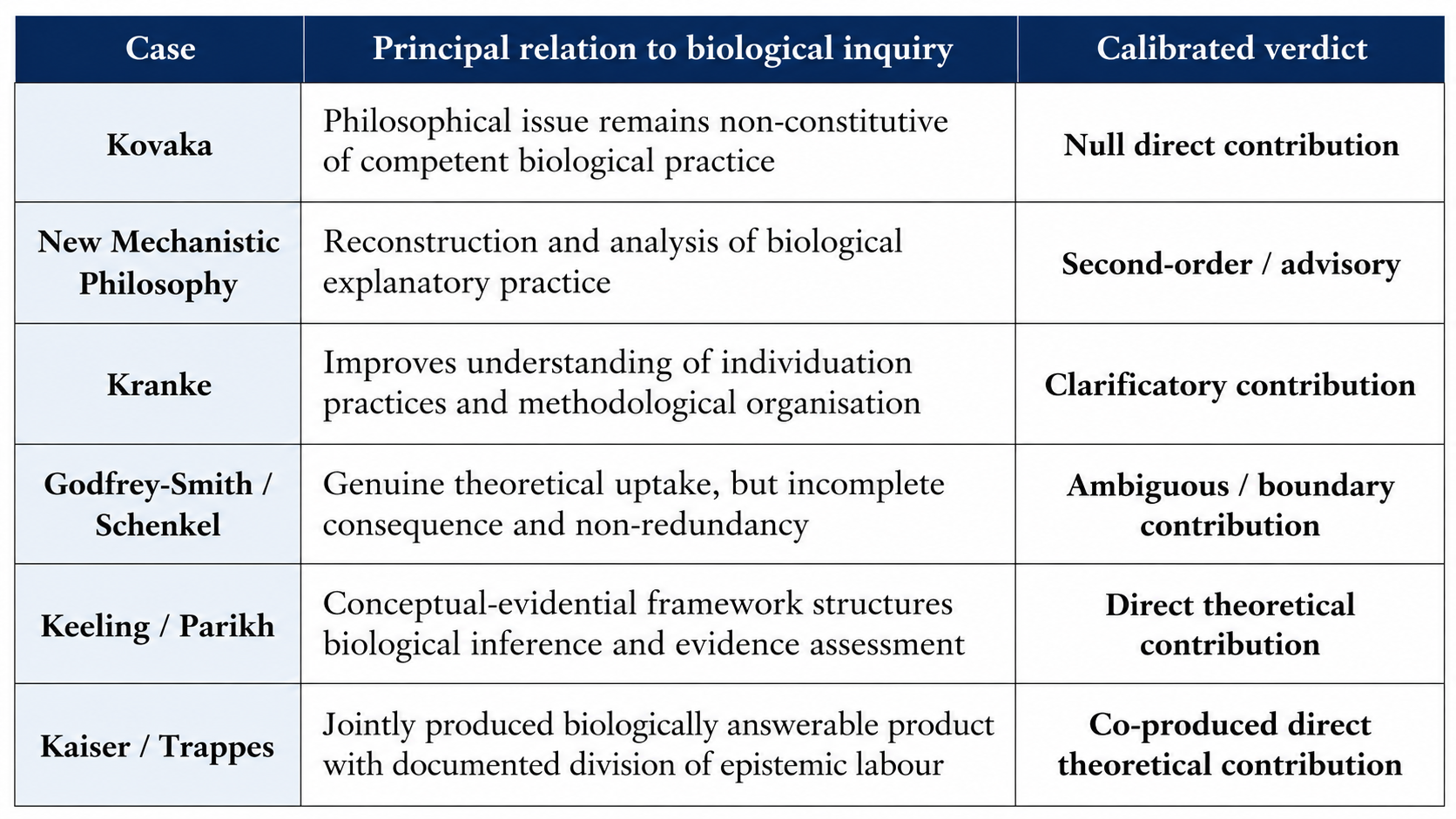
The significance of this distribution lies less in the labels themselves than in why the same architecture generates different results. The classifications do not track the professional identity of authors, the presence of philosophical concepts, scientific citation, or disciplinary venue. They track differences in intended epistemic product, relation to biological evidence, documented consequences for inquiry, and the functional distinctiveness of the contribution.
Several comparisons make the discriminatory capacity especially clear.
First, biological relevance is insufficient. The New Mechanistic Philosophy is deeply informed by biological science and provides a powerful account of explanatory practice, yet the principal product remains second-order. Kranke’s work goes further by clarifying how biological individuation is organised in actual research contexts, but clarification still differs from constructing or revising a biologically answerable theoretical product. Kovaka supplies the stronger control: a philosophically significant issue can remain unresolved without preventing competent biological inquiry.
Second, uptake is insufficient. Both the de novo-gene framework and the Darwinian-populations framework are used in subsequent biological work. Yet they do not receive the same classification. In the Keeling case, the framework is demonstrably used to organise what evidence is sought and how functional claims are assessed. In the Godfrey-Smith case, conceptual uptake and theoretical relevance are genuine, but biological consequence is less securely demonstrated and functional non-redundancy remains open. The resulting direct/ambiguous contrast shows why uptake must remain evidence about contribution rather than its definition.
Third, collaboration is insufficient. The Kaiser/Trappes case receives the strongest positive verdict, but not because philosophers and biologists collaborated. Co-production identifies a mode of production. The direct verdict depends on the further fact that the jointly produced work is biologically answerable, changes questions, concepts, operational distinctions and research organisation, and exhibits a functionally differentiated division of epistemic labour.
The comparison also demonstrates the importance of ambiguous and null outcomes. Without them, the architecture would tend toward retrospective celebration: cases of successful philosophical engagement could be selected and redescribed as evidence that disciplinary boundaries are porous. The present framework instead requires the same burden across positive and negative cases. It must explain why some biologically sophisticated philosophy remains second-order, why some work clarifies without becoming direct, why some uptake remains ambiguous, and why other cases cross into direct theoretical contribution.
The six cases therefore support the central claim at the strength intended: a product-centred division of explanatory labour has discriminative capacity. They do not establish universal prevalence, exceptionless necessary and sufficient conditions, or a permanent map of theoretical biology and philosophy of biology. The case set was explicitly designed for calibration rather than statistical representation. What it establishes is that the boundary problem can be posed more precisely than as a choice between disciplinary separation and unrestricted overlap.
The final question is what this result implies for the boundary itself, and what limits must accompany that conclusion.
8. Implications, Limitations, and Boundary Verdict
The governing question was: When does philosophy of biology remain second-order analysis, when does it clarify biological inquiry, and when does it contribute directly to theoretical biology? The comparative analysis supports an answer, but not one that locates a fixed territorial boundary between the disciplines.
Philosophical work remains principally second-order when its epistemic product analyses biological concepts, reasoning, assumptions, or explanatory practice without itself participating in construction or revision of a biologically answerable explanatory product. It becomes clarificatory when it improves problem formulation, evidential distinctions, model interpretation, methodological organisation, or other aspects of biological inquiry without assuming the full evidential responsibilities of a theoretical-biological proposal. It can count as a direct theoretical contribution when it participates in constructing, revising, or assessing a biologically answerable explanatory or theoretical product, assumes responsibility to relevant biological evidence, and has documented consequences for biological inference or research organisation. Such contribution may also be co-produced through inquiry-embedded collaboration.
The resulting boundary is therefore functional and product-relative rather than territorial. Theoretical biology and philosophy of biology need not occupy exclusive subject matters, use mutually exclusive methods, publish in different venues, or be practised by different people. Their activities can overlap extensively. What matters for the present classification is the explanatory work performed by a particular epistemic product and the responsibilities that product assumes within biological inquiry.
The contribution of this account must be stated narrowly. It is not the claim that philosophy can enter science, contribute to scientific problems, influence scientific practice, or participate in production of scientific knowledge. Existing work on philosophy in science, collaborative philosophical dialogue, philosophy of scientific practice, and reflective interdisciplinarity already establishes those possibilities. Nor is co-production itself novel. The residual contribution is instead a comparative, product-centred architecture for distinguishing different forms of explanatory labour once those possibilities are conceded. It combines intended product, evidential responsibility, documented biological consequence, and functional non-redundancy while permitting second-order, clarificatory, ambiguous, direct, co-produced direct, and null outcomes.
Several limitations follow directly from this conclusion.
First, the architecture does not provide universal necessary and sufficient conditions for theoretical biology. The criteria are calibrated comparative discriminators whose value has been tested against a deliberately contrasting case set. Their joint performance supports the present boundary account, but it does not establish exceptionless conditions applicable to every form of theoretical-biological work.
Second, functional non-redundancy is not historical indispensability. Showing that a philosophical contribution supplied a distinctive epistemic capacity within a documented research process does not establish that biology could never have generated an equivalent capacity independently. The argument concerns the organisation of explanatory labour in actual cases, not speculative alternative histories.
Third, direct theoretical contribution does not require empirical discovery. A contribution may change biological inference, evidential organisation, questions, operationalisation, methods, explanatory structure, or research organisation without itself generating data or discovering a mechanism. This qualification is necessary if theoretical contribution is not to be reduced to experimental contribution.
Fourth, the six cases support calibration, not prevalence claims. They were purposively selected to expose contrasts among different kinds of explanatory labour. Their successful discrimination does not show how common direct philosophical contribution to theoretical biology is, whether the outcome distribution is typical, or whether the same proportions would appear in another biological domain.
Two case-specific limitations must also remain explicit. The Darwinian-populations case retains an ambiguous boundary verdict. Its uptake and theoretical relevance are genuine, but strong biological consequence and functional non-redundancy remain incompletely established. The architecture gains rather than loses credibility by leaving that uncertainty unresolved: ambiguity is an evidential outcome, not a defect to be eliminated for argumentative symmetry.
The strongest positive co-production case carries a different limitation. Evidence concerning the organisation of explanatory labour in the Kaiser collaboration includes reflective reports from participants themselves (Kaiser et al. 2026). Such evidence is appropriate for reconstructing collaborative process, but it should not be treated as fully independent external validation of every claim about contribution. The concrete epistemic products and their subsequent use strengthen the case, but the process-level evidence retains this qualification.
These limitations define the appropriate strength of the boundary verdict. The article does not replace disciplinary histories, institutional classifications, or professional identities, all of which remain legitimate objects of analysis. Nor does it propose that the distinction between theoretical biology and philosophy of biology should disappear. It identifies a different question: when their explanatory activities overlap, what kind of work is a particular epistemic product doing?
The answer supplied by the six-case comparison is that disciplinary provenance cannot settle that question. A philosophical product may remain second-order, may clarify biological inquiry, or may participate directly in theoretical biology. A collaborative product may cross that boundary without ceasing to have philosophical contributions within its genealogy. Equally, work can be biologically relevant and philosophically sophisticated without crossing it at all. The boundary therefore lies neither between communities nor between subject matters, but in the division of explanatory labour realised in particular epistemic products.
This is a deliberately modest conclusion, but it provides a more discriminating alternative to both disciplinary demarcation and unrestricted overlap. Theoretical biology is characteristically concerned with constructing, revising, and assessing biologically answerable explanatory and theoretical products; philosophy of biology characteristically examines the concepts, reasoning, assumptions, and explanatory practices through which biological knowledge is produced. Where these activities intersect, their relation should be determined not by disciplinary ownership but by the explanatory work actually performed, the evidential responsibilities assumed, and the consequences for biological inquiry.
The boundary is therefore best understood not as a line separating two intellectual territories, but as a functional division of explanatory labour whose location can vary with the epistemic product under examination.
References
- (2026). Biology Needs Philosophy, But What Philosophy?. BioScience, 76(5), 417–428 . https://doi.org/10.1093/biosci/biag016
- (2007). Employing Philosophical Dialogue in Collaborative Science. BioScience, 57(1), 55–64 . https://doi.org/10.1641/B570109
- (2009). Darwinian Populations and Natural Selection. Oxford University Press. https://doi.org/10.1093/acprof:osobl/9780199552047.001.0001
- (2026). Reflective Interdisciplinarity in Practice: Integrating Biology and Philosophy in Studies of Individualization. Humanities and Social Sciences Communications, 13 . https://doi.org/10.1057/s41599-026-08458-4
- (2019). The Meanings of 'Function' in Biology and the Problematic Case of De Novo Gene Emergence. eLife, 8 . https://doi.org/10.7554/eLife.47014
- (2015). Biological Individuality and Scientific Practice. Philosophy of Science, 82(5), 1092–1103 . https://doi.org/10.1086/683443
- (2024). Do Concepts of Individuality Account for Individuation Practices in Studies of Host–Parasite Systems? A Modeling Account of Biological Individuality. Theory in Biosciences, 143, 279–292 . https://doi.org/10.1007/s12064-024-00426-3
- (2000). Thinking About Mechanisms. Philosophy of Science, 67(1), 1–25 . https://doi.org/10.1086/392759
- (2022). Origins, Evolution, and Physiological Implications of De Novo Genes in Yeast. Yeast, 39(9), 471–481 . https://doi.org/10.1002/yea.3810
- (2024). Philosophy in Science: Can Philosophers of Science Permeate through Science and Produce Scientific Knowledge?. The British Journal for the Philosophy of Science, 75(2), 375–416 . https://doi.org/10.1086/715518
- (2026). Evolutionary Transitions and Reversions in Individuality. Journal of Evolutionary Biology, 39(4), 423–436 . https://doi.org/10.1093/jeb/voag007
- (2022). How Individualized Niches Arise: Defining Mechanisms of Niche Construction, Niche Choice, and Niche Conformance. BioScience, 72(6), 538–548 . https://doi.org/10.1093/biosci/biac023