The Chronometric Revolution — Time, Scale and Biological Explanation
The Chronometric Revolution transformed natural history by making the timing and duration of geological and biological events increasingly accessible to scientific measurement. This article traces the development of geological chronology, radiometric dating, radiocarbon methods and molecular clocks, explaining how they changed the reconstruction of life's history. It distinguishes chronological measurement from historical reconstruction and causal explanation, and considers the significance of temporal scale for the Agency–Process–Scale (APS) framework. APS is presented as a qualified interpretive perspective, not as the origin of chronometric methods or a demonstrated improvement upon established biological explanations.
Key Points
- Scientific chronometry transformed the reconstruction of natural history by establishing increasingly reliable numerical timescales.
- Stratigraphy, radiometric dating and molecular clocks provide different but complementary forms of historical evidence.
- Establishing when a biological event occurred is not equivalent to explaining how or why it occurred.
- Biological processes operate across different temporal extents, from physiological regulation to evolutionary transformation.
- APS relates temporal scale to biological process and organisation without claiming to replace established historical or evolutionary explanations.
Where This Article Fits
*This article belongs to the History of Ideas *reading pathway within the Philosophy of Biology topic. It examines the development of scientific chronometry and its consequences for understanding biological history. It complements the broader historical discussions in From Aristotle to Modern Biology and Explanatory Grammars and the History of Ideas, while providing background for the APS treatment of Scale and evolutionary explanation. It does not introduce a new APS principle or claim distinctive explanatory gain.
Introduction — Making Deep Time Measurable
The history of life extends across billions of years, yet the scientific ability to measure that history is comparatively recent. For much of human history, accounts of the distant past depended upon inherited traditions, written records, observations of the natural world and the interpretation of material remains. Different cultures developed different understandings of historical time, but none possessed the scientific instruments and methods now available for estimating the ages of ancient geological and biological events.
The emergence of modern geology transformed this situation. During the eighteenth and nineteenth centuries, scientists increasingly recognised that Earth had a history extending far beyond recorded human experience. The subsequent development of radiometric dating and other methods made it possible to assign numerical ages to events previously understood primarily through their relative sequence.
This transformation may be described as the Chronometric Revolution: the progressive development of scientific methods for establishing the timing, duration and temporal relationships of events in natural history. It was not a single discovery, nor was it confined to the twentieth century. Rather, it was a cumulative transformation in the evidence available for reconstructing the past.
Its consequences for biology have been profound. The history of life could increasingly be investigated within a measurable geological framework, while molecular methods later introduced additional ways of estimating evolutionary relationships and divergence times.
Yet the measurement of time and the explanation of biological change remain distinguishable scientific achievements. Establishing when something happened does not, by itself, establish how or why it happened. The Chronometric Revolution therefore provides an instructive example of the relationship between historical evidence and biological explanation.
The Discovery of Deep Time
The modern understanding of geological time developed gradually through the investigation of rocks, landscapes and fossils. Earlier naturalists had recognised that Earth possessed a history, but the systematic reconstruction of that history required methods for establishing the order in which geological events occurred.
Stratigraphy supplied one such method. By examining the relationships among rock layers, geologists could infer the relative sequence of deposition, deformation, erosion and other geological processes. Fossils provided an additional means of identifying and correlating strata across different locations.
The work of James Hutton, Charles Lyell, William Smith and many other investigators helped establish the intellectual and practical foundations of historical geology. Smith’s use of fossil succession, for example, demonstrated how characteristic fossils could be used to identify corresponding geological formations across extensive areas. His geological map of England and Wales, published in 1815, was an important achievement in the representation of geological succession.
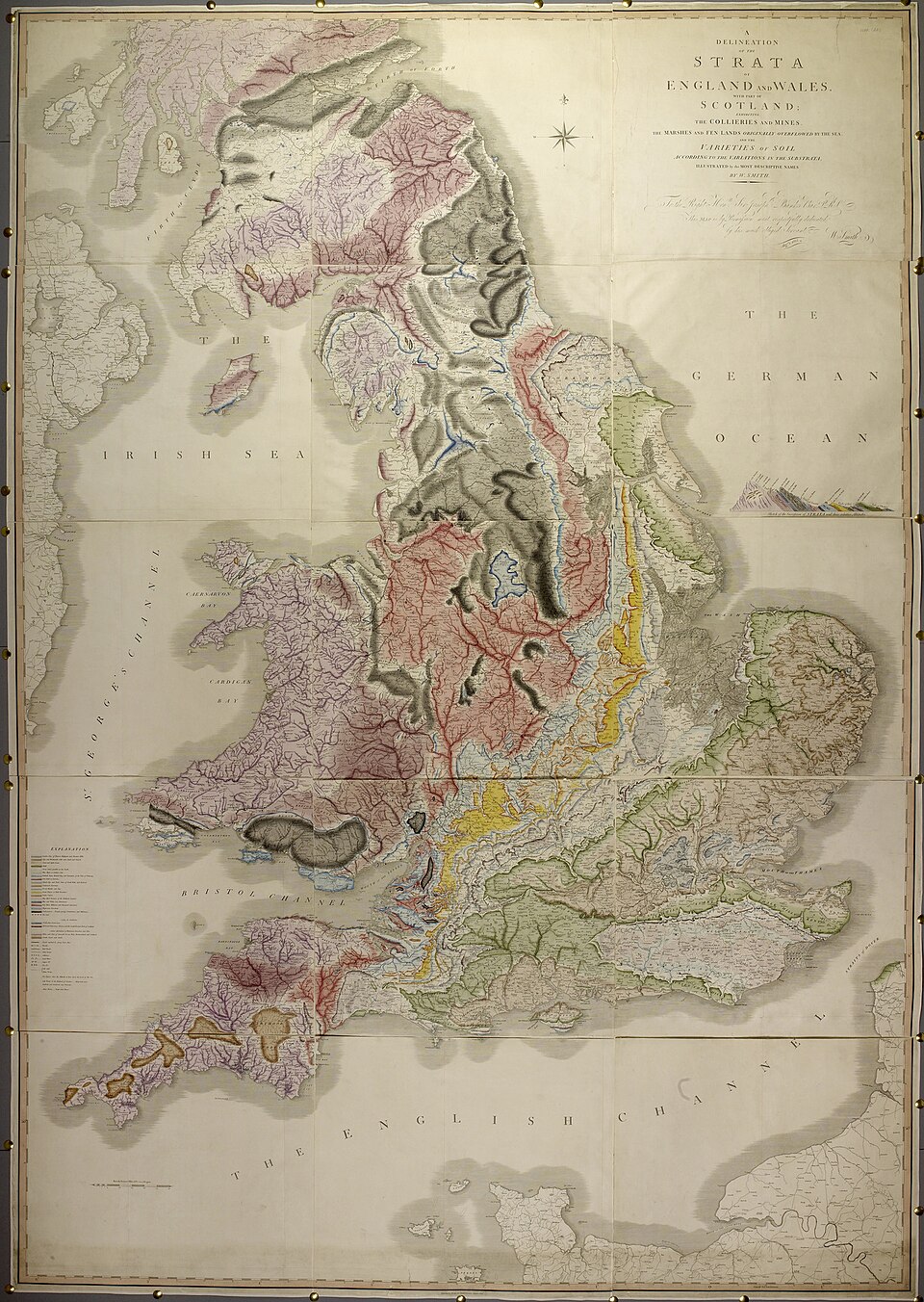
These developments made it possible to reconstruct substantial portions of Earth’s history without knowing their numerical ages. A geological formation could be recognised as older or younger than another, and changes in fossil assemblages could be placed in an ordered sequence.
This was already a major scientific accomplishment. The past had become accessible to disciplined investigation through physical evidence rather than through chronology inherited from historical records alone.
The implications for biology were especially important. Fossils documented the appearance, persistence and disappearance of different forms of life. Geological succession provided a historical framework within which biological change could be investigated.
By the time Darwin published On the Origin of Species in 1859, the idea of an ancient Earth had become central to much geological thinking. Evolutionary explanations required substantial periods during which variation, inheritance, selection and other processes could operate. Nevertheless, the numerical extent of geological time remained uncertain and contested.
Relative chronology established an order of events. A reliable numerical timescale would require further scientific developments.
Radioactivity and Numerical Geological Time
The discovery of radioactivity near the end of the nineteenth century opened a new approach to measuring geological ages.
Certain naturally occurring atomic isotopes transform into other isotopes through radioactive decay. Because the rates of these transformations can be measured, suitable minerals can preserve evidence of the time elapsed since particular geological events.
Radiometric dating made it possible to estimate ages in years rather than relying exclusively upon relative geological sequence. Arthur Holmes was among the early twentieth-century geologists who recognised and developed the potential of radioactive decay for establishing geological chronology.
Different radiometric systems are appropriate for different materials and timescales. Uranium–lead dating, for example, is especially important in studies of ancient minerals, including zircon crystals. Potassium–argon and related methods have been widely used to date volcanic materials and geological events.
These techniques do not all measure the same thing. A radiometric age may refer to the crystallisation of a mineral, the cooling of a rock, or another event that established or reset the relevant isotopic system. The significance of a measured age therefore depends upon the geological history of the material and the assumptions of the dating method.
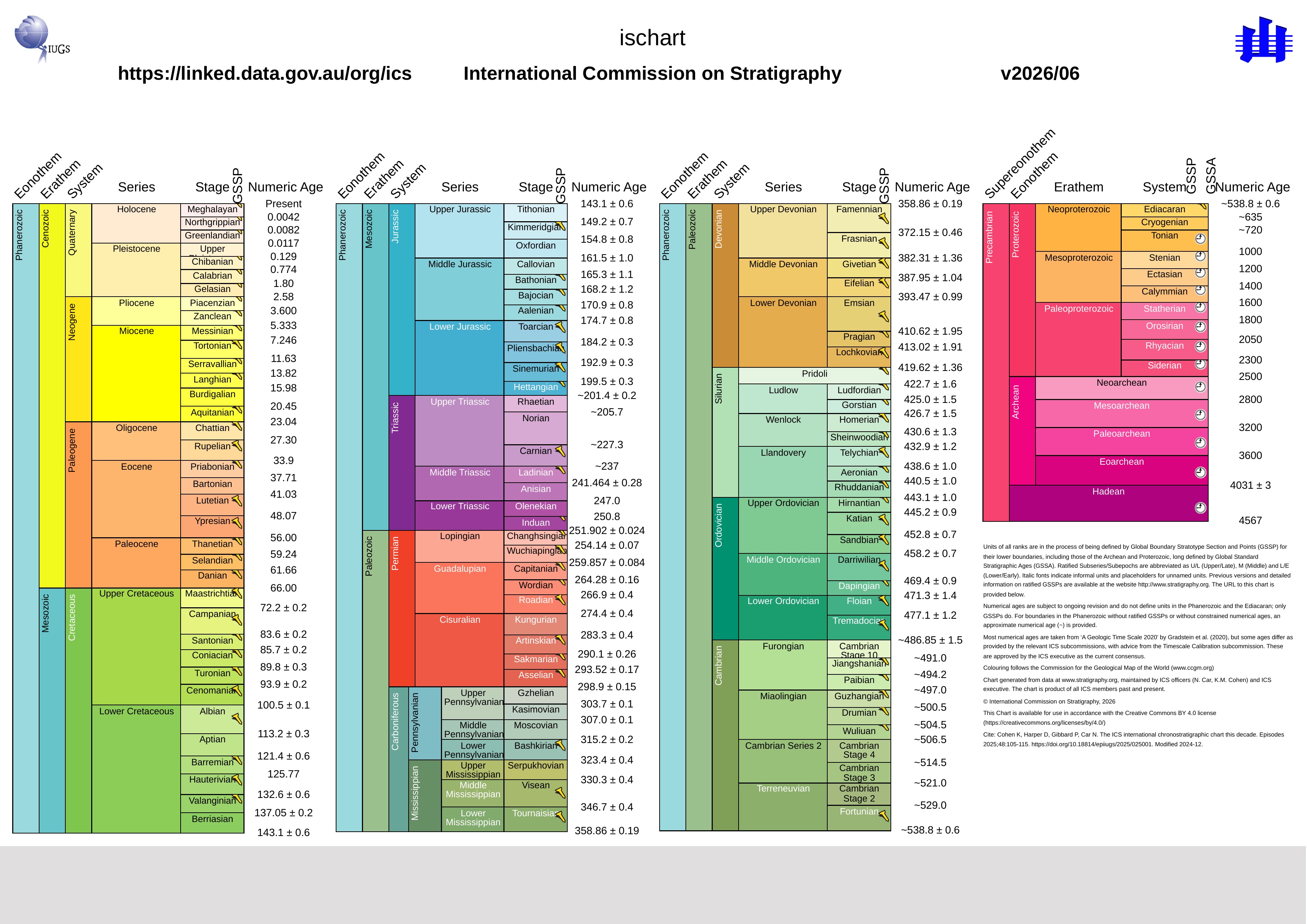
One of the most consequential achievements of modern geochronology was the establishment of Earth’s age at approximately 4.54 billion years. This estimate does not depend upon a single ancient terrestrial rock. It draws upon converging isotopic evidence, particularly from meteorites, together with the broader history of Solar System formation. Patterson’s 1956 investigation was a landmark in this development.
The resulting timescale transformed the interpretation of geological and biological history. Events could be located within an immense chronological framework extending from Earth’s formation to the present.
Numerical dating also strengthened relationships among different scientific disciplines. Geological formations, fossil assemblages, environmental changes and evolutionary events could increasingly be investigated as parts of a common, measurable history.
The geological timescale remained dependent upon interpretation, correlation and revision. Its strength lay not in replacing geological reasoning with numbers, but in bringing independent forms of evidence into closer relationship.
Radiocarbon Dating and the Recent Past
Radiometric dating also transformed the investigation of much more recent history.
In the late 1940s, Willard Libby and his colleagues developed radiocarbon dating, which uses the radioactive isotope carbon-14 to estimate the ages of suitable organic materials. Their early investigations established an important new method for archaeological and environmental chronology.
Living organisms exchange carbon with their environments. Following the cessation of this exchange, the amount of radiocarbon in their remains generally diminishes through radioactive decay. Measuring the remaining radiocarbon, with appropriate assumptions and corrections, can therefore provide information about the age of the material.
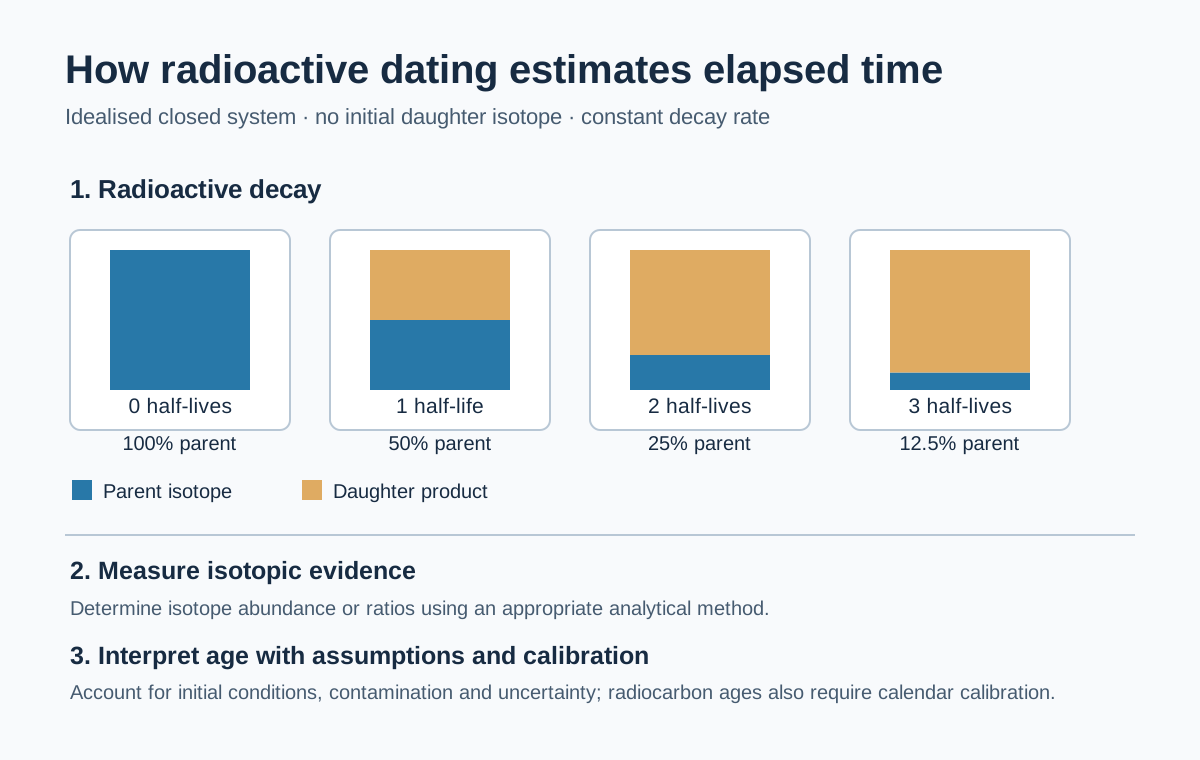
Radiocarbon dating became particularly important in archaeology, palaeoecology and studies of recent environmental change. Organic remains could be placed within increasingly well-constrained chronological sequences, allowing investigators to compare evidence from different sites and regions.
The method has limitations. Its practical reach is generally around 50,000 years, depending upon sample preservation, contamination and measurement conditions. Radiocarbon ages also require calibration because atmospheric radiocarbon concentrations have varied through time.
The development of accelerator mass spectrometry greatly improved the ability to measure small quantities of radiocarbon, often permitting smaller samples to be analysed. It did not, however, remove the fundamental limitations imposed by radioactive decay and background contamination.
Radiocarbon dating illustrates an important feature of scientific chronometry: a numerical result is not automatically a historical interpretation. A dated piece of charcoal, for example, may establish when the original wood ceased exchanging carbon with its environment, but further evidence may be required to determine when the charcoal was deposited or how it relates to a particular archaeological event.
The historical significance of a date depends upon understanding what has actually been measured.
Molecular Clocks and Evolutionary History
The development of molecular biology introduced another important means of reconstructing the past.
During the 1960s, researchers including Emile Zuckerkandl and Linus Pauling recognised that differences among protein sequences could provide information about evolutionary divergence. The idea of a molecular clock arose from the observation that some molecular changes accumulated at rates sufficiently regular to support estimates of evolutionary time.
Early molecular comparisons revealed patterns of sequence difference; the molecular-clock hypothesis proposed that some of these differences could accumulate at approximately regular rates, while subsequent calibration against independent historical evidence made estimates of divergence dates possible.
The basic principle is that related biological lineages accumulate genetic differences after diverging from a common ancestor. Under suitable assumptions, the extent of those differences can contribute to estimates of when divergence occurred.
Molecular clocks differ fundamentally from radiometric clocks. Radioactive decay follows physical laws governing particular isotopes. Molecular evolution involves biological processes whose rates can vary among genes, organisms, lineages and historical circumstances.
Early molecular-clock approaches often relied upon relatively simple assumptions of constant evolutionary rates. Subsequent research demonstrated the importance of rate variation, differences among molecular sequences and uncertainty in evolutionary models.
Modern molecular dating employs statistical methods that can accommodate varying rates and integrate different forms of evidence. Fossils, geological events, dated specimens and other information may be used to calibrate molecular estimates.
Calibration is essential because genetic differences alone do not generally provide an absolute timescale. A molecular comparison may indicate relative evolutionary separation without establishing how many years have elapsed.
Molecular dating has expanded the range of questions accessible to evolutionary investigation. It can help estimate divergence times where fossil evidence is incomplete, compare evolutionary histories across groups, and examine the timing of biological diversification.
Its conclusions nevertheless remain conditional upon the quality of the evidence and the assumptions of the models employed. Estimates may change when new fossils are discovered, molecular datasets expand or analytical methods improve.
The significance of molecular clocks is therefore not that evolution has acquired a perfectly regular internal clock. It is that molecular evidence can contribute to historically calibrated reconstructions of evolutionary change.
Other Methods and the Integration of Chronologies
The development of scientific chronology was not confined to radiometric dating and molecular clocks. Other methods established independent temporal records, extended the range of measurable history and provided ways of checking dates obtained through different forms of evidence.
Some methods depend upon the accumulation of recognisable sequences. Dendrochronology uses annual growth rings in trees to establish precisely ordered chronologies, while annually deposited lake sediments, known as varves, and layers preserved in ice cores provide records of environmental change. Such sequences can sometimes be counted directly and connected with independently dated events. Tree-ring chronologies have also been especially important in calibrating radiocarbon ages.
Other methods measure physical changes in minerals or geological materials. Luminescence dating can estimate the time elapsed since suitable mineral grains were last exposed to light or sufficiently heated. Cosmogenic nuclide methods can help establish how long geological surfaces have been exposed to cosmic radiation. Uranium-series and fission-track techniques provide additional approaches applicable to particular materials and geological circumstances.
Still other methods establish correlations rather than independent numerical ages. Palaeomagnetic records preserve evidence of changes in Earth’s magnetic field, while tephrochronology uses identifiable volcanic ash deposits to correlate geographically separated sequences. Astronomical tuning relates certain sedimentary cycles to variations in Earth’s orbital configuration, although such correlations require careful assessment to avoid circular reasoning.
The scientific importance of these methods lies partly in their complementarity. Each has characteristic materials, timescales, assumptions and uncertainties. Their results become especially informative when independently established chronologies can be compared, calibrated and reconciled.
Scientific chronometry therefore developed not as a single universal technique but as an increasingly integrated system of historical measurement. Its achievement was to make events and processes occurring at very different temporal scales accessible to systematic comparison, while preserving the distinction between establishing when something happened and explaining why it happened.
The Integration of Biological and Geological History
The most important consequence of scientific chronometry may be the increasing integration of evidence that was once investigated through largely separate historical records.
Geologists reconstruct the formation and transformation of Earth’s materials. Palaeontologists investigate the distribution and succession of fossil organisms. Evolutionary biologists reconstruct relationships among lineages, while molecular researchers examine patterns of genetic change.
Chronological methods allow these different investigations to constrain and inform one another.
For example, a fossil may provide evidence that a lineage existed by a particular geological date. A molecular analysis may suggest a divergence predating that fossil. Geological evidence may help establish the environmental circumstances in which evolutionary changes occurred.
Agreement among independent methods can strengthen a historical reconstruction. Disagreement can identify uncertain assumptions, incomplete evidence or questions requiring further investigation.
Such comparisons are especially important because historical evidence is rarely complete. Fossil preservation is selective, geological materials may be altered, and molecular estimates depend upon evolutionary models. Scientific reconstruction therefore involves evaluating the reliability and compatibility of different kinds of evidence.
Chronometry has also changed the questions biologists can ask. The timing of evolutionary radiations can be compared with environmental changes; the durations of geological intervals can be related to patterns of biological diversification; and the histories of organisms can be investigated alongside changes in climate, geography and ecological conditions.
These possibilities represent genuine scientific advances. They arise from improved measurement, evidence and methods of historical inference, not from any particular philosophical framework.
Chronology and Biological Explanation
The establishment of a date is an important scientific achievement, but it is not necessarily an explanation of the event being dated.
Knowing when an evolutionary lineage diverged does not establish which processes caused its divergence. Knowing when a mass extinction occurred does not, by itself, identify the mechanisms responsible. Similarly, establishing the antiquity of a biological feature does not explain its development, function or persistence.
Chronological evidence contributes to explanation by establishing temporal relationships and constraining possible accounts of change. It may exclude proposed causes that occurred too late, reveal the order of relevant events, or establish the duration over which a process could have operated.
Historical explanation requires additional evidence concerning causal processes, circumstances and relationships.
This distinction does not diminish the importance of chronology. On the contrary, accurate dating can make explanations more precise and more open to assessment. A proposed account of evolutionary change must be compatible with the available temporal evidence.
The distinction also prevents the mistaken assumption that an increasingly detailed timeline automatically supplies an increasingly complete explanation.
A chronology tells us something about the organisation of events in time. An explanation addresses the processes and relationships through which those events occurred.
Temporal Scale and the APS Framework
The Chronometric Revolution is relevant to the Agency–Process–Scale (APS) framework because biological explanations concern processes operating over different temporal extents.
APS approaches living systems through three complementary perspectives: Agency, Process and Scale. Agency concerns viability-oriented activity; Process concerns the organised activities through which biological systems persist and change; and Scale concerns the extent over which relevant biological organisation and relationships are investigated.
Temporal scale is one aspect of this explanatory perspective.
A physiological explanation may concern processes unfolding over seconds or minutes. Developmental explanations may extend across an organism’s lifetime. Studies of inheritance examine relationships across generations, while evolutionary explanations may concern changes extending across thousands or millions of years.
These examples do not represent a single obligatory sequence of biological explanation. Different questions require different evidence, processes and timescales.
An account of short-term physiological regulation cannot simply be extended into an explanation of evolutionary transformation. Nor can a history of evolutionary change substitute for an explanation of how a particular organism maintains its viability.
APS emphasises that the appropriate scale of investigation depends upon the biological organisation and processes relevant to the question being asked.
Scientific chronometry assists by establishing the temporal circumstances within which some of those processes can be reconstructed. It may reveal the duration of an evolutionary event or constrain the timing of a lineage’s appearance. It does not, by itself, determine which biological relationships constitute the explanation.
The APS contribution here is interpretive rather than methodological invention. The importance of temporal scale is already recognised in physiology, developmental biology, ecology, evolutionary biology and historical science. APS offers a way of discussing how scale relates to agency and process within a broader account of biological organisation.
Organised Persistence Through Time
One recurring concern in biology is how living systems maintain continuity while undergoing change.
An organism may replace many of its material constituents while maintaining a distinguishable organisation. Development involves substantial transformation without necessarily eliminating the continuity of the developing individual. Biological lineages may persist through successive generations while accumulating variation and undergoing evolutionary change.
These forms of continuity differ. The persistence of an individual organism is not equivalent to the continuity of a lineage, and the mechanisms sustaining each must be investigated separately.
Within APS, organised persistence refers to the maintenance of a distinguishable biological organisation through relevant processes of activity and change. Its interpretation depends upon the system, the biological question and the timescale under investigation.
The Chronometric Revolution provides important historical evidence about the duration and sequence of some biological transformations. It does not establish the organisational conditions that constitute biological individuality or prove the APS account of persistence.
Its relevance is more limited and more defensible: the ability to measure time helps scientists investigate biological continuity and transformation with greater historical precision.
It also reminds us that continuity cannot be inferred merely from temporal succession. Establishing that one event followed another does not show that the same biological individual persisted, that a lineage remained unchanged, or that a particular organisational relationship was maintained.
Those conclusions require appropriate biological evidence.
What the Chronometric Revolution Means for Biology
The Chronometric Revolution transformed natural history by making the timing and duration of events increasingly accessible to scientific measurement. It helped establish the immense age of Earth, supplied numerical frameworks for geological and biological history, and strengthened the integration of fossil, geological and molecular evidence.
Its significance extends beyond the accumulation of dates. Chronological evidence makes historical claims more precise, constrains possible explanations and permits comparisons among events and processes operating across very different periods of time.
Yet chronology and explanation remain distinct. The age of an event, the reconstruction of its historical setting and the explanation of its causes are related achievements that require different kinds of evidence and reasoning.
For APS, this history illustrates why temporal scale matters to biological explanation. Living systems maintain, develop and transform their organisation through processes whose relevant durations vary with the question under investigation.
APS does not claim to have discovered this dependence upon temporal scale, nor does the Chronometric Revolution demonstrate any general superiority of APS over established biological explanations.
The more modest conclusion is that scientific chronometry provides an illuminating historical example of how measurement, process and scale become connected in the construction of biological knowledge.
The history of life is not merely a succession of dates. It is a history of biological processes and relationships whose explanation depends upon understanding both what happened and the temporal circumstances in which it happened.
Explanatory Architecture
Central Question
How did the development of scientific methods for establishing geological and biological chronology transform the explanation of life’s history, and what does this reveal about the role of temporal scale in biological explanation?
Architectural Role
This article is a historical extension within the APS Philosophy of Biology topic and its History of Ideas reading pathway.
Its purpose is to reconstruct the development of scientific chronometry and explain how increasingly reliable chronological evidence changed the questions that could be asked about biological history.
It does not introduce a new APS definition of life, agency or evolution.
Relationship to the History of Biological Explanation
The chronometric revolution transformed the scientific investigation of biological history by making it possible to distinguish relative sequence, numerical age, duration and rates of change.
Its importance lies not in a single discovery but in the progressive integration of geological, physical, chemical and biological evidence into increasingly well-constrained historical accounts.
Relationship to Temporal Scale
Temporal scale influences which biological processes can be investigated, which historical relationships can be reconstructed and which explanations are appropriate.
The development of chronometric methods expanded the temporal reach of biological investigation without making temporal scale an independent causal agent.
Position within APS
APS distinguishes Agency, Process and Scale as complementary analytic projections of one viability-oriented, constraint-closed organisation.
Chronometric evidence contributes particularly to the Scale projection by establishing temporal relationships relevant to biological processes and organised persistence.
This does not imply that geological time is itself a biological process, that chronology supplies a complete biological explanation, or that APS has demonstrated superiority over established historical and evolutionary approaches.
Corpus Significance
This article contributes a historical account of how scientific methods made biological history increasingly measurable, comparable and open to investigation.
Its central interpretive proposition is:
Chronology makes biological history scientifically assessable, but the explanation of that history additionally requires evidence concerning biological processes, organisation and change.
The article provides historical context for the APS discussions of temporal scale, organised persistence and evolutionary explanation without duplicating their specialised functions.
References
- (2012). Out of Tune: The Dangers of Aligning Proxy Archives. Quaternary Science Reviews, 36, 38–49 . https://doi.org/10.1016/j.quascirev.2010.11.012
- (1991). The Age of the Earth. Stanford University Press.
- (1859). On the Origin of Species. John Murray.
- (2016). Molecular Clocks. Current Biology, 26(10), R399–R402 . https://doi.org/10.1016/j.cub.2016.03.071
- (1949). Age Determination by Radiocarbon Content: World-Wide Assay of Natural Radiocarbon. Science, 109(2827), 227–228 . https://doi.org/10.1126/science.109.2827.227
- (2018). Dating in Archaeology. Wiley. https://doi.org/10.1002/9781119188230.saseas0154
- (1956). Age of Meteorites and the Earth. Geochimica et Cosmochimica Acta, 10(4), 230–237 . https://doi.org/10.1016/0016-7037(56)90036-9
- (1815). A Delineation of the Strata of England and Wales, with Part of Scotland. John Cary.
- (2005). Quaternary Dating Methods. John Wiley & Sons.
- (1962). Molecular Disease, Evolution, and Genic Heterogeneity. Academic Press.